The short version
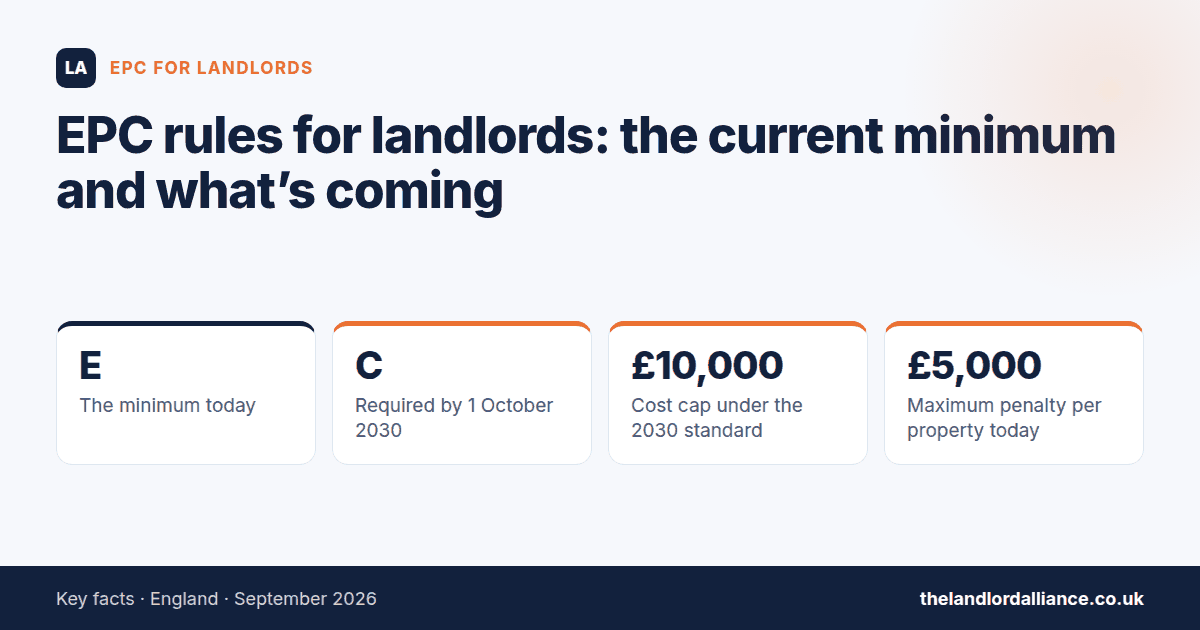
Today the minimum is EPC E. You cannot let, or continue to let, a property rated F or G unless a valid exemption is registered. That has been the position for all tenancies since April 2020 and has not changed. What has changed is the future: in January 2026 the government confirmed that private rented homes must reach EPC C by 1 October 2030, with a cost cap of £10,000 per property — or 10% of the property’s value where that is lower. Spending from 1 October 2025 counts towards the cap, which means work you do now is not wasted.
Where things stand
| Date | Requirement | Status |
|---|---|---|
| April 2018 | EPC E minimum for new tenancies | In force |
| April 2020 | EPC E minimum for all tenancies, including existing ones | In force — this is the rule today |
| 1 October 2025 | Qualifying expenditure starts counting towards the future cost cap | Running now |
| 1 October 2029 | Properties reaching C before this date on the current methodology are deemed compliant until that EPC expires | Confirmed |
| 1 October 2030 | EPC C minimum for all private rented homes | Confirmed policy, January 2026 |
Do not wait for 2029. Two reasons. First, expenditure only counts towards the £10,000 cap from 1 October 2025 — work done before that does not, and work done now does. Second, if you reach EPC C before 1 October 2029 under the current methodology, that certificate is treated as compliant until it expires, up to ten years. Acting early can effectively bank compliance well past the deadline.
The rule that applies today: EPC E
It is unlawful to let a domestic property with an EPC rating of F or G, or to continue an existing tenancy of one, unless you have registered a valid exemption. This is the Minimum Energy Efficiency Standard, and the detail — including how the current £3,500 cost cap works and what each exemption requires — is in our guide to MEES.
Enforcement is by the local authority, with a penalty of up to £5,000 per property. An EPC is valid for ten years, and you must have a valid one to market a property at all.
What EPC C will require
Most F and G properties can reach E with loft insulation and a reasonable boiler. Reaching C is a different order of work, and for older housing stock it usually means addressing the fabric.
| Measure | Typical effect | Notes |
|---|---|---|
| Loft insulation to 270mm | Good, cheap | The first thing to do in almost every case |
| Cavity wall insulation | Strong, where the walls are suitable | Not possible on solid-wall property, which is where the difficulty concentrates |
| Modern condensing boiler and controls | Good | Smart controls and TRVs add points cheaply |
| Double or triple glazing | Moderate | Expensive per point; often restricted in conservation areas |
| Solid wall insulation | Large | Expensive, disruptive, and carries its own exemption for ten years |
| Solar PV | Large | Increasingly the cheapest route to the last few points on a hard-to-treat property |
| Low-carbon heating | Large | Grant support available — see EPC grants |
The cost cap and exemptions
You are not required to spend without limit. Once you have spent £10,000 on qualifying improvements — or 10% of the property’s value where the property is worth under £100,000 — and the property still falls short, you can register an exemption. Confirmed exemptions include:
- All relevant improvements made and the standard still not achieved.
- Low-value property, where the reduced cap applies.
- Third-party consent refused — freeholder, lender or tenant.
- Solid wall insulation, where it is not appropriate. Valid ten years.
- Negative impact, where the work would devalue the property or damage the fabric. Valid ten years.
Exemptions must be registered on the PRS Exemptions Register. An unregistered exemption is not an exemption, however good the reason — this is the single most common failure in this area.
What to do now
- Check the rating and expiry date of the EPC on every property you own. An expired EPC means you cannot market the property.
- Read the recommendations report attached to the EPC. It lists the measures and the points each would add.
- Start with the cheap points — loft insulation, heating controls, low-energy lighting, hot water cylinder insulation. Many properties get from D to C on these alone.
- Keep every invoice from 1 October 2025. This is what counts towards the £10,000 cap if you later need to register an exemption.
- Check grant eligibility before you spend — see EPC grants for landlords.
- Plan the hard cases now. Solid-wall Victorian terraces and flats with restricted external walls are the properties where 2030 is a genuine problem, and four years is not long for planning consent, funding and works.
Read next
What EPC rating do I need right now?
E. Letting a property rated F or G without a registered exemption is unlawful and carries a penalty of up to £5,000.
Is EPC C by 2030 definitely happening?
It was confirmed as government policy in January 2026, with a deadline of 1 October 2030 and a £10,000 cost cap. Detailed regulations are still to follow, so the mechanics could be refined — but plan on the basis that it is happening.
Is there a separate 2028 deadline for new tenancies?
That was proposed at consultation but the confirmed position is a single deadline of 1 October 2030 for all tenancies.
How much will I have to spend?
Up to £10,000, or 10% of the property’s value if it is worth under £100,000. Beyond that you can register an exemption if the property still falls short.
Does work I do now count?
Yes, if it is from 1 October 2025. Keep the invoices — they count towards the cap.
How long is an EPC valid?
Ten years. You need a valid one to market the property, and a property reaching C before 1 October 2029 on the current methodology is treated as compliant until that certificate expires.
Sources. Energy Efficiency (Private Rented Property) (England and Wales) Regulations 2015; the government’s confirmed position on private rented sector minimum standards announced January 2026 alongside the Warm Homes Plan; PRS Exemptions Register guidance. Detailed regulations for the 2030 standard are still pending. Checked 8 September 2026.
Related: Compliance checklist · All guides · Buy-to-let