The short version
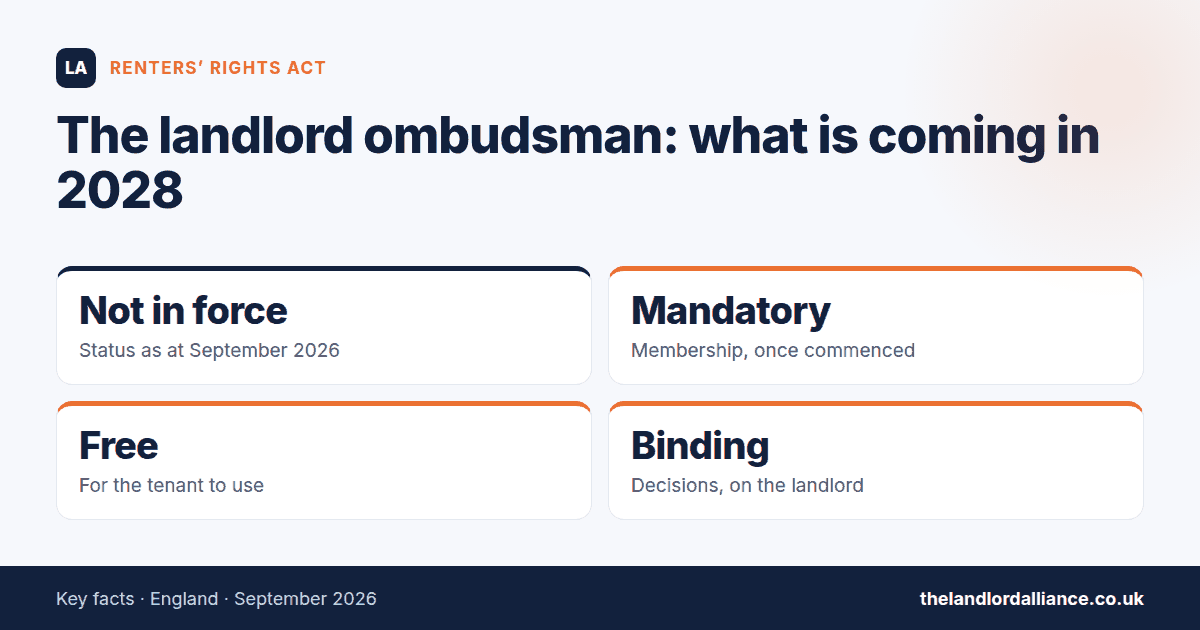
The Renters’ Rights Act requires private landlords in England to join an ombudsman scheme — a free, binding route for tenants to complain without going to court. It is not in force. The powers exist, the scheme has not been established, and no commencement date has been confirmed. Letting agents have had to belong to a redress scheme since 2014; this extends the same principle to landlords, including those who self-manage. When it arrives, expect it to be mandatory, to carry a membership fee, and to be able to order an apology, remedial work, or compensation.
What an ombudsman actually does
An ombudsman investigates complaints that a landlord has failed to deal with properly, after the tenant has exhausted the landlord’s own complaints process. It is not a court and does not decide legal claims for possession or rent. It deals with service failure: repairs not done, complaints ignored, poor communication, unreasonable behaviour.
| Likely to be in scope | Not in scope |
|---|---|
| Repairs reported and not actioned | Possession proceedings |
| Failure to respond to communications | Rent arrears recovery |
| Poor complaint handling | Deposit disputes — these go to the scheme adjudicator |
| Unreasonable conduct or delay | Rent increase challenges — these go to the tribunal |
| Failure to meet obligations under the tenancy | Anything already before a court |
Expected remedies are an apology, an order to carry out work, and compensation — and decisions binding on the landlord once accepted by the tenant.
Why it matters more than it sounds
Two reasons. First, it is free and informal for the tenant, which means complaints that would never have reached court will reach the ombudsman. The volume will be materially higher than landlords are used to.
Second, it creates a written record. A pattern of upheld complaints is exactly the kind of evidence that matters for the fit and proper person test on a licence application, and potentially for entries on the PRS database. The systems are designed to talk to each other.
The single best preparation is a complaints process. Most complaints reaching an ombudsman are not about the original problem; they are about how the landlord responded to it. A written procedure — acknowledge within a set period, investigate, respond in writing with a decision and next steps — resolves most issues before anyone escalates, and demonstrates competence if they do.
Where it has got to
| Step | Status |
|---|---|
| Power to require landlords to join a redress scheme | In the Act, which received Royal Assent on 27 October 2025 |
| Scheme designated or established | Not yet |
| Regulations setting membership, fees and scope | Not made |
| Commencement date | Not announced |
What to do now
- Write a one-page complaints procedure and give it to tenants at the start of the tenancy alongside the written statement of terms.
- Acknowledge everything in writing. Same day where you can. The response time is what gets judged.
- Keep a repairs log per property: reported, inspected, actioned, completed, with dates. This is the evidence in any complaint, and it is also your defence on damp and mould.
- Agree with your agent who handles complaints, and remember your agent’s redress membership is not yours.
- Do not panic-buy readiness services. There is no scheme to join yet.
Read next
Do I have to join an ombudsman scheme now?
No. The requirement is in the Act but has not been commenced, and no scheme has been established for landlords to join.
When will it start?
No date has been announced. Commentary suggests 2028 as a working expectation; treat any firmer claim with caution.
Will it apply if I use a letting agent?
Yes. Your agent’s existing redress membership covers the agent’s conduct, not yours as landlord.
Will it cost money?
A membership fee is expected. No level has been set.
Can the ombudsman evict my tenant or recover rent?
No. It handles service and conduct complaints. Possession and rent recovery remain court matters.
Are its decisions binding?
They are expected to be binding on the landlord where the tenant accepts them, in line with how comparable schemes operate.
Sources. Renters’ Rights Act 2025 (c. 26), landlord redress scheme provisions; Renters’ Rights Act 2025 (Commencement No. 2) Regulations 2026 (SI 2026/421); Redress Schemes for Lettings Agency Work and Property Management Work (Requirement to Belong to a Scheme etc.) (England) Order 2014. Status confirmed as not commenced at 8 September 2026.
Related: The Renters’ Rights Act · All guides · Compliance checklist