The short version
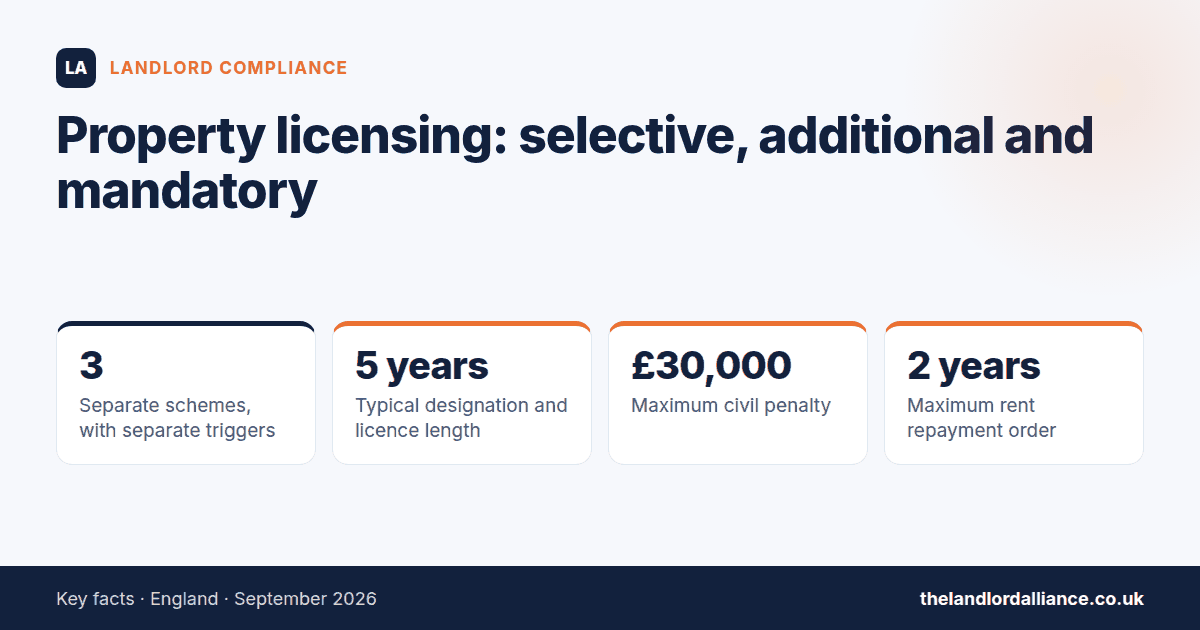
There is no national landlord licence in England. There are three separate schemes, and whether you need one depends on the specific address, not the town. Mandatory licensing applies to HMOs with five or more occupants, everywhere. Additional licensing covers smaller HMOs where a council has designated a scheme. Selective licensing covers all private rented homes in a designated area — including an ordinary one-tenant flat with nothing unusual about it. Letting unlicensed now risks a civil penalty of up to £30,000 and a rent repayment order of up to two years’ rent, which the tenant can apply for themselves.
The three schemes
| Scheme | What it covers | Where | Who it catches |
|---|---|---|---|
| Mandatory HMO | 5 or more occupants forming 2 or more households, sharing facilities | All of England | HMO landlords — see HMO licensing |
| Additional HMO | Smaller HMOs, typically 3 or 4 occupants | Only where designated | Landlords of small house shares who assume they are below the threshold |
| Selective | Every privately rented dwelling in the area, HMO or not | Only where designated | Ordinary single lets. This is the one that surprises people. |
The single most common way to become an unlicensed landlord is to own a normal flat, let it to one family, never think about licensing because it is obviously not an HMO, and not notice that the council designated a selective scheme covering your street. No one writes to tell you. The obligation is yours to discover.
How to check, properly
- Go to your council’s own licensing pages and find the designation map or postcode checker. Do not rely on a third-party site or on what an agent told you two years ago.
- Check the full address, not the postcode district. Designations are frequently drawn at ward or even street level, and two houses on the same road can fall either side of a boundary.
- Check the designation dates. Schemes run for up to five years and are then renewed, redrawn or dropped. A property outside a scheme in 2023 can be inside one now, and vice versa.
- Check for a pending designation. Councils consult before designating, and a scheme in consultation today is an obligation in nine months.
- Do this before you exchange on a purchase. Licensing costs and conditions belong in the numbers, not in a surprise after completion.
What a licence requires
Conditions vary by scheme and council, but selective licences commonly require:
- A fit and proper person as licence holder, with the resources and arrangements to manage the property.
- Valid gas and electrical safety certificates, supplied on request.
- Working smoke and carbon monoxide alarms.
- Written tenancy agreements and references taken.
- Deposit protection with prescribed information served.
- Arrangements for dealing with antisocial behaviour, and often a requirement to respond to the council within a set period.
- Property condition standards, sometimes with a schedule of works attached to the licence.
Fees vary enormously between authorities — commonly several hundred pounds for a five-year selective licence, more for HMOs, and sometimes charged per room. Many councils offer a discount for early application or for accredited landlords, which is worth asking about.
What it costs to let without one
| Consequence | Exposure |
|---|---|
| Civil penalty | Up to £30,000 per offence, imposed by the council without going to court |
| Prosecution | Unlimited fine and a criminal record |
| Rent repayment order | Up to two years’ rent, raised from twelve months by the Renters’ Rights Act. The tenant can apply, not only the council. |
| Banning order | For serious or repeat offending, with entry on the database of rogue landlords |
| Management order | The council takes over management and collects the rent |
Applying is the protection. It is an offence to have control of or manage a licensable property without a licence, but there is a defence where a valid application has been duly made and is outstanding. If you discover you should have applied, applying now stops the exposure growing. It does not erase the period you were unlicensed, so take advice first if the sums are large.
Practical points
- Licences do not transfer on sale. A buyer must apply for their own. Check this on any purchase of a tenanted property.
- Diarise renewal three months early. A lapsed licence means an unlicensed property from the day it expires, with no grace period.
- Your agent’s licence is not your licence unless they hold it. Agree in writing who is the licence holder and who is responsible for renewing.
- Licensing is not planning, and neither is the other. An HMO can hold a licence and still be operating without the planning permission it needed.
- Keep the paperwork with the licence. Councils ask for certificates on request, usually with a short deadline.
Read next
Do I need a licence for a normal single let?
Only if the property sits inside a selective licensing designation. Check the specific address on your council’s licensing map — a well-run flat with one tenant still needs a licence if it is in the area.
How do I find out if my area has a scheme?
Your council’s own licensing pages, using the address rather than the postcode district. Designations are often drawn street by street.
How much does a licence cost?
It varies widely by authority. Several hundred pounds for a five-year selective licence is common; HMO licences cost more and are sometimes charged per room.
Does the licence transfer if I sell?
No. The buyer must apply for their own, and the property is unlicensed from completion until they do.
What if I have been letting unlicensed without realising?
Apply now. A duly made application gives you a defence going forward and demonstrates cooperation. It does not erase past liability, so take advice before contacting the council if the exposure is significant.
Can a tenant claim my rent back?
Yes. A rent repayment order can require repayment of up to two years’ rent for letting an unlicensed property, and the tenant can apply for it directly.
Sources. Housing Act 2004, Parts 2 and 3 (HMO and selective licensing), and sections 72 and 95 on offences; Housing and Planning Act 2016 on civil penalties, banning orders and rent repayment orders; Renters’ Rights Act 2025 (c. 26) extending rent repayment orders to two years. Checked 8 September 2026.
Related: Compliance checklist · All guides · HMOs