The short version
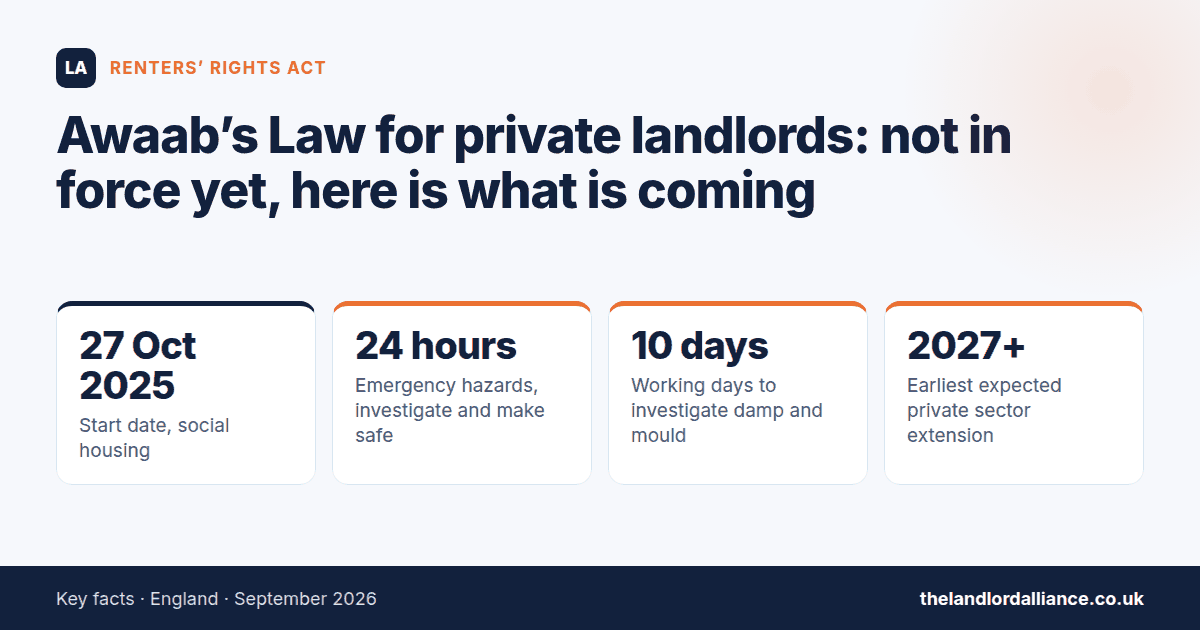
Awaab’s Law does not apply to private landlords. It commenced on 27 October 2025 for social landlords, requiring emergency hazards to be investigated and made safe within 24 hours and significant damp and mould to be investigated within 10 working days and made safe within 5. The Renters’ Rights Act contains the power to extend it to the private rented sector, but the regulations have not been made and commencement is not expected before 2027 at the earliest. Anyone selling you compliance with private-sector Awaab’s Law today is selling you something that does not exist — which does not mean you have no duties on damp, because you do.
What Awaab’s Law requires
The law is named after Awaab Ishak, who died in 2020 aged two after prolonged exposure to mould in social housing. It converts what was a general obligation to repair within a reasonable time into fixed, enforceable deadlines.
| Hazard | Investigate within | Make safe within |
|---|---|---|
| Emergency hazards | 24 hours | 24 hours |
| Significant damp and mould | 10 working days | 5 working days of identification |
Why it does not bind you yet
The first phase applies to registered providers of social housing. The Renters’ Rights Act includes a power to apply equivalent requirements to the private rented sector, and the government has said it intends to use it. What has not happened is the making of regulations setting the private-sector timescales and scope, or any announcement of a commencement date. Published commentary points to 2027 at the earliest.
“Not yet” is not “not at all”, and it is certainly not a defence. A landlord who ignores mould today is not exposed to Awaab’s Law. They are exposed to the Homes (Fitness for Human Habitation) Act 2018, which lets the tenant sue directly for an order and damages, and to a council improvement notice under HHSRS. Those already exist and are already used.
What already applies to you
Three obligations bind private landlords on damp and disrepair today:
- Section 11, Landlord and Tenant Act 1985 — keep the structure, exterior and installations in repair.
- Homes (Fitness for Human Habitation) Act 2018 — the property must be fit to live in at the start of the tenancy and throughout it. Damp and mould is an express factor, and the tenant enforces it directly.
- HHSRS — councils assess hazards and can serve improvement notices, with penalties for non-compliance and power to do the work and bill you.
The practical detail — diagnosis, what to do when mould is reported, and why “the tenant does not ventilate” is a weak answer — is in our guide to damp and mould.
Preparing sensibly
The deadlines above are a reasonable operating standard whether or not they bind you, and adopting them costs almost nothing:
- Acknowledge every report in writing the same day.
- Treat anything involving no heat, no water, an electrical fault or a safety risk as a 24-hour job.
- Inspect damp reports within about ten working days, and record what you found with photographs.
- Have a contractor you can actually reach. The deadlines are unmeetable without one, and that is the real preparation.
- Keep a per-property repairs log — reported, inspected, actioned, completed, with dates.
- Fix ventilation properly. Working extractor fans and clear trickle vents prevent most of the reports in the first place.
If the extension arrives in 2027, a landlord already working this way has nothing to change. One who is not will have to build the capability under a deadline.
Read next
Does Awaab’s Law apply to private landlords?
Not yet. It commenced for social housing on 27 October 2025. The power to extend it to the private sector exists in the Renters’ Rights Act but has not been used.
When will it apply?
No date has been announced. Published commentary points to 2027 at the earliest.
So I can ignore mould until then?
No. The Homes (Fitness for Human Habitation) Act 2018 and section 11 already apply, and the tenant can enforce them directly in court.
What counts as an emergency hazard?
Under the social housing rules, a hazard posing an imminent and significant risk to health or safety. In practice: no heating or hot water, serious electrical faults, gas leaks, structural danger.
Would I have to rehouse my tenant?
Under the social housing version, yes, where the deadlines cannot be met. Whether that transfers to the private sector will be set in the regulations.
Should I buy an Awaab’s Law compliance package?
No. There is nothing to comply with yet. Spend the money on ventilation and a reliable contractor instead.
Sources. Awaab’s Law provisions for social housing, commenced 27 October 2025; Renters’ Rights Act 2025 (c. 26); Homes (Fitness for Human Habitation) Act 2018; Landlord and Tenant Act 1985, section 11; Housing Act 2004 Part 1 (HHSRS); Shelter England professional guidance. Status confirmed as not applying to the private rented sector at 8 September 2026.
Related: The Renters’ Rights Act · Compliance checklist · All guides