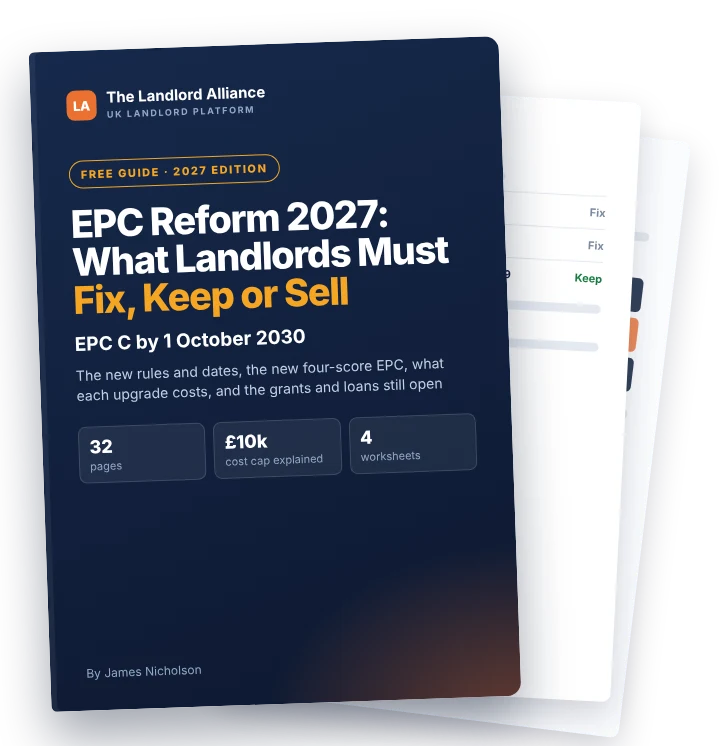
EPC Reform 2027: What Landlords Must Fix, Keep or Sell
EPC C by 1 October 2030 is now government policy, with a £10,000 cost cap and fines of up to £30,000 in a Bill before Parliament. This free EPC guide for landlords sets out what it means for each of your properties: which to fix, which are already safe, which to sell, and the grants and loans still open to pay for the work.
- The rules today and the 2030 standard, with every date that matters
- Why a C lodged before 1 October 2029 is the best-value move most landlords have
- The new four-score EPC, and what it means for your properties
- What each upgrade costs, with three properties worked through
- Every grant and loan still open, a plan to 2030 and four worksheets
Written by James Nicholson, landlord and founder of The Landlord Alliance
Get the free guide
We’ll email you the PDF straight away.
The EPC dates every landlord needs
The government confirmed the 2030 standard on 21 January 2026, alongside the Warm Homes Plan. Today’s minimum is still E. Two of the dates below are only weeks away.
ECO4 ends. Work funded by it has to be installed by then, and there is no ECO5.
0% VAT on insulation and heat pumps ends, and so does the £9,000 heat pump grant for off-gas homes.
The last day to lodge a C on today’s rating and have it count until the EPC expires.
Every private rented home must meet EPC C or have a registered exemption.
Four parts, 11 chapters, four worksheets
Written for landlords in England and Wales, whether you have one property or fifty. Every fact is traced to GOV.UK, Ofgem or the Energy Saving Trust, and the dates, costs and grants are in tables you can check in seconds.
The rules
- The rules today: EPC E
- The 2030 standard: EPC C
- The date that matters most
- The new EPC: four scores, not one
Fix, keep or sell
- Find out where you stand
- The upgrades that move the rating
- Three properties, worked through
- Deciding, property by property
Paying for it
- Grants and loans still open
- The ones that have closed
- Using them well
The toolkit
- A plan from now to 2030
- Portfolio EPC audit
- Upgrade plan and cost cap tracker
- Grant checklist and fix, keep or sell scorecard
What the upgrades cost
Typical costs for a semi-detached house, from the Energy Saving Trust. The guide shows which measures move the rating most, which count towards the £10,000 cap, and the order that usually works.
Grant money from ECO4 and the Warm Homes: Local Grant counts towards the cap. Boiler Upgrade Scheme money doesn’t. Chapter 10 shows how to use that.
The question the guide answers for every property
Most landlords are planning for 2030. The smarter date is a year earlier: a C on today’s rating, lodged before 1 October 2029, counts until that EPC expires, up to ten years. The guide sorts your portfolio into four groups, safe, close, far and breach, and gives each one a plan. For the rules in more depth, see our EPC rules for landlords, the 2030 EPC C deadline and MEES and the exemptions.
Rated F or G today? You can’t let it, or keep letting it, without a registered exemption. Chapter 1 covers what to do now, before any of the new rules start.
EPC reform FAQ
Do rented homes need EPC C by 2030?
Yes, as government policy. In January 2026 the government confirmed that privately rented homes in England and Wales must reach EPC C by 1 October 2030, with a cost cap of £10,000 per property, or 10% of the value for homes worth under £100,000. The regulations are due to be made in 2027.
What is the minimum EPC rating to let a property now?
E. You can’t let, or keep letting, a home rated F or G unless you’ve registered an exemption. The fine is up to £5,000 per property today, and the Energy Independence Bill, introduced on 4 November 2026, would raise it to £30,000.
Does an EPC C I already have count towards 2030?
If it’s a C on today’s Energy Efficiency Rating and was lodged before 1 October 2029, it counts until the certificate expires or is replaced. EPCs last 10 years, so a C lodged in 2027 could keep a property compliant until 2037.
What grants can landlords get for EPC improvements?
As at 20 November 2026: the Boiler Upgrade Scheme (£7,500 off a heat pump, or £9,000 for off-gas homes until 31 March 2027), the Warm Homes: Local Grant in England where the tenant is on a low income, ECO4 until 31 December 2026, and cheaper loans for heat pumps and solar through the Warm Homes Loan Scheme. The Great British Insulation Scheme closed on 31 March 2026.
Is the guide financial or legal advice?
No. It is general information about the rules in England and Wales, written by a landlord and checked against GOV.UK, Ofgem and the Energy Saving Trust on 20 November 2026. Grant rules change often, so check the current terms before you commit to any work.
Is the guide really free?
Yes. Enter your first name and email and we’ll send you the PDF. The guide mentions The Landlord Alliance and our training courses, and you can unsubscribe from our emails at any time.
Get EPC Reform 2027: What Landlords Must Fix, Keep or Sell
The rules, the dates, the costs and the grants, plus a plan to 2030 and four worksheets to work through your portfolio.
Rules: England and WalesUpdated 20 November 2026General information, not financial or legal advice
Sources include the government’s response on improving the energy performance of privately rented homes, the Warm Homes Plan, Ofgem’s scheme guidance and the Energy Saving Trust. The full list is at the back of the guide.