The short version
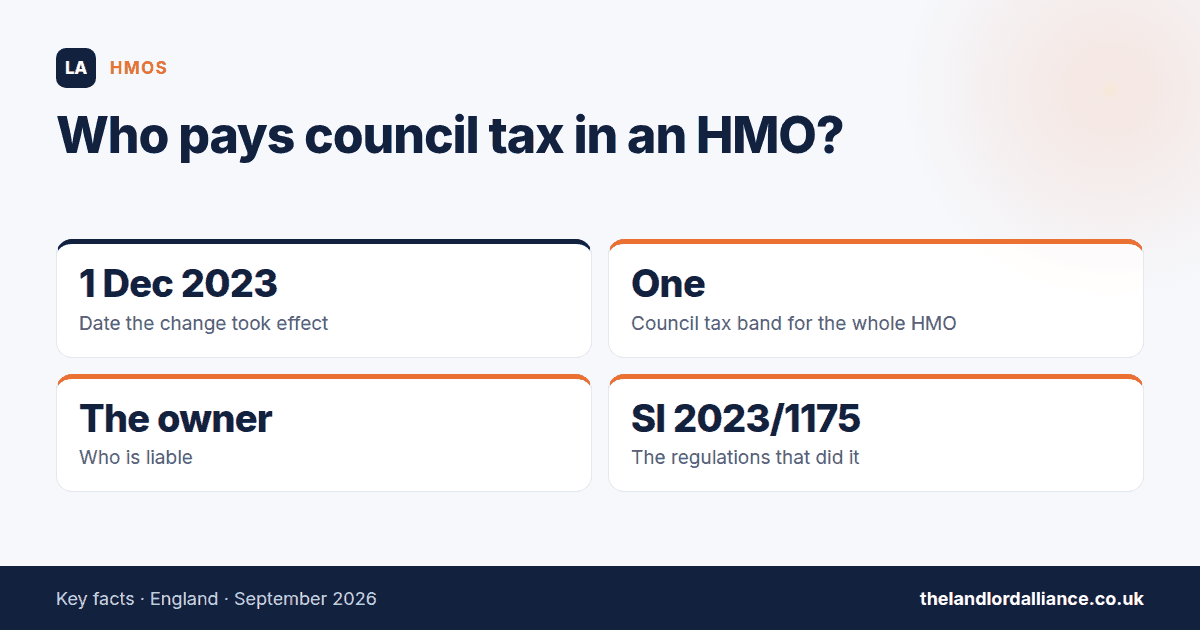
Since 1 December 2023 an HMO in England is treated as a single dwelling for council tax, and the owner is liable — not the tenants. That reversed a practice under which valuation officers had been banding individual rooms separately, leaving sharers with their own council tax bills for a bedroom. For most HMO landlords the change was welcome and simplifying, but it made council tax a permanent, non-recoverable landlord cost. If your rent does not have it priced in, it is coming out of your margin.
What changed, and why it mattered
The Valuation Office Agency had increasingly been treating individual rooms in an HMO as separate chargeable dwellings, each with its own council tax band. In practice that produced absurd outcomes: a six-bedroom house share generating six Band A bills, tenants receiving demands for a bedroom, and landlords facing retrospective disaggregation on properties they had underwritten on a single band.
The Council Tax (Chargeable Dwellings and Liability for Owners) (Amendment) (England) Regulations 2023 fixed it from 1 December 2023. An HMO, as defined in the Housing Act 2004, must now be treated as a single dwelling, and the class of properties where the owner rather than the residents is liable was widened to cover HMOs generally.
| Before 1 December 2023 | Now | |
|---|---|---|
| Banding | Rooms could be banded individually by the VOA | The HMO is one dwelling, one band |
| Who is billed | Often the individual tenants, per room | The owner |
| Tenant on a room-only agreement | Could receive their own council tax demand | Receives none — it is not their liability |
| Landlord’s exposure | Uncertain, and vulnerable to retrospective disaggregation | Certain, and a fixed operating cost |
So who pays now?
The owner. In an HMO, council tax liability sits with the owner regardless of what the tenancy agreement says. That has been the position for certain HMOs for a long time under the Council Tax (Liability for Owners) Regulations 1992; the 2023 amendment widened it so that HMOs generally fall into the owner-liable class.
You can recover the cost through the rent — and virtually every HMO is let on an inclusive-of-bills basis for exactly that reason — but you cannot make the tenant liable to the council. A clause purporting to pass council tax liability to an HMO tenant does not bind the billing authority.
Where this bites hardest. Rent in an HMO is normally fixed and inclusive, and under the Renters’ Rights Act you can only raise it once a year, by section 13 notice, with two months’ notice, and the tenant can challenge it at tribunal. So a council tax rise mid-year is a cost you absorb until the next review comes round. Build headroom into the inclusive rent rather than pricing to the current bill.
When it is not one dwelling
The single-dwelling rule applies to properties meeting the Housing Act HMO definition. It does not turn genuinely self-contained accommodation into an HMO.
- Self-contained flats with their own kitchen, bathroom and lockable entrance are separate dwellings, banded separately, with the occupier liable. Converting an HMO into self-contained studios changes the council tax treatment as well as the planning and licensing position.
- Section 257 HMOs — poorly converted blocks of flats — have their own treatment, and the 2023 regulations carry specific exclusions. If your property is a converted block rather than a shared house, take advice on its banding rather than assuming.
- A single household sharing a house is not an HMO at all, and the residents are liable in the normal way.
Exemptions and discounts worth knowing
| Situation | Position |
|---|---|
| All occupants are full-time students | The dwelling is exempt from council tax. The exemption follows the occupiers, so it survives owner liability — but you must evidence it with exemption certificates each year. |
| Some students, some working tenants | No full exemption. Students are disregarded when counting occupants, which can leave a single non-student and a 25% single-person discount. |
| Property empty between tenancies | Discounts vary by council and many have removed them entirely. Some charge a premium on long-term empties. |
| Rooms unlettable during works | Occasionally a reduction applies for major repair or structural alteration. Ask the council; it is discretionary and time-limited. |
Practical points
- Check your current banding. If your property was disaggregated into multiple bands before December 2023, it should now be a single dwelling. Contact the Valuation Office Agency if it has not been corrected — this is not automatic in every case.
- Price the bill into the inclusive rent, with headroom for an annual increase you cannot pass on until the next section 13.
- Collect student certificates annually and keep them. The exemption is worth more than any other saving available here.
- Tell the council when occupancy changes, particularly when a student HMO takes a non-student, because that ends the exemption.
- Do not put a council tax clause in a room-only agreement. It is unenforceable against the billing authority and misleads the tenant.
Read next
Who pays council tax in an HMO?
The owner. Since 1 December 2023 an HMO in England is a single dwelling for council tax and liability sits with the owner, not the occupiers.
Can I make the tenants pay it?
You can include the cost in an inclusive rent, which is what almost all HMO landlords do. You cannot make them liable to the council — a clause attempting that has no effect on the billing authority.
My HMO has six separate council tax bands. Is that still right?
It should not be. Since December 2023 an HMO is a single dwelling. Contact the Valuation Office Agency to have the banding reviewed if it has not already been corrected.
Is an all-student HMO exempt?
Yes, where every occupant is a qualifying full-time student. Keep exemption certificates for each tenant for each year — the exemption depends on evidence, not on the property type.
What if one tenant is not a student?
The full exemption is lost. Students are disregarded for counting purposes, so a single non-student occupant will usually leave a 25% single-person discount rather than a full charge.
Does this apply to self-contained studios?
No. Genuinely self-contained units with their own facilities and lockable entrance are separate dwellings, banded individually, with the occupier liable.
Sources. Council Tax (Chargeable Dwellings and Liability for Owners) (Amendment) (England) Regulations 2023 (SI 2023/1175), in force 1 December 2023; Council Tax (Chargeable Dwellings) Order 1992; Council Tax (Liability for Owners) Regulations 1992; Housing Act 2004, section 254; Local Government Finance Act 1992. Checked 8 September 2026.
Related: HMOs explained · All guides · Free calculators