The short version
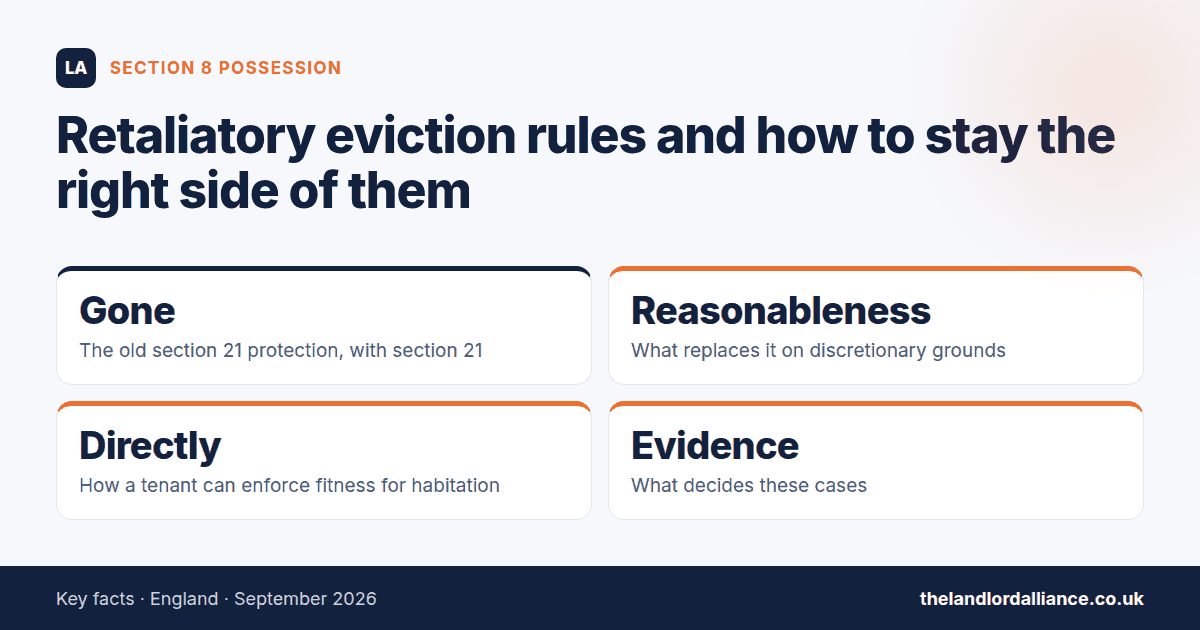
The old retaliatory eviction rules worked by invalidating a section 21 notice served after a tenant complained about disrepair. Section 21 is gone, so that specific protection has gone with it — but the risk to landlords has not reduced, it has moved. You now need a section 8 ground, and on the discretionary grounds the court must also be satisfied it is reasonable to order possession. A history of ignored repair complaints followed by a possession notice is exactly the sort of fact that makes an order unreasonable. On top of that sit council enforcement, penalties, and a fitness for habitation claim the tenant can bring directly.
What changed
Under the Deregulation Act 2015, a section 21 notice was invalid if the tenant had complained about the condition of the property, the landlord had not responded adequately, and the council had served a relevant notice. It was a specific, mechanical protection tied to a specific document.
With section 21 abolished on 1 May 2026, that mechanism has no work to do. The replacement is less mechanical and, for landlords, less predictable:
| Route | How a complaint bites |
|---|---|
| Discretionary grounds | The court must find it reasonable to order possession. A documented pattern of unaddressed complaints followed by a notice goes directly to that question. |
| Mandatory grounds | The court must order possession if the ground is proved — but the tenant may still counterclaim for disrepair, which can offset arrears and, on Ground 8, potentially take them below the threshold. |
| Council enforcement | An HHSRS improvement notice can require works with a deadline and a penalty for non-compliance, whatever is happening in the possession claim. |
| Fitness for habitation | The tenant can sue directly under the 2018 Act for an order and damages, without the council. |
| Ground 1A misuse | Using the selling ground and then re-letting within twelve months is a breach in its own right, and a well-advised tenant will look for it. |
The sequencing is what looks bad. Tenant reports damp in March; landlord does nothing; tenant contacts the council in June; landlord serves notice in July. Nobody has to prove your motive — the timeline does the work. If you genuinely need possession and there is an outstanding complaint, deal with the complaint first, in writing, and let some time pass.
Staying the right side of it
- Respond to every complaint in writing, promptly. Same day acknowledgement, inspection within days. Your response time is the first thing anyone examines.
- Keep a repairs log per property — reported, inspected, actioned, completed, with dates and invoices. This is your entire defence and it takes minutes to maintain.
- Fix the cause, not the symptom. Painting over mould and leaving a blocked gutter reads badly and fails anyway.
- Never link the two conversations. Anything that connects a complaint to a notice — even a frustrated text message — is disclosable and damaging.
- If you must serve notice while a complaint is live, have a clear, evidenced, unrelated reason, and take advice first.
- Do not misuse Ground 1A. If you serve it to sell, you must not re-let for twelve months. Serving it to remove a complaining tenant and then re-letting is the clearest possible case against you.
What tenants are told to do
It helps to know the other side of the process. Tenants are advised to put complaints in writing, keep copies, photograph the problem, allow a reasonable time, then contact the council’s environmental health team, and to seek advice if a notice arrives afterwards. Every one of those steps produces a document. Assume the file exists.
That is not a reason for defensiveness. It is a reason to make sure your own file is better — and the way to do that is simply to fix things and record that you did.
Read next
Do retaliatory eviction rules still exist?
The section 21 mechanism has gone with section 21. The protection now works through the reasonableness test on discretionary grounds, council enforcement, and the tenant’s direct right to sue on fitness for habitation.
Can I serve notice after a tenant complains?
There is no automatic bar, but the sequence looks bad and can defeat a discretionary ground. Deal with the complaint first and take advice.
Does a complaint stop a Ground 8 claim?
Not directly — Ground 8 is mandatory. But a disrepair counterclaim can reduce the arrears, potentially below the three-month threshold, which defeats the ground.
What if the council serves an improvement notice?
Comply with it. Non-compliance carries a penalty and the council can do the work and recover the cost, entirely separately from any possession claim.
How do I prove I was not retaliating?
With the repairs log. A record showing prompt responses and completed work, and a possession reason that stands on its own, is the answer.
Can I use Ground 1A to remove a difficult tenant?
Only if you genuinely intend to sell. You cannot re-let for twelve months afterwards, and re-letting is straightforward for a tenant to discover and act on.
Sources. Renters’ Rights Act 2025 (c. 26) and the abolition of section 21 from 1 May 2026; Deregulation Act 2015, sections 33–34 (now of historic effect); Homes (Fitness for Human Habitation) Act 2018; Housing Act 2004 Part 1 (HHSRS); Housing Act 1988 Schedule 2 as amended. Checked 8 September 2026.
Related: Section 8 grounds · Compliance checklist · All guides