Information, not advice. We are landlords, not insurance brokers, and we do not sell insurance or take commission on it. Cover varies enormously between policies — read the schedule, not the marketing page.
The short version
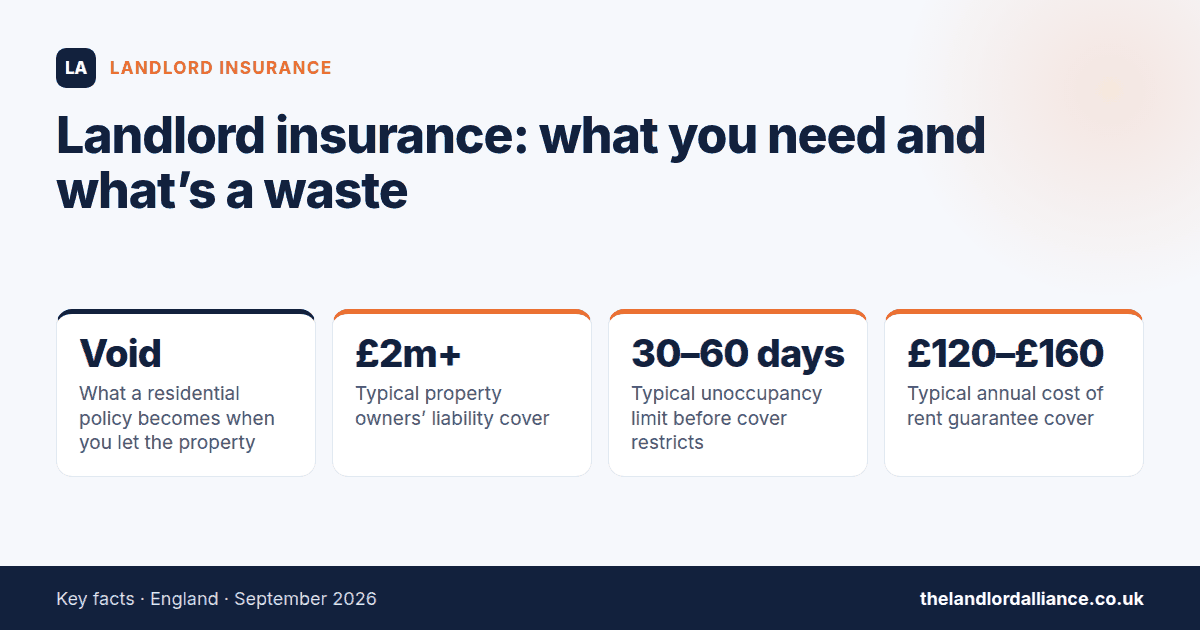
Only one thing is genuinely non-negotiable: your buildings policy must be a landlord policy. A standard residential policy is void the moment you let the property, which means a fire claim gets declined on a technicality. After that, property owners’ liability is cheap and essential, and everything else is a judgement call. The biggest source of confusion in this category is that “loss of rent” is not rent guarantee — loss of rent pays when the property is uninhabitable after an insured event like a fire. It pays nothing at all when a tenant simply stops paying.
What each cover actually does
| Cover | What it pays for | Verdict |
|---|---|---|
| Buildings | Rebuilding the structure after fire, flood, storm, subsidence, escape of water | Essential, and almost always a mortgage condition. Must be a landlord policy. |
| Property owners’ liability | Claims by a tenant or visitor injured because of the property — a loose stair rail, a falling tile | Essential. Usually bundled, costs very little, and the one claim that can be ruinous. |
| Loss of rent | Rent lost while the property is uninhabitable after an insured event | Worth having, usually included with buildings. Not the same as rent guarantee. |
| Landlord’s contents | Your items: carpets, curtains, white goods, furniture in a furnished let | Sized to what you own. An unfurnished flat needs very little. Do not insure the tenant’s belongings — that is their job. |
| Malicious damage by tenant | Deliberate damage beyond fair wear and tear | Situational. Often excluded as standard and added at a price. Check whether the deposit would cover the realistic worst case first. |
| Accidental damage | The drilled-through pipe, the sofa through the window | Optional. Cheap; frequently claimed for small amounts that are not worth the excess. |
| Rent guarantee and legal expenses | Rent when the tenant defaults, plus the cost of getting possession | Increasingly worth it now section 21 is gone — but the conditions are strict. See the detail. |
| Employers’ liability | Injury to someone you employ, such as a regular cleaner or gardener | Only if you employ anyone. A contractor with their own insurance is not your employee. |
| Home emergency | Call-outs for boiler failure, blocked drains, lock-outs | Usually poor value. You are buying convenience, not risk transfer. Compare against a good local plumber on speed dial. |
The mistake that voids claims
Letting a property on a residential buildings policy is the single most common serious error in this area. It is not a technicality the insurer might overlook — the risk they priced is not the risk they are carrying, and a declined claim on a rebuild is a life-changing amount of money.
It bites in the accidental cases most: the accidental landlord who moved in with a partner and let the old flat; the person who kept the policy running because switching felt like admin. Tell the insurer the moment the use changes.
The unoccupancy clause. Most policies restrict cover once a property is empty for 30, 45 or 60 consecutive days — typically dropping to fire, lightning and explosion only, with escape of water and theft excluded. Since 1 May 2026 tenants can leave on two months’ notice at any point, so unplanned voids are more likely than they used to be. Read your limit, and tell the insurer when a property goes empty. A burst pipe in an unnotified empty flat is the classic declined claim.
Leasehold flats
If you own a leasehold flat, the freeholder almost certainly insures the building and recharges you through the service charge. You do not need your own buildings cover, and buying it duplicates what you are already paying for. What you do need is your own contents cover for anything you own inside the flat, and your own property owners’ liability — the block policy covers the freeholder’s liability, not yours as the landlord of your particular flat.
Ask the freeholder or managing agent for a copy of the buildings insurance schedule each year. You are entitled to it, and you need it for your own records anyway.
What actually drives the price
- Tenant type. Students, benefit claimants and sharers are priced higher by many insurers. Note that refusing a tenant on benefits is now unlawful — if an insurer’s terms push you that way, change insurer rather than breaking the law.
- Property type and construction. Non-standard construction, flat roofs and listed buildings all cost more; so do flats above commercial premises.
- Claims history and excess. Raising the excess is usually the cheapest genuine saving. Removing liability cover to save money is not.
- Portfolio policies. Once you are past three or four properties, a portfolio policy is normally cheaper than separate ones and much easier to administer.
Before you renew
- Confirm the policy is a landlord policy and the schedule names the correct use.
- Check the rebuild value is current. Building costs have moved a great deal; underinsurance means claims are scaled down proportionately.
- Check the unoccupancy limit and diary it against your tenancy.
- Check whether malicious damage by tenant is included or excluded.
- If you added rent guarantee, check its referencing conditions still match how you actually let.
Read next
Is landlord insurance a legal requirement?
No, but buildings cover is almost always a condition of a buy-to-let mortgage, and letting without liability cover is a serious risk to take deliberately.
Can I use my normal home insurance?
No. A residential policy does not cover a let property and a claim will be declined. Tell your insurer as soon as the property is let.
Does loss of rent cover a tenant who stops paying?
No. Loss of rent applies when the property cannot be lived in after an insured event such as a fire. Tenant default is rent guarantee, which is a separate product.
Do I need contents cover for an unfurnished let?
Usually only a small amount — carpets, curtains, blinds, any white goods you supplied. The tenant insures their own belongings.
What happens if the property is empty between tenants?
Cover typically restricts after 30 to 60 consecutive days. Tell the insurer, and consider unoccupied property cover for a long void or a refurbishment.
Does insurance cover the deposit dispute?
No. Deposit deductions are handled through the scheme’s adjudication, not your insurer. See deductions and disputes.
Sources. Financial Conduct Authority guidance on insurance disclosure and fair value; published policy wordings and schedules from mainstream UK landlord insurers, September 2026; Renters’ Rights Act 2025 (c. 26). Checked 7 September 2026.
Related: All landlord guides · Free calculators · Compliance checklist