The short version
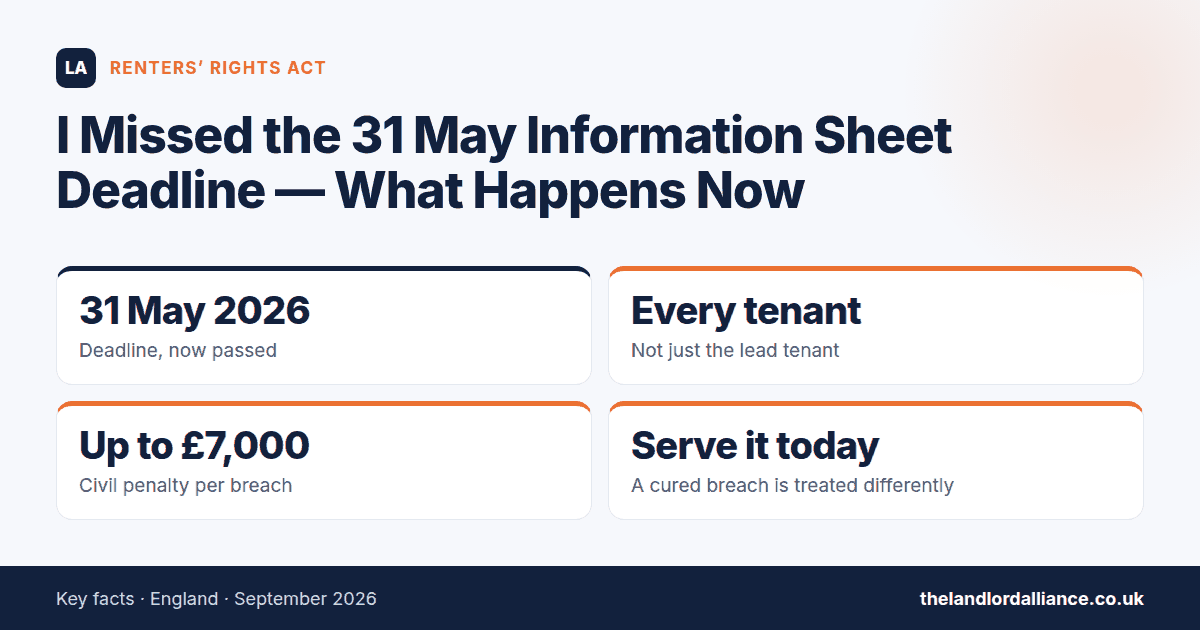
The deadline to give existing tenants the Renters’ Rights Act information sheet was 31 May 2026. It has passed. If you didn’t serve it, you are in breach of a continuing duty, and the penalty is a civil fine of up to £7,000 per breach — assessed per tenancy, not per landlord. The single most useful thing you can do is serve it today and record that you did. A breach you have already cured, voluntarily, before any enforcement contact, is a very different conversation with a council than one you are still in. The next deadline of this kind is the national landlord register, which opens region by region from 15 December 2026 with the same £7,000 maximum penalty.
Almost every guide written about the information sheet was published in March or April 2026, when 31 May was still ahead. They tell you to serve it by the deadline. That advice has expired, and nobody seems to have written the version for landlords reading this in August having realised they never did it.
So here is that page. It is not a comfortable one, but the position is more recoverable than most people assume.
What you were supposed to do
When the Act commenced on 1 May 2026, every existing assured shorthold tenancy converted automatically into a periodic assured tenancy. Tenants didn’t ask for that and mostly didn’t know about it, so the Act placed a duty on landlords to tell them: give every existing tenant a copy of The Renters’ Rights Act Information Sheet 2026, the government-published document explaining what changed, within one month of commencement.
The duty in short
- Who had to serve it
- Landlords of tenancies that existed on 1 May 2026
- Who had to receive it
- Every named tenant, not just the lead tenant
- Deadline
- 31 May 2026
- Document
- The government’s own information sheet, unaltered
- If there was no written agreement
- A written statement of terms as well
- Penalty
- Civil penalty up to £7,000
New tenancies granted on or after 1 May don’t need the information sheet — they need a written statement of terms instead. The sheet exists specifically to explain a change to people who were already renting when it happened.
What the penalty actually is
A civil penalty of up to £7,000, imposed by the local housing authority. Two things about that number are worth understanding properly.
It is a maximum, not a tariff. Councils set penalties against their own published enforcement policy, and those policies almost universally scale by culpability, harm, and whether the landlord cooperated. A portfolio landlord who ignored the duty across forty tenancies and argued about it is at one end. A landlord with one property who missed it, served it voluntarily in August, and can show the record is at the other. Most council policies have an explicit reduction for early cooperation and self-remedy.
It is assessed per breach. If you have six tenancies and served none of them, that is six breaches, not one. This is the reason the exposure gets large quickly for anyone with a portfolio, and the reason serving all of them this week matters more than agonising over any single one.
Beyond the civil penalty, a breach that continues after enforcement action can escalate — to prosecution, and to substantially higher penalties for repeated offending. The way to stay well away from that end of the scale is simply to stop being in breach.
The duty is continuing, not spent. Missing 31 May did not convert this into a historic failure you can do nothing about. You are in breach for as long as the tenant has not been given the sheet. Every day you leave it is another day of a breach that a council can act on — and, just as importantly, another day you cannot claim you put it right of your own accord.
What to do this week
In order, and none of it takes long.
1. Serve it, today
- Download the current information sheet from GOV.UK
- Send it to every named tenant on every tenancy that existed on 1 May
- Attach the PDF — do not send a link
- Do not edit, rebrand or summarise it
2. Record that you served it
- Keep the sent email with the attachment intact
- Note the date, time, method and every recipient
- If posting, use a service that gives you proof
- Save it all to that tenancy’s compliance file
3. Check what else is missing
- Deposit protected and prescribed information served?
- Gas safety certificate current and given?
- EICR in date and given?
- EPC given?
4. Do not do these
- Don’t backdate anything. Ever
- Don’t send a link instead of the document
- Don’t serve only the lead tenant
- Don’t wait until you happen to be in touch about something else
On backdating: I want to be blunt, because the temptation is obvious and the consequences are not proportionate. A late information sheet is a civil penalty. A fabricated record of service, produced to a council or a court, is a different category of problem entirely, and it converts a manageable compliance failure into something that can cost you far more than £7,000. Serve it today, dated today.
The detail on service — why a link doesn’t count, what to send it with, and what a defensible record looks like — is on how to serve the information sheet.
Does this affect my ability to get possession?
This is the question I get asked most, and it deserves a careful answer rather than a confident one.
The information sheet duty is a standalone compliance obligation enforced by councils through civil penalties. It is not drafted in the way the deposit rules are — deposit protection is an express statutory bar, where the court simply cannot make a possession order if the deposit was never protected. The information sheet is not written as that kind of hard bar.
That said, I would not want any landlord to read that as “it doesn’t matter for possession”. If you are heading towards a contested possession claim, your whole compliance file gets looked at, and arriving with an obvious unremedied statutory breach is not a position you want to argue from. Serve the sheet before you serve any notice, not after.
If you are actively pursuing possession right now and haven’t served the information sheet, get advice on your specific case before you serve anything. The general position above is not a substitute for someone looking at your file.
The other deadline that passed
While you are auditing, check this one too. Any section 21 notice served before 1 May 2026 only remained usable if you had already requested the claim form from the court before 1 May. Everything else expired on 31 July 2026.
If you were holding a section 21 notice and waiting to see whether the tenant left, that notice is now dead. You cannot revive it and you cannot serve a new one, because section 21 no longer exists. Any possession now has to run on a section 8 ground, with the evidence and notice period that ground requires.
Questions
Is it too late to serve it now?
No — and serving it now is materially better than not serving it. The duty continues until discharged, so serving it stops the breach running.
Will the council definitely fine me?
Not necessarily. Councils act on complaints and on what they find during other enforcement. A landlord who has already put it right, unprompted, is a poor use of enforcement resource compared to one still in breach.
My tenant moved out in June. Do I still need to serve it?
The duty attached while they were your tenant, so the historic breach isn’t undone. There is nothing to be gained by serving it to someone who has left, but note the position honestly in your records rather than pretending it didn’t happen.
I used an agent. Whose problem is this?
Practically, both. Check your management agreement for where the duty sat and what indemnity you have. The council will generally look to whoever was responsible for compliance under that agreement — but do not assume it lands entirely on the agent.
What if my tenant says they never received it?
This is exactly why the record matters more than the sending. A sent email with the PDF attached, retained in full, is the practical minimum.
Never miss the next one
The Landlord Alliance app tracks every compliance date across your portfolio and tells you before a deadline lands, not after. £10 a month, cancel anytime.
See what’s includedEngland only. Position as at 20 August 2026. General information from a landlord, not legal advice. If you are facing enforcement action or contested possession, take advice on your specific circumstances.
Related: the full Renters’ Rights Act guide · what the information sheet is · how to serve it properly · section 8 grounds