The short version
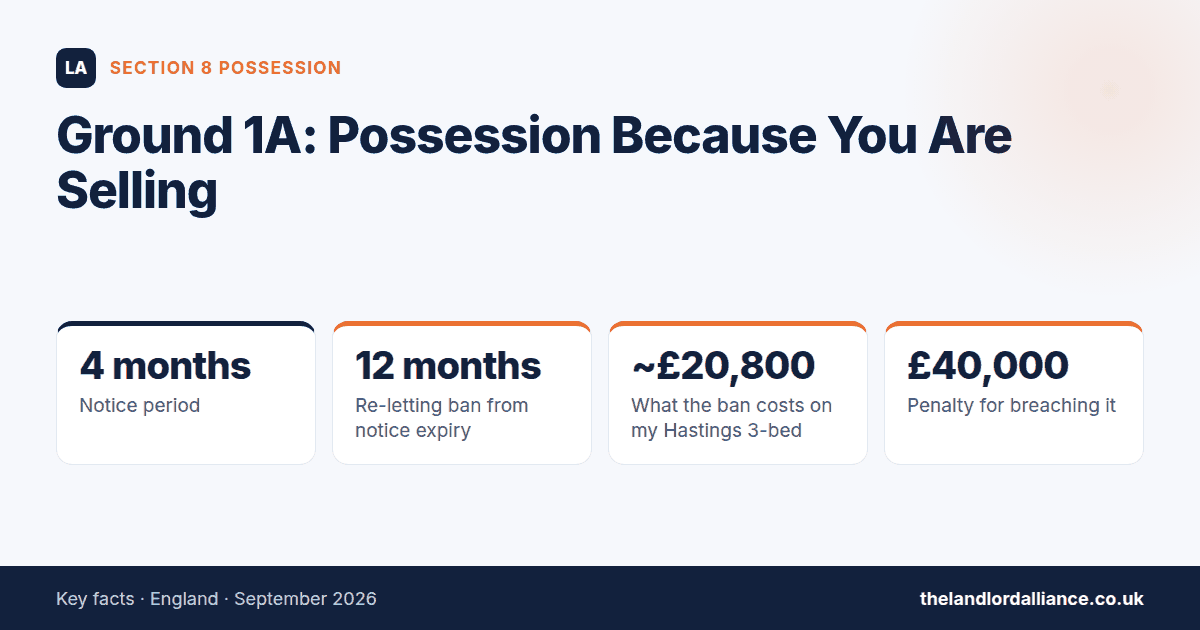
Ground 1A lets you take possession because you intend to sell. It is mandatory, needs four months’ notice, and the date you specify cannot fall inside the tenancy’s first year. The sting is what follows: you cannot let the property, licence it for money, or even market it to let for twelve months from the date your notice expires. On a four-month notice that is roughly sixteen months from service. Breaching it is a criminal offence with a £40,000 civil penalty as the alternative.
Ground 1A is the ground doing most of the heavy lifting right now, because selling is the most common reason a landlord wants a property back and it’s the closest thing left to the old no-fault route. It is also the ground with the most expensive tail, and the cost is not obvious from reading the ground itself.
When you can use it
| Condition | Detail |
|---|---|
| Intention to sell | Selling a freehold or leasehold interest, or granting a lease of more than 21 years |
| Notice period | Four months |
| Year-one condition | The tenancy must have begun at least a year before the date specified in the notice |
| Type | Mandatory — the court must order possession if the ground is proved |
| Not available to | Registered providers, registered social landlords, charitable housing trusts |
| Not available for | “Legacy” assured tenancies — see below |
The year-one condition is about the notice’s expiry date, not the date you serve it. This is widely misreported as “you can’t use ground 1A in the first year”. You can serve inside year one — the date you specify just has to fall on or after the first anniversary. Serving at month four means giving more than four months’ notice, but it is perfectly valid.
The legacy tenancy carve-out
Ground 1A does not apply at all to a “legacy assured tenancy” — one entered into before 1 May 2026 that was not an assured shorthold immediately before that date. In practice these are old-style assured or “lifetime” tenancies, typically pre-1997.
If you hold one, you have no sale ground whatsoever. Converted ASTs are fully within ground 1A; only the genuinely old tenancies are excluded. Most landlords will never encounter one, but if you do, this is a significant restriction and worth taking advice on. Note the carve-out is specific to ground 1A — ground 1, moving in yourself or family, is unaffected.
The re-letting ban, and how it is actually calculated
This is the part that costs money, and the arithmetic is not intuitive. The restricted period starts the day you serve the notice and ends twelve months after the date specified in the notice as the earliest date proceedings can begin.
Worked example
- Notice served
- 1 September 2026
- Earliest date specified
- 1 January 2027 (four months)
- Restricted period runs
- 1 September 2026 → 31 December 2027
- Total
- 16 months during which you cannot let or market
What the restriction actually prohibits is broader than “don’t re-let”:
| Prohibited during the restricted period |
|---|
| Letting the property on a tenancy of 21 years or less |
| Permitting occupation under a licence for money |
| Marketing it to let — advertising alone is a breach |
| Authorising someone else to market it |
Putting it back on a portal “just to test the market” is a breach. Marketing is caught expressly and separately from letting. If your agent re-lists it without instruction, that is still a problem — the restriction binds anyone acting on your behalf.
You cannot shorten it by adding another ground
The Act anticipates the obvious workaround. If you cite ground 1A alongside an antisocial behaviour ground that carries no notice period, the restricted period is still calculated as though you had served a ground 1A notice alone on the same date. Bolting on a no-notice ground shortens nothing.
It does end early in one situation: if the court makes a possession order on a ground other than ground 1 or 1A, the restricted period ends that day.
What it costs
Here are my own numbers, from a three-bed in Hastings letting at £1,500 a month. Yours will differ; the shape won’t.
| Cost of the 12-month ban | Amount |
|---|---|
| Rent you can’t collect (12 × £1,500) | £18,000 |
| Council tax on the empty property | ~£2,380 |
| Landlord insurance | £150 |
| Utility standing charges | ~£300 |
| Total | ~£20,800 |
That last point is the one I’d want a landlord to sit with before serving. Sales collapse. If yours does at month nine, you are still eleven months from being able to advertise the property, with no rent coming in and no way to shorten the clock.
The penalties
Worth being precise here, because the figures get muddled. Breaching the re-letting restriction is a criminal offence, not a civil penalty matter:
| Route | Consequence |
|---|---|
| Prosecution | Criminal offence, unlimited fine on summary conviction |
| Civil penalty (alternative to prosecuting) | Up to £40,000, imposed by the local housing authority |
| Rent repayment order | Up to two years’ rent |
You may see £7,000 quoted. That is a different penalty for different breaches — the written statement duty and some of the section 16E(1) obligations. It does not apply to the re-letting ban.
The exceptions
There are narrow carve-outs. The useful ones: you can grant a lease of more than 21 years, you can license to someone who has agreed to buy your interest, and there is a shared-ownership exception with conditions attached. Selling with a tenant in situ avoids the whole problem, because you never take possession at all.
Consider whether you need vacant possession at all. A tenanted sale to another landlord means no notice, no four months, no re-letting ban, and rent continuing throughout. You’ll likely take a lower price — but weigh that against £20,800 of carrying cost plus four months of notice period.
Questions
Can I serve ground 1A in the first year of the tenancy?
Yes — you just have to specify a date on or after the first anniversary, which means giving more than four months’ notice.
What if the sale falls through?
The restricted period runs regardless. There is no exception for a collapsed sale, which is why the ban should be priced in before you serve.
Can I sell with the tenant still there instead?
Yes, and it sidesteps the ground entirely. No notice, no ban, rent continues. Usually a lower price, but often better arithmetic.
Do I have to prove I’m selling?
You have to state the ground and give particulars of it in the notice, and the court will want to be satisfied the intention is genuine. Marketing evidence or a solicitor’s instruction helps.
What if I change my mind and want to move in myself?
Ground 1 covers that, but it carries its own re-letting ban on the same terms. Decide before you serve.
Does the ban stop me selling?
No — selling is the whole point. It stops you letting or marketing to let. You can market for sale freely.
Sixteen months is a long time to track by memory
The app holds the notice date, the specified date, and the day your restricted period actually ends — so you know exactly when you can advertise again. £10 a month, cancel anytime.
See what’s includedEngland only. Position as at 31 August 2026. General information from a landlord, not legal advice. Ground 1A has significant financial consequences — take advice before serving if the sums are material.
Sources: Housing Act 1988 Sch 2 Ground 1A, ss.16E, 16F, 16J, 16K and 16M as inserted by RRA 2025; SI 2026/421 reg 5; MHCLG enforcement guidance.
Related: all 32 grounds · completing Form 3A · the court claim · the Renters’ Rights Act