The short version
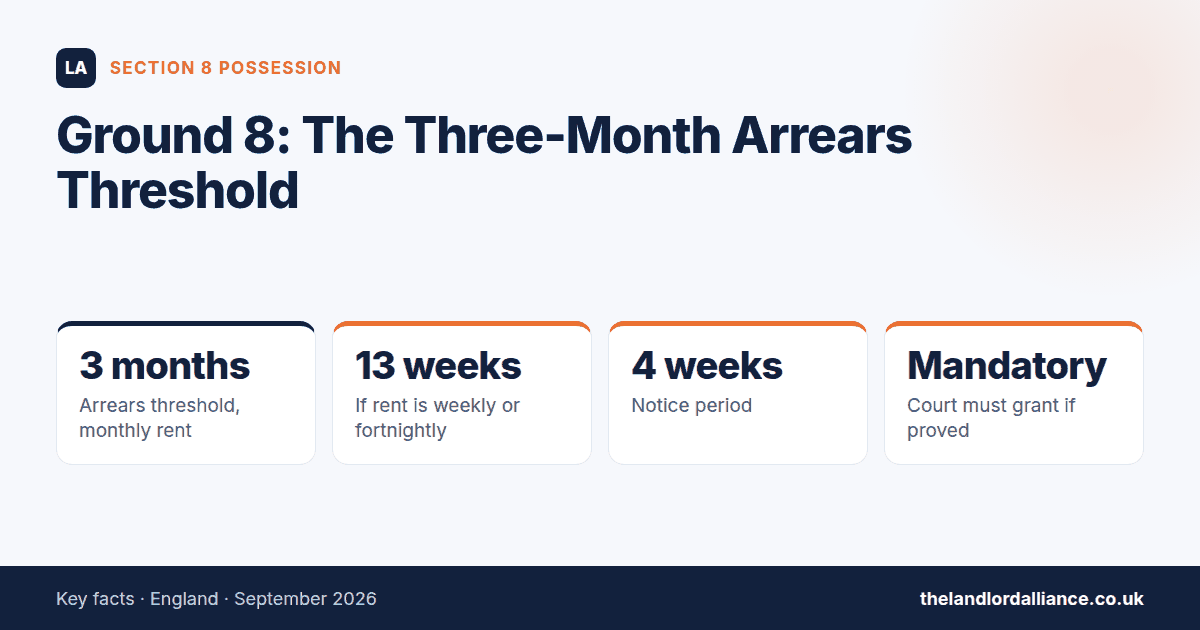
Ground 8 is the mandatory rent arrears ground. Since 1 May 2026 the threshold is three months’ or 13 weeks’ arrears, up from two months. The arrears must meet that level both when you serve the notice and again at the hearing — if the tenant pays it down below the threshold before the hearing, the mandatory ground fails. Notice period is four weeks. Arrears that exist only because a Universal Credit payment hasn’t arrived yet are ignored.
Ground 8 is the strongest tool most landlords have, because it is mandatory — prove it and the court must order possession, with no reasonableness test. But the Act made it materially harder to reach, and the dual-date test catches people who assume that serving the notice locks the position in. It does not.
The threshold, and what changed
| Rent period | Before 1 May 2026 | Now |
|---|---|---|
| Monthly | 2 months’ arrears | 3 months’ arrears |
| Weekly or fortnightly | 8 weeks’ arrears | 13 weeks’ arrears |
| Quarterly | One quarter, 3 months late | No ground 8 route at all |
| Yearly | 3 months’ rent, 3 months late | No ground 8 route at all |
In practice the quarterly point matters less than it looks, because rent periods longer than a month no longer have effect anyway — a tenancy purporting to charge quarterly rent defaults to monthly. But if you have an older arrangement still running on quarterly figures, reconcile the rent account before you count arrears.
The dual-date test — the thing that catches people
The statute requires the arrears to be at or above the threshold both at the date you serve the notice and at the date of the hearing. Not one or the other. Both.
A tenant who pays one month’s rent the week before the hearing defeats a mandatory ground 8 claim. Three months’ arrears becomes two, the threshold isn’t met on the second date, and the mandatory ground fails — even though it was perfectly good when you served. This is deliberate, it happens regularly, and it is the single most important thing to understand about ground 8.
Which is why you almost always cite grounds 10 and 11 alongside ground 8. Ground 10 covers arrears below the ground 8 threshold; ground 11 covers persistent late payment even where the account is now clear. Both are discretionary, so the court also has to think an order reasonable — but they survive a last-minute payment where ground 8 doesn’t. Citing all three costs nothing extra: they share the same four-week notice period.
The Universal Credit disregard, precisely
The Act inserted a disregard into ground 8. The wording matters, because it is narrower than most summaries suggest:
“…if the tenant is entitled to receive an amount for housing as part of an award of universal credit…, any amount that was unpaid only because the tenant had not yet received the payment of that award is to be ignored.“
Read “only because” carefully. The disregard applies where the money hasn’t arrived yet. It does not apply where:
| Situation | Disregarded? |
|---|---|
| UC housing payment delayed, not yet received | Yes — ignored for ground 8 |
| Tenant received the housing element and spent it | No |
| Housing element is less than the contractual rent | No — the shortfall counts |
| Legacy Housing Benefit rather than UC | No — the provision names UC only |
The practical effect is that where a tenant is waiting on a UC decision or a first payment, ground 8 effectively pauses. Worth establishing early which of these situations you’re actually in, because it changes whether you have a mandatory ground at all.
Serving it
Ground 8 notice
- Form
- Form 3A — download fresh from GOV.UK each time
- Notice period
- Four weeks from service
- Also cite
- Grounds 10 and 11 — same notice period, survive part-payment
- Particulars needed
- The arrears figures and the dates they arose
- Valid for
- 12 months from service
- Court can dispense with notice?
- No — expressly not for ground 8
That last row is the one to note. For most grounds the court has a power to dispense with the notice requirement where it would be just and equitable. That power is expressly unavailable for ground 8, so a defective notice cannot be rescued. Get it right first time — see how to complete Form 3A.
Do not serve an arrears notice during a Breathing Space moratorium. Once you’ve been notified that a tenant has entered the Debt Respite Scheme, you must not serve a notice relying on grounds 8, 10 or 11 without the court’s permission. A moratorium also extends the life of a notice you served earlier.
Before you serve: check the deposit
This is the trap that costs landlords whole claims. Since 1 May 2026, an unprotected deposit — or one where the prescribed information was never served — bars a possession order on section 8 grounds, not just the abolished section 21. Only the two antisocial behaviour grounds are excepted.
The PRS database adds a second bar of the same shape. Once the landlord register reaches the region your property is in, a landlord in breach of the duty to register cannot get a possession order on ground 8 either.
So a textbook ground 8 case with four months of arrears fails at the door if a deposit from 2019 was never protected. It is curable: protect it late or return it, and you can proceed. But cure it before you serve, and note that curing the possession bar doesn’t extinguish the tenant’s separate claim for one to three times the deposit.
What happens at the hearing
Ground 8 is mandatory, so if the ground is made out the judge must order possession. The date is usually within 14 days, though the judge can allow up to six weeks where the tenant would suffer exceptional hardship.
What the court cannot do on a mandatory ground is suspend the order on terms — that latitude only exists on discretionary grounds. Which cuts both ways: if your ground 8 fails on the dual-date test and you’re left running on grounds 10 and 11, the court may well make a suspended order instead, letting the tenant stay while paying the arrears down.
On current Ministry of Justice figures the median time from issuing a claim to actually recovering the property is 27.1 weeks. Add your four weeks’ notice on the front. The full process and costs are on the possession claim page.
Questions
The tenant paid a month off just before the hearing. What now?
Your mandatory ground 8 fails. If you cited grounds 10 and 11 as well, the claim continues on those — discretionary, so the court also weighs reasonableness. If you cited only ground 8, you are starting again.
Can I count arrears from before 1 May 2026?
Yes — the arrears are the arrears. What changed is the threshold you have to reach, not the period you can count.
What counts as rent for this?
Rent lawfully due from the tenant. Not service charges or other sums unless the agreement makes them rent.
My tenant is on Universal Credit and owes four months. Can I use ground 8?
It depends entirely on why. If the payments arrived and weren’t passed on, yes. If they haven’t arrived yet, those amounts are ignored and you may fall below the threshold.
Should I always cite grounds 10 and 11 too?
In almost every arrears case, yes. Same notice period, no extra cost, and they survive a part-payment that kills ground 8.
How long from serving to getting the property back?
Four weeks’ notice, then a median of 27.1 weeks from claim to repossession. Realistically eight months or so, longer if defended.
Know the threshold day by day
The app tracks arrears against the ground 8 threshold on every tenancy, flags when a tenant crosses it, and holds the deposit-protection status that quietly blocks possession. £10 a month, cancel anytime.
See what’s includedEngland only. Position as at 31 August 2026. General information from a landlord, not legal advice.
Sources: Housing Act 1988 Schedule 2 Ground 8 and s.8, as amended by Renters’ Rights Act 2025 Sch 1 para 24; SI 2026/421; Ministry of Justice possession statistics April–June 2026.
Related: all 32 grounds · completing Form 3A · the court claim · the Renters’ Rights Act