The short version
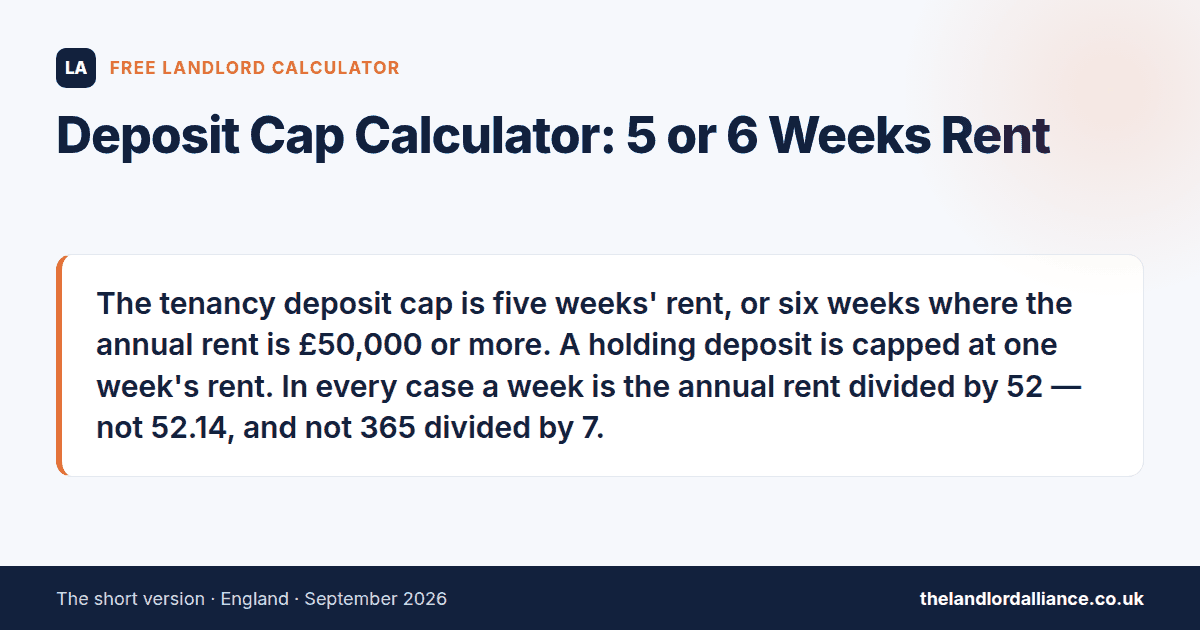
The tenancy deposit cap is five weeks' rent, or six weeks where the annual rent is £50,000 or more. A holding deposit is capped at one week's rent. In every case a week is the annual rent divided by 52 — not 52.14, and not 365 divided by 7. Anything above the cap is a prohibited payment and the council can fine you up to £5,000.
Deposit cap calculator
Enter the rent. Nothing is stored or sent anywhere.
The rule it is applying
| Payment | Cap | Provision |
|---|---|---|
| Tenancy deposit, annual rent under £50,000 | 5 weeks' rent | Tenant Fees Act 2019 Sch 1 para 2(3) |
| Tenancy deposit, annual rent £50,000 or more | 6 weeks' rent | Tenant Fees Act 2019 Sch 1 para 2(3) |
| Holding deposit | 1 week's rent | Tenant Fees Act 2019 Sch 1 para 3(3) |
The divisor is 52. There are 52.14 weeks in a year and plenty of calculators use that, or use 365 divided by 7. Both produce a figure a few pence lower than the statutory one on a holding deposit and a few pounds lower on a five-week deposit — which is safe. Using 52 weeks of a 4-week month, or multiplying a monthly rent by 4.33, is what produces an overcharge. Only the excess is prohibited, not the whole deposit, but the excess is enough to trigger enforcement.
Three things the calculator cannot tell you
Whether the rent is real
The cap is calculated on the rent payable under the tenancy. Inflating the first month's rent to lift the cap, then dropping it, is a route enforcement officers know about.
What happens on a rent increase
The cap is fixed by reference to the rent immediately after the grant, renewal or continuance. A later section 13 increase does not entitle you to top up an existing deposit.
Whether you protected it in time
A lawful amount protected on day 31 is worth the same as an unlawful one. The thirty-day clock is separate and carries a mandatory penalty of one to three times the deposit.
Whether a holding deposit counts
Only if you applied it towards the tenancy deposit, which needs the payer's consent. Once applied it counts towards the cap — and the protection clock runs from the tenancy date. See holding deposits.
Does the £50,000 threshold use the rent or the property value?
The annual rent. Six weeks applies where the annual rent is £50,000 or more — roughly £4,167 a month.
I charged £5 over the cap. Is the whole deposit unlawful?
No. Only the excess is a prohibited payment. But it is still a prohibited payment, recoverable by the tenant at the First-tier Tribunal and enforceable by the council with a penalty of up to £5,000.
Can I take a bigger deposit if the tenant has a pet?
No. There is no pet exception to the cap, and you cannot require pet insurance or a separate pet deposit. See the 2026 position on pets.
Does the cap apply to a guarantor?
The cap applies to the deposit however it is funded. A guarantor arrangement is separate and is not a way of taking more.
Getting the number right is the easy half
The Landlord Alliance tracks the amount, the protection date and the prescribed information against every tenancy, so the lawful deposit stays lawful. £10 a month, cancel anytime.
See what is includedEngland only. Position as at 31 August 2026. General information from a landlord, not legal advice. This tool runs entirely in your browser and stores nothing.
Sources: Tenant Fees Act 2019 Schedule 1 paras 2 and 3, ss.1, 8 and 15; Housing Act 2004 s.213.
Related: All calculators · Tenancy deposits · Holding deposits · Section 8 notice period calculator