The short version
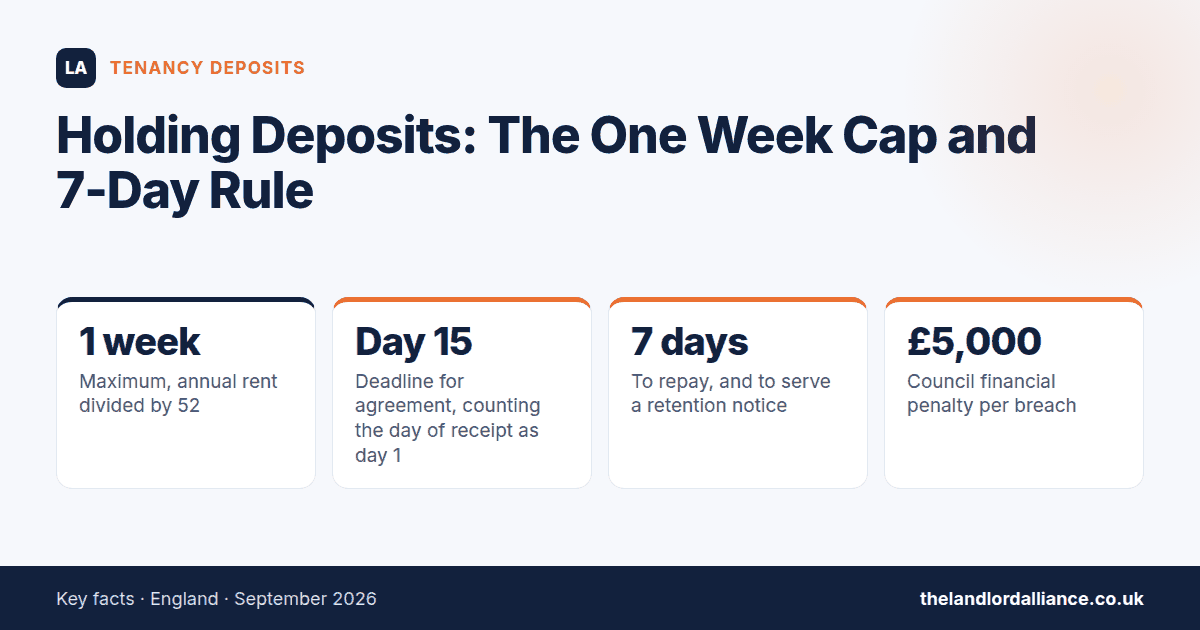
A holding deposit is capped at one week's rent, calculated as the annual rent divided by 52. You have until the fifteenth day after receiving it to enter into a tenancy agreement. Once the outcome is settled you have seven days to repay it — in every case. If you intend to keep it you must give written reasons within seven days, and if you miss that deadline you lose the right to keep it however good your reasons were. Get it wrong and the penalty is a council fine of up to £5,000.
Holding deposits are the smallest sums in letting and generate a disproportionate share of the trouble. The reason is that almost every landlord and a fair number of agents describe the timings wrong — usually as "fourteen days" for both the agreement deadline and the repayment. Neither figure appears anywhere in the Act. This page uses the actual paragraph numbers so you can check every date against the statute yourself.
The cap: one week's rent, divided by 52
Schedule 1 paragraph 3(3) of the Tenant Fees Act 2019 says that if the holding deposit exceeds one week's rent, the amount of the excess is a prohibited payment. Note what that does and does not mean: the whole deposit does not become unlawful, only the surplus.
Paragraph 3(4) gives the formula, and it is specific: one week's rent is the annual rent payable immediately after the grant, renewal or continuance of the tenancy, divided by 52. Not 52.14, and not 365 divided by 7. Landlords who use the more mathematically honest divisors end up overcharging.
| Monthly rent | Annual rent | Maximum holding deposit |
|---|---|---|
| £800 | £9,600 | £184.61 |
| £1,200 | £14,400 | £276.92 |
| £1,750 | £21,000 | £403.84 |
| £2,500 | £30,000 | £576.92 |
The tenancy deposit cap works the same way but at five weeks' rent, or six where the annual rent is £50,000 or more. Our deposit cap calculator runs both figures at once.
The deadline for agreement is the fifteenth day, not fourteen days
Schedule 2 paragraph 2(1) defines the deadline for agreement as the fifteenth day of the period beginning with the day on which the holding deposit is received. The day you receive the money is day one.
Receive the deposit on 1 June and your deadline is 15 June. Count forward fourteen days from receipt, as most guidance invites you to, and you land on 15 June only by accident of arithmetic in some months and get it wrong in others. Use the rule as written: date of receipt plus fourteen.
You can change it. Paragraph 2(2) lets the landlord or agent agree a different day with the tenant, but the agreement must be in writing. The Act sets no maximum and does not require the new day to be later, so this is a genuine negotiation rather than a unilateral extension.
Repayment: seven days, three triggers
Paragraph 3 sets out the three circumstances in which the deposit must be repaid, and paragraph 4 gives you seven days from a different starting point in each case.
| What happened | Provision | Seven days from |
|---|---|---|
| You and the tenant enter into a tenancy agreement | para 3(a) | The date of the tenancy agreement |
| You decide, before the deadline, not to grant the tenancy | para 3(b) | The date you decide |
| Neither of you enters into an agreement before the deadline | para 3(c) | The deadline for agreement |
The most common misstatement in circulation is a "14 day" repayment deadline. It does not exist. It is probably borrowed from the fourteen days a court gives a landlord to comply with an order under section 214 of the Housing Act 2004 — a different statute about a different kind of deposit.
Applying it to the rent or the deposit instead of repaying
Paragraph 6 lets you apply the holding deposit towards the first rent payment or towards the tenancy deposit rather than repaying it — but only with the consent of the person who paid it. Consent is not optional and should be in writing.
Paragraph 7 then does something useful that almost nobody knows about. Where the holding deposit is applied towards the tenancy deposit, that amount is treated for Housing Act 2004 purposes as received on the date of the tenancy agreement. So your thirty-day protection clock runs from the tenancy date, not from the day you took the holding deposit weeks earlier. That is a real and lawful extension of the deadline — see how the protection schemes work for what you then have to do with it.
When you may lawfully keep it
Paragraphs 8 to 12 of Schedule 2 are frequently described as giving landlords a right to keep the money. They do not. They disapply the duty to repay, which is a narrower thing, and paragraph 13 overrides three of the five.
| Ground | Provision | Conditions |
|---|---|---|
| Right to rent failure | para 8 | You are prohibited by s.22 Immigration Act 2014 from granting the tenancy, and you did not know and could not reasonably have been expected to know before accepting the deposit, and nor did any agent you instructed |
| False or misleading information | para 9 | The tenant gave false or misleading information, and you are reasonably entitled to take into account either the difference it makes or the fact of them providing it |
| The tenant withdraws | para 10 | The tenant notifies you before the deadline that they have decided not to proceed |
| The tenant fails to take reasonable steps | paras 11 and 12 | You took all reasonable steps to enter into the agreement, your agent took all reasonable steps to assist, but the tenant failed to |
Paragraph 13 is the trap. Grounds 10, 11 and 12 fall away entirely — so you must repay — if before the deadline you or your agent imposed a prohibited requirement in breach of section 1 or 2, or behaved towards the tenant in such a way that it would be unreasonable to expect them to enter into a tenancy with you. A tenant who walked away because of how they were treated is a tenant you must repay.
The seven-day notice you must serve to keep it
This is the provision that costs landlords money most often, because the right to retain is lost by silence.
Paragraph 5 says you must repay the deposit if you believe one of paragraphs 8 to 12 applies but you do not give the payer a written notice explaining why you intend not to repay, within the relevant period. That period is seven days, running either from the date you decided not to grant the tenancy, or from the deadline for agreement where neither of you entered into an agreement.
The retention notice
- Form
- In writing, to the person who paid the deposit
- Content
- An explanation of why you intend not to repay — not merely a statement that you are keeping it
- Deadline
- Seven days from the decision, or from the deadline for agreement
- If you miss it
- You must repay in full, however strong the underlying ground was
One holding deposit per property at a time
Schedule 1 paragraph 3(5) makes a holding deposit a prohibited payment altogether if you have previously received one for the same housing, have not repaid all or part of it, and no lawful ground covers the retention. Take a second deposit in those circumstances and the whole of it is prohibited — not merely an excess.
In practice this means clearing the previous applicant properly before advertising to the next. Holding two deposits while you decide between two tenants is not a grey area.
What it costs if you get it wrong
| Consequence | Provision | Detail |
|---|---|---|
| Financial penalty | s.8(2) | Up to £5,000, imposed by the local authority where it is satisfied beyond reasonable doubt of a breach of s.1, s.2, s.5A or Schedule 2 |
| Higher penalty | s.8(3) | Up to £30,000 where the authority is satisfied an offence under s.12 has been committed |
| Criminal offence | s.12 | A further breach of s.1 or s.2 within five years of a penalty or conviction for a different breach of the same section. Summary conviction, unlimited fine |
| Banning order | s.12(6) | A s.12 offence is a banning order offence, which also feeds the rogue landlord database |
| Tenant recovery | s.15 | The person who paid can apply to the First-tier Tribunal to recover the unrepaid holding deposit directly |
A nuance worth knowing. The s.12 offence covers breaches of section 1 or 2 only — not breaches of Schedule 2. So a pure holding-deposit failure, such as repaying late or missing the seven-day notice, is capped at £5,000 and can never reach the £30,000 tier. Overcharging is different: the excess above one week's rent is a prohibited payment under section 1, so that can escalate.
The possession consequence has gone
Until 1 May 2026, section 17 of the Tenant Fees Act barred a landlord from serving a section 21 notice while a prohibited payment or holding deposit remained unrepaid. Section 21 no longer exists, and section 17 was omitted outright by section 27(2) of the Renters' Rights Act 2025. It was not replaced with an equivalent restriction on section 8 possession. There is now no possession consequence anywhere in the Tenant Fees Act.
Do not extend that conclusion to tenancy deposits. The possession bar for those very much survives, in a new form, in section 215 of the Housing Act 2004 — it now stops the court making a possession order rather than stopping you serving a notice. The penalties page sets out how that works. Holding deposit and tenancy deposit are different animals with different sanctions.
One quirk if you go looking: the contents page for the Tenant Fees Act on legislation.gov.uk still lists section 17 as a live entry and the link still resolves. Open the section itself and you will see the omission annotation.
A workable process
Do
- Calculate the cap as annual rent divided by 52 and round down
- Write the deadline for agreement on the file the day you take the money
- Diarise a seven-day repayment reminder against each of the three possible triggers
- Get written consent before applying it to rent or the tenancy deposit
- Serve a written retention notice with reasons, inside seven days, even where the ground is obvious
Don't
- Hold two holding deposits for the same property
- Assume "fourteen days" for either the agreement deadline or the repayment
- Keep the money on a ground under paragraphs 10 to 12 if the tenant walked because of how they were treated
- Take a holding deposit and a tenancy deposit that together exceed the caps
- Extend the deadline for agreement verbally
Can I take a holding deposit from two applicants and pick one?
Not for the same property while the first is unrepaid and no lawful ground covers keeping it. The second becomes a prohibited payment in full under Schedule 1 paragraph 3(5).
The tenant failed a right to rent check. Can I keep it?
Only if you did not know and could not reasonably have been expected to know that the prohibition applied before you accepted the deposit, and the same is true of any agent you instructed. And you still have to serve the seven-day notice.
Does the holding deposit count towards the five-week cap?
Only if you apply it towards the tenancy deposit, which requires the payer's consent. Once applied, it is part of the tenancy deposit and counts towards the cap and the protection duty.
The tenant changed their mind on day sixteen. Do I repay?
Yes. Once the deadline for agreement has passed without an agreement, paragraph 3(c) bites and you have seven days from that deadline. Paragraph 10 only helps where the tenant notifies you before the deadline, and even then only with the seven-day notice.
What if I just never mention it and keep the money?
The tenant can go to the First-tier Tribunal under section 15 and recover it, and the council can impose a financial penalty of up to £5,000 on the same facts.
The deadlines are short and there are three of them
The Landlord Alliance tracks holding deposit deadlines, protection dates and notice periods against each tenancy, so a seven-day window never closes while you are looking the other way. £10 a month, cancel anytime.
See what is includedEngland only. Position as at 31 August 2026. General information from a landlord, not legal advice.
Sources: Tenant Fees Act 2019 Schedule 1 paras 2–3, Schedule 2 paras 2–13, ss.8, 12, 15 and 17; Renters' Rights Act 2025 s.27; SI 2026/421; Housing Act 2004 s.213.
Related: Tenancy deposits: the complete guide · Protection schemes compared · Unprotected deposit penalties · Deposit cap calculator