This is information, not tax advice. We are landlords, not accountants. Everything here is checked against HMRC guidance and the published Budget documents, and dated, but your circumstances change the answer. Before you act on any of it, particularly anything involving incorporation or a sale, speak to an accountant.
The short version
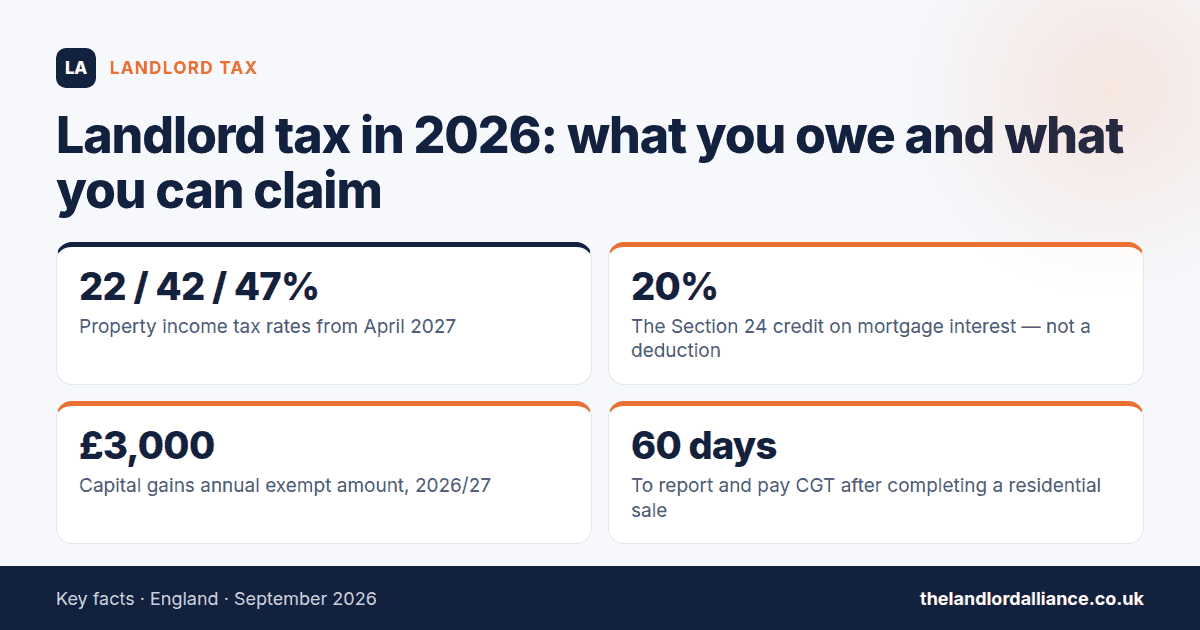
In 2026/27 rental profit is taxed at your normal income tax rate: 20%, 40% or 45%. From April 2027 that stops being true. Property income gets its own rates, two percentage points above the main ones — 22%, 42% and 47% — announced at the Autumn Budget in November 2025. Alongside that, Making Tax Digital reached landlords with qualifying income over £50,000 on 6 April 2026 and will reach £30,000 in 2027 and £20,000 in 2028. Section 24 still means you cannot deduct mortgage interest, only claim a 20% credit against it.
What you pay on rental profit in 2026/27
Rental profit is added to your other income and taxed at whatever rate that pushes it into. There is no separate property tax rate this year — that starts next year.
| Band | Taxable income | Rate on rental profit 2026/27 | Rate from April 2027 |
|---|---|---|---|
| Personal allowance | Up to £12,570 | 0% | 0% |
| Basic | £12,571–£50,270 | 20% | 22% |
| Higher | £50,271–£125,140 | 40% | 42% |
| Additional | Over £125,140 | 45% | 47% |
There is a separate £1,000 property allowance. If your gross rental income for the year is under £1,000 you do not need to declare it at all. If it is over, you can either claim the £1,000 instead of your actual expenses, or claim the expenses — not both. For anyone with a mortgage the expenses are almost always worth more.
What changes in April 2027
At the Autumn Budget on 26 November 2025 the government announced that property income would get its own rates from April 2027, set two percentage points above the main income tax rates. Savings income moves the same way at the same time; dividends went up two points a year earlier, in April 2026.
Scotland and Wales. The new property income rates apply in England, Wales and Northern Ireland. The Scottish and Welsh governments have the power to set property income rates in line with their existing income tax powers, so if you let in Scotland, watch the Scottish Budget rather than this table.
What it costs a real landlord
Take a higher-rate taxpayer with £60,000 of employment income and one let property: £18,000 of rent, £3,000 of running costs and £6,000 of mortgage interest.
| Step | 2026/27 | 2027/28 |
|---|---|---|
| Rent | £18,000 | £18,000 |
| Less running costs | −£3,000 | −£3,000 |
| Taxable property profit (interest is not deducted) | £15,000 | £15,000 |
| Tax at the higher rate | £6,000 (40%) | £6,300 (42%) |
| Less Section 24 credit at 20% of £6,000 interest | −£1,200 | −£1,200 |
| Tax on the property | £4,800 | £5,100 |
One thing genuinely is not settled. The Section 24 credit is fixed at the basic rate. If the basic rate for property income becomes 22%, does the credit follow to 22%, or stay at 20%? On the numbers above that is the difference between paying £5,100 and £4,980. We have not found a clear answer in the published documents and we are not going to invent one — watch the draft legislation, and do not let anyone tell you confidently either way without showing you the source.
Section 24, in one screen
Since April 2020 you cannot deduct mortgage interest from rental income. You add it back, pay tax on the higher profit, and then take a tax reducer worth 20% of the interest. For a basic-rate taxpayer that is roughly neutral. For a higher-rate taxpayer it is a real cost, and it is the single biggest reason landlords look at limited companies.
It also has a second effect that catches people out: because the profit figure is now bigger, it can push you into the higher-rate band, remove your child benefit, or start tapering your personal allowance, even though your actual cash position has not changed. The rule bites hardest on highly geared portfolios in the £40,000–£60,000 income range.
What you can and cannot claim
| Claimable in full | Not claimable |
|---|---|
| Letting agent and management fees | Mortgage interest (20% credit instead) |
| Repairs and maintenance that restore the property | Improvements — these go against CGT when you sell |
| Landlord insurance | Your own time or labour |
| Ground rent, service charges, council tax and utilities you pay | Capital cost of the property itself |
| Accountancy fees for the rental accounts | Personal expenses with incidental business use |
| Gas, electrical and EPC certificates | Fines and penalties |
| Replacing domestic items like a cooker or a sofa, like for like | The first purchase of an item for an unfurnished let |
| Advertising and tenant referencing | Costs of buying or selling — these are CGT costs |
The tax calendar
| Date | What happens |
|---|---|
| 5 April | Tax year ends |
| 7 May, 7 Aug, 7 Nov, 7 Feb | MTD quarterly update deadlines, if you are in scope |
| 5 October | Deadline to register for self assessment if this is your first year letting |
| 31 October | Paper tax return deadline |
| 31 January | Online return, balancing payment, and first payment on account |
| 31 July | Second payment on account |
| Within 60 days of completion | Report and pay CGT on a UK residential property sale |
Capital gains tax when you sell
Gains on residential property are taxed at 18% to the extent they fall within your remaining basic rate band, and 24% above it. The annual exempt amount for 2026/27 is £3,000. You deduct the purchase price, the buying and selling costs, and any capital improvements — which is why keeping the invoices for that new kitchen matters years later even though you could not claim it against rent at the time.
If you ever lived in the property, private residence relief may cover part of the gain. If you are selling with a tenant in place, the timing interacts with possession law as well as tax: our guide to Ground 1A covers what you can and cannot do to get vacant possession.
Limited company: when it actually pays
Incorporating solves Section 24 — companies deduct mortgage interest in full — and the April 2027 property income rates apply to individuals, not companies. That widens the gap again. It is not free, though:
- Moving existing properties into a company is a sale. Expect capital gains tax and stamp duty at the higher rates unless a relief applies.
- Limited company mortgage rates and fees are typically higher than personal ones.
- Profits are taxed in the company, then taxed again when you take them out. Dividend rates rose two points in April 2026.
- You add annual accounts, corporation tax returns and a confirmation statement to your admin.
The rough shape: a higher-rate taxpayer building a geared portfolio from here is often better off in a company. A basic-rate taxpayer with one or two low-debt properties usually is not. Anyone with existing properties needs the transfer cost modelled before anything else, because it frequently swallows a decade of savings.
Making Tax Digital
From 6 April 2026, landlords with qualifying income over £50,000 must keep digital records and send HMRC a quarterly update using compatible software. £30,000 follows in April 2027 and £20,000 in April 2028. Qualifying income is gross rent plus any self-employment turnover, measured before expenses — not profit. Full detail, including which software is recognised, is in our Making Tax Digital guide.
Read next
Do I have to declare rental income under £1,000?
No. The property allowance means gross rental income under £1,000 a year does not need to be declared. Above that you must report it, even if the property makes a loss.
Can I still deduct my mortgage payments?
You never could deduct the capital repayment. Since April 2020 you cannot deduct the interest either — you get a tax reducer worth 20% of it. Companies are different and still deduct interest in full.
Are the April 2027 property income rates definitely happening?
They were announced at the Autumn Budget in November 2025 and are government policy, but announced is not the same as enacted. Rates have been changed between announcement and start date before. Plan for them; do not treat them as immovable.
What if I make a loss?
Rental losses are carried forward and set against future rental profits from the same property business. You cannot set them against employment income.
My spouse and I own jointly — how is it split?
Married couples and civil partners are taxed 50/50 by default regardless of the actual shares, unless you hold the property as tenants in common in unequal shares and file a Form 17 declaration. Unmarried joint owners are taxed on their actual beneficial shares.
Do I pay tax on the deposit?
No. A tenancy deposit is held on trust and is not your income. It only becomes taxable if you keep part of it at the end — and only the part that covers something you would otherwise have claimed as an expense.
Sources. HMRC guidance on property income, allowable expenses and capital gains tax rates; gov.uk Making Tax Digital for Income Tax for sole traders and landlords; House of Commons Library briefing CBP-10450 on the Budget 2025 changes to income tax rates on property, savings and dividend income. Checked 7 September 2026.
Related: Free calculators · All guides · Our pricing