Information, not tax advice. A disposal is usually the largest single tax event in a landlord’s life and the numbers are unforgiving. Get an accountant involved before you exchange, not after you complete.
The short version
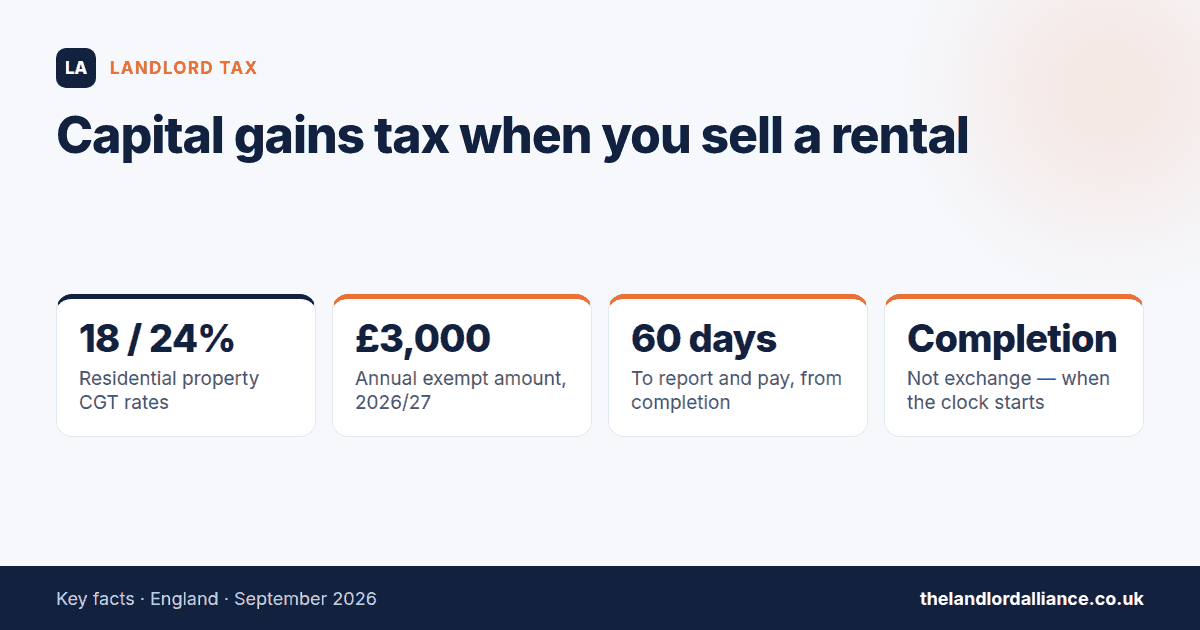
Gains on residential property are taxed at 18% to the extent they fall within your remaining basic rate band and 24% above it. The annual exempt amount for 2026/27 is £3,000. The deadline that catches people is the 60 days: you must report and pay within 60 days of completion, separately from your tax return, and the penalties for missing it are automatic. Every improvement you made over the years reduces the gain — which is why the invoice for that kitchen you could not claim against rent still matters a decade later.
How the gain is worked out
| Step | Example |
|---|---|
| Sale price | £320,000 |
| Less purchase price | −£200,000 |
| Less buying costs — stamp duty, legals, survey | −£13,500 |
| Less selling costs — agent, legals | −£5,500 |
| Less capital improvements | −£18,000 |
| Gain | £83,000 |
| Less annual exempt amount | −£3,000 |
| Taxable gain | £80,000 |
| Tax at 24% (higher-rate taxpayer) | £19,200 |
Which rate applies
The gain is stacked on top of your income for the year. Whatever falls within your remaining basic rate band is taxed at 18%; everything above it at 24%.
So a basic-rate taxpayer with a large gain will pay 18% on the slice that fits and 24% on the rest, and a higher-rate taxpayer pays 24% throughout. A year with unusually low income — a career break, a gap between jobs, retirement — can therefore be a materially cheaper year to sell, which is worth planning around when you have the choice.
The 60-day rule
For a UK residential property disposal producing a gain, you must file a Capital Gains Tax on UK property return and pay the estimated tax within 60 days of completion. This is separate from, and additional to, reporting it on your annual self assessment return.
Sixty days is not long. The clock runs from completion, not exchange, and the return needs the full computation — base cost, improvements, costs, reliefs — before you can file it. Assemble the paperwork during the conveyancing, not after. Late filing attracts an automatic penalty, and interest runs on late payment.
The reliefs that apply
| Relief | When it applies |
|---|---|
| Private residence relief | Where the property was your only or main home for part of your ownership. The gain is apportioned, and the final 9 months of ownership count as a qualifying period even if you had moved out. |
| Lettings relief | Heavily restricted since April 2020. It now applies only where you shared occupation of the property with the tenant. Most landlords who once expected it no longer qualify. |
| Transfers between spouses | No gain, no loss between married couples and civil partners living together. Transferring a share before sale can use two annual exempt amounts and two basic rate bands. |
| Capital losses | Losses on other chargeable assets can be set against the gain, and unused losses carry forward indefinitely if you have reported them. |
| Incorporation relief | Can defer the gain on a transfer into a company, but only where a genuine property business is transferred as a going concern. |
What reduces the bill, legitimately
- Find the improvement invoices. Extensions, new bathrooms, loft conversions, driveways, double glazing where it was an upgrade. This is usually the largest single lever and the one most often lost to poor record keeping.
- Use both annual exempt amounts where the property is jointly owned, and consider a spousal transfer where it is not.
- Time the disposal. A gain straddling two tax years is not possible, but choosing which tax year to complete in can be, and it can move the whole gain into a lower-income year.
- Report your losses. Losses must be claimed to be usable, generally within four years of the end of the tax year in which they arose.
- Check private residence relief carefully if you ever lived there, including the final nine months.
Selling with a tenant in place
Tax is only half the problem. Since section 21 was abolished, obtaining vacant possession to sell means using Ground 1A, which cannot be used in the first twelve months of a tenancy, requires four months’ notice, and prevents re-letting for twelve months afterwards.
Selling with the tenant in situ avoids all of that, but narrows the buyer pool to investors and usually costs something on price. The trade-off is a real one, and it should be decided before the property goes on the market rather than after an offer falls through. Our guide to selling tenanted versus empty works through both routes.
Read next
What is the CGT rate on a rental property?
18% on the part of the gain falling within your remaining basic rate band, 24% above it, for residential property.
When do I have to pay?
Within 60 days of completion, using the Capital Gains Tax on UK property service. You also report the disposal on your annual tax return.
Can I deduct the stamp duty I paid when I bought it?
Yes. Stamp duty, legal fees and survey costs on purchase are all part of the base cost.
Does lettings relief still exist?
Only in a very narrow form since April 2020 — it now requires that you shared occupation of the property with your tenant. Most landlords no longer qualify.
What if I make a loss?
Report it. Capital losses can be set against gains in the same year and carried forward indefinitely, but only if claimed.
I lived in it before letting it. Does that help?
Yes. Private residence relief covers the period it was your main home, plus the final nine months of ownership, apportioned across the total period you owned it.
Sources. Taxation of Chargeable Gains Act 1992; GOV.UK capital gains tax rates and allowances for 2026/27; HMRC guidance on reporting and paying CGT on UK property within 60 days; HMRC Capital Gains Manual on private residence and lettings relief. Checked 8 September 2026.
Related: Landlord tax · All guides · Free calculators