The short version
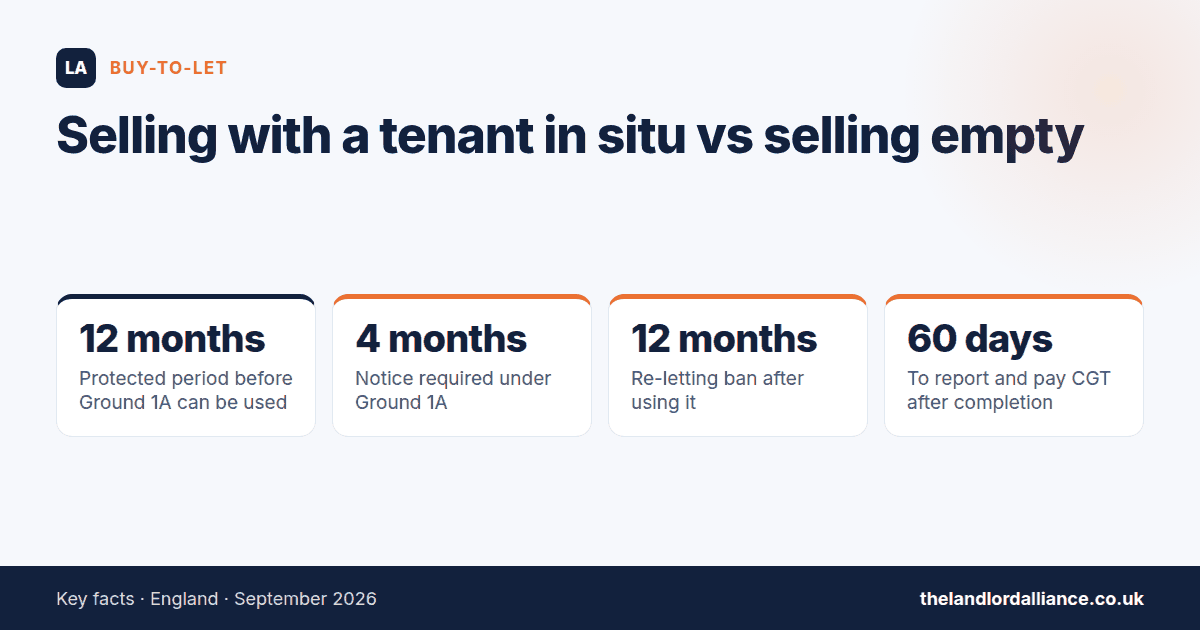
Since section 21 was abolished, getting a property empty to sell it is a project rather than a formality. Ground 1A cannot be used in the first twelve months of a tenancy, requires four months’ notice, and bans you from re-letting for twelve months afterwards — so a sale that falls through leaves you with an empty property you cannot legally let. Selling with the tenant in place avoids all of that and completes far faster, but narrows the buyer pool to investors and usually costs something on price. The right answer depends on the tenant, the property and how long you can afford to wait.
The two routes, side by side
| Vacant possession | Tenant in situ | |
|---|---|---|
| Buyer pool | Everyone — owner-occupiers, first-time buyers, investors | Investors and landlords only. No residential mortgage, no first-time buyer. |
| Price | Full open market | Typically a discount, varying by area and yield |
| Time to get to market | Four months’ notice minimum, longer if the tenant does not leave | Immediate |
| Income while selling | None once the tenant leaves | Rent continues to completion |
| Risk if the sale falls through | Severe — empty property, no rent, and you cannot re-let for 12 months | Minimal — the tenancy carries on |
| Condition on viewing | You control presentation | You do not |
| Deposit and paperwork | Returned and closed off | Transferred to the buyer — must be done correctly |
Route one: vacant possession
If the tenant will leave voluntarily, this is straightforward — agree a surrender in writing, confirm the date, deal with the deposit, and market the property. Most tenants are reasonable if given notice and treated well, and a modest incentive is usually cheaper than the alternative.
If they will not, you need Ground 1A, and the timeline is longer than most sellers expect:
- Twelve months from the start of the tenancy before the ground is available at all.
- Four months’ notice under Ground 1A.
- If the tenant stays past the notice date, a possession claim, and current court timescales add months again.
- If they still do not leave, bailiff enforcement on top.
Then, having obtained possession, you cannot re-let the property for twelve months. That obligation is the one to think hardest about, because it removes your fallback.
Do not serve notice on the strength of an unexchanged sale. If the buyer withdraws after your tenant has gone, you hold an empty property with a mortgage, no rent, and a legal bar on letting it again for a year. Where you can, exchange with a completion date that follows the possession date, rather than the other way round.
Route two: selling with the tenant in place
An investor buying a tenanted property is buying an income stream, so they price it on yield rather than on how the kitchen looks. That works in your favour on a well-let property at a sensible rent and against you where the rent is below market or the tenant is difficult.
What makes a tenanted sale attractive:
- A clean payment history, evidenced with a rent statement.
- Rent at or near market, since the buyer inherits it and can only raise it once a year by section 13.
- Complete compliance paperwork — deposit protection and prescribed information, gas, EICR, EPC, written statement of terms. Gaps here are repriced or used to renegotiate.
- A tenant who wants to stay. Continuity is the product.
What has to happen on completion: the tenancy transfers with the property, and so does the deposit. The buyer must protect it in their own scheme and serve fresh prescribed information — failing to do so exposes them to a penalty of up to three times the deposit, so expect their solicitor to press on it. Tell the tenant in writing who their landlord now is and where to pay the rent; there is a statutory duty to notify them of a change of landlord, and it is also simply how you avoid arrears in month one.
How to decide
| If this is true | Lean towards |
|---|---|
| Tenant wants to leave anyway, or will accept a surrender | Vacant possession — you get the full market without the risk |
| Good tenant, market rent, full paperwork | Tenanted sale — the discount is usually smaller than four months of void plus the risk |
| Rent well below market | Vacant possession if you can, since the buyer will price the shortfall in perpetuity |
| You need the money on a deadline | Tenanted sale — it is the only route with a predictable timeline |
| Property needs work to show well | Tenanted sale, or do the work after possession — but remember the 12-month re-letting ban |
| Tenancy is under twelve months old | Tenanted sale, because Ground 1A is not available to you yet |
Tax on the way out
Either route produces the same capital gains tax position. Gains are taxed at 18% within your remaining basic rate band and 24% above it, with a £3,000 annual exempt amount for 2026/27, and you must report and pay within 60 days of completion. Assemble the base cost, the buying and selling costs and every improvement invoice during the conveyancing — see capital gains tax when you sell a rental.
Read next
Can I sell a property with a tenant living in it?
Yes. The tenancy transfers to the buyer along with the property, and the tenant’s rights are unaffected. The buyer must be a cash buyer or use a buy-to-let mortgage.
How much less is a tenanted property worth?
It varies by area and yield. The right comparison is not against the vacant price alone, but against the vacant price minus four or more months of lost rent, the notice risk, and the cost of a failed sale.
Do I have to tell the tenant I am selling?
You are not required to seek their permission, but you must give proper notice for viewings and you must tell them in writing when the landlord changes. Telling them early and honestly usually produces far better cooperation.
What happens to the deposit?
It transfers with the tenancy. The buyer must protect it in a scheme in their own name and serve fresh prescribed information, or face a penalty of up to three times the deposit.
Can I use Ground 1A if I have only just let the property?
No. There is a twelve-month protected period at the start of a tenancy during which Grounds 1 and 1A cannot be used.
What if the sale falls through after I get possession?
You cannot re-let for twelve months from the date possession was obtained under Ground 1A. That is the single strongest argument for exchanging before the tenant leaves.
Sources. Renters’ Rights Act 2025 (c. 26) and GOV.UK guide to the Act, including the 12-month protected period and Ground 1A restrictions; Housing Act 1988 Schedule 2 as amended; Housing Act 2004 Part 6 on deposit protection; Landlord and Tenant Act 1985 section 3 on notifying a change of landlord; GOV.UK capital gains tax on UK property. Checked 8 September 2026.
Related: Buy-to-let · All guides · Landlord tax