The short version
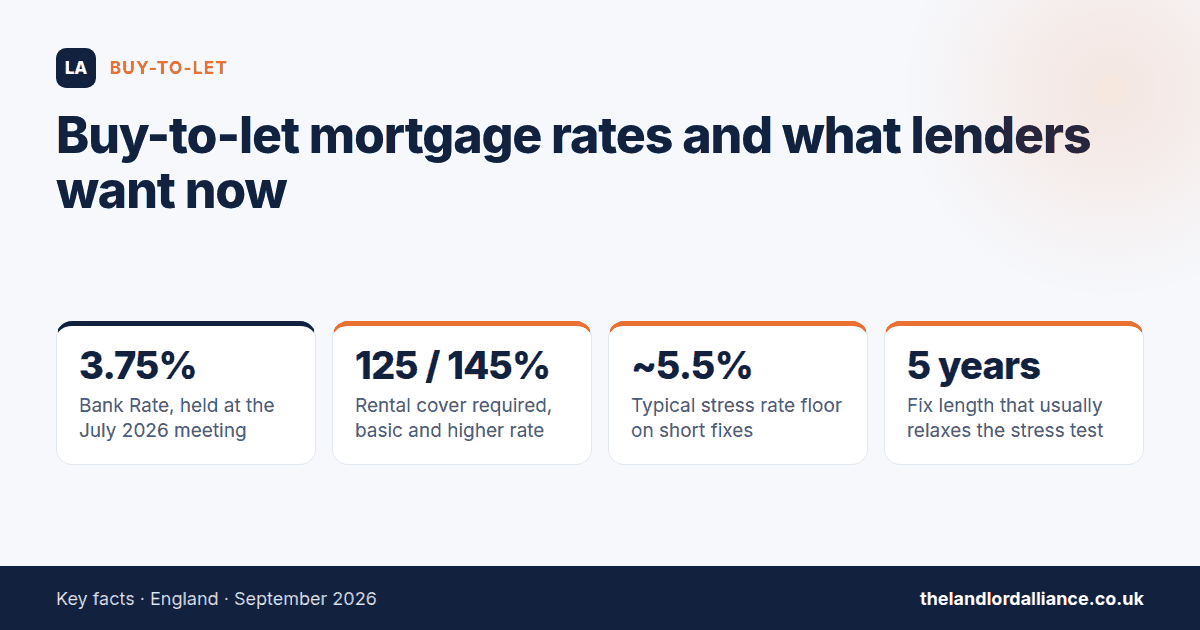
Two things decide a buy-to-let mortgage, and the advertised rate is only one of them. The first is the fee: the lowest headline rates in September 2026 carry arrangement fees running to several thousand pounds, often charged as a percentage of the loan, which can add more to the true cost than the rate saves. The second is the stress test, which decides how much you can borrow at all — rent must cover a stressed interest rate by 125% for a basic-rate borrower and 145% for a higher-rate one. That single difference can change a loan by tens of thousands of pounds on identical rent.
Where rates sit
Bank Rate has been held at 3.75% since the July 2026 meeting, with the next decision due in September. At the time of writing the sharpest advertised buy-to-let products sit around 3.1% on a two-year fix and 4.2% on a five-year, both at conservative loan-to-values and both carrying substantial fees.
Those headline numbers are not what most landlords pay. They are the products at the bottom of the best-buy table, available at lower loan-to-value, with the largest fees. A typical 75% loan-to-value product sits meaningfully above them.
Rates move daily. Anything quoted on a page like this is a snapshot, not a quote. Use the figures to understand the shape of the market, then get current numbers from a broker before you commit to anything.
Why the fee usually matters more than the rate
Buy-to-let arrangement fees are frequently charged as a percentage of the loan — commonly 3% to 5% on the sharpest-looking products. On a £150,000 loan, a 5% fee is £7,500. Spread over a two-year fix that is roughly 2.5 percentage points a year, which comfortably outweighs the half-point saved on the headline rate.
| Product | Rate | Fee | Interest over 2 years | Total cost |
|---|---|---|---|---|
| Low rate, high fee | 3.10% | £7,500 | £9,300 | £16,800 |
| Higher rate, low fee | 4.60% | £999 | £13,800 | £14,799 |
Adding the fee to the loan makes it worse again, because you then pay interest on it for the whole term rather than the two years you fixed for. That is often the right choice for cash flow, but it should be a decision rather than a default.
The stress test
Lenders do not size the loan on what you will actually pay. They apply an interest coverage ratio to a stressed interest rate.
| Borrower | Cover required | Rent needed on a £150,000 loan stressed at 5.5% |
|---|---|---|
| Basic-rate taxpayer | 125% | £859 a month |
| Higher-rate taxpayer | 145% | £997 a month |
| Limited company | Often 125% | £859 a month |
The stress rate itself is typically a floor of around 5.5%, or the product rate plus about two points, whichever is higher. The important exception: fixed terms of five years or more are usually assessed at or close to the pay rate instead.
This is why five-year fixes are so common in buy-to-let, and it is often not a view on interest rates at all. It is how the borrowing reaches the size the purchase needs. Landlords who assume a five-year fix is a bet on rates are missing the mechanism — and landlords who take one purely to pass the stress test should understand they are also accepting five years of early repayment charges.
What else lenders look at
- Minimum income. Many lenders want £25,000 of income outside the rent, though some will lend without it at lower loan-to-value.
- Deposit. 25% is the practical minimum; the best pricing starts around 40%.
- Property type. Flats above commercial premises, ex-local authority high-rise, non-standard construction and short leases all narrow the lender pool sharply.
- HMOs and multi-unit blocks. Priced higher, fewer lenders, and licensing status matters. See HMO licensing.
- Portfolio landlords. Four or more mortgaged buy-to-lets triggers portfolio underwriting: business plan, cash flow, and stress testing across the whole portfolio rather than just the property you are buying.
- Company structure. Limited company products price above personal ones with a smaller lender pool, and a personal guarantee is close to universal. See when a company pays.
Remortgaging in 2026
If you are coming off a fix taken in a cheaper market, the arithmetic has changed underneath you. Two things to do before the rate expires:
- Run the stress test at current rates, not the rate you have been paying. A loan that passed at 2% may not pass at a 5.5% stress, which can force a reduction in borrowing at exactly the moment you need to refinance.
- Start six months out. Most offers are valid for three to six months and rates can usually be secured early and reviewed downward if the market improves. Rolling onto a lender’s standard variable rate while you organise yourself is expensive.
Where the rent no longer supports the existing loan, the options are a product transfer with your current lender — which often avoids a fresh affordability assessment — a capital reduction, or a longer fix to relax the stress. A broker earns their fee in exactly this situation.
Read next
What deposit do I need for a buy-to-let?
Usually at least 25%, with better pricing from around 40%. In practice the stress test often decides the real answer before the deposit does.
Why is my rent not enough for the loan I want?
Because lenders stress the interest at around 5.5% and require the rent to cover it by 125% or 145% depending on your tax band. A five-year fix is usually assessed closer to the pay rate, which increases the loan available.
Should I take the lowest rate?
Not automatically. Compare total cost over the fixed term including the fee. A 3.1% product with a £7,500 fee can cost more than a 4.6% product with a £999 fee.
Do I need a minimum income?
Many lenders want around £25,000 outside the rental income, though not all. It is a lender-by-lender criterion rather than a rule.
What is a portfolio landlord?
Four or more mortgaged buy-to-let properties. It triggers additional underwriting across your whole portfolio, not just the property being financed.
Interest-only or repayment?
Most buy-to-let is interest-only, which maximises cash flow and, since only interest attracts the Section 24 credit, keeps the tax position simple. It also means the capital is still owed at the end, so have a plan for it.
Sources. Bank of England Bank Rate, maintained at 3.75% at the July 2026 MPC meeting; PRA supervisory statement SS13/16 on underwriting standards for buy-to-let mortgage contracts; published best-buy buy-to-let rates as at 6 September 2026. Rates and fees change daily — verify before committing. Checked 8 September 2026.
Related: Buy-to-let · All guides · Free calculators