Never evict without a warrant. Changing the locks, removing belongings or cutting off services to force a tenant out is unlawful eviction under the Protection from Eviction Act 1977 — a criminal offence carrying an unlimited fine and imprisonment, plus substantial civil damages. Whatever the provocation, the only lawful route is a court-appointed officer.
The short version
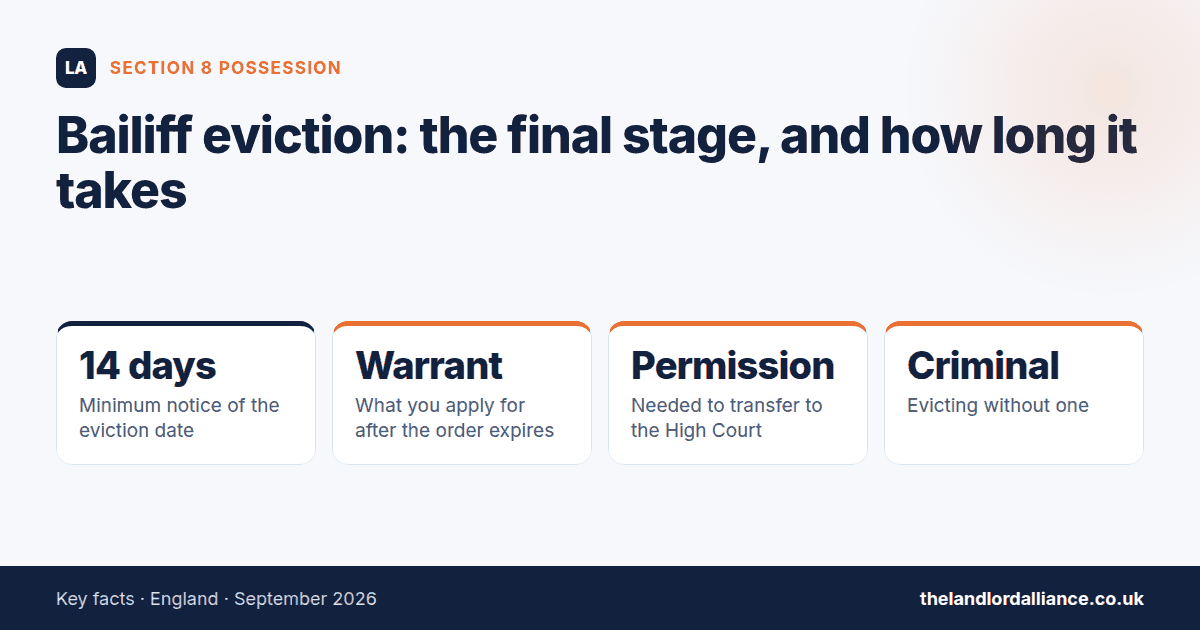
A possession order is not the end. If the tenant does not leave by the date on the order, you apply for a warrant of possession and a county court bailiff carries out the eviction. The tenant must be given at least 14 days’ notice of the eviction date. County court bailiff waiting times are the main variable and can run to several months in busy areas. Transferring the case to the High Court for enforcement by a High Court Enforcement Officer is usually faster but costs more and needs the court’s permission.
The sequence
| Stage | What happens | Typical time |
|---|---|---|
| 1. Possession order | The court orders the tenant to give up possession, usually within 14 days, or up to 6 weeks on exceptional hardship | — |
| 2. Order date passes | If the tenant leaves, it ends here. Most do. | 2–6 weeks |
| 3. Apply for a warrant of possession | Application and fee to the county court that made the order | Days |
| 4. Bailiff appointment issued | The court allocates a date, driven entirely by local bailiff capacity | Weeks to several months |
| 5. Notice of eviction | The tenant is given at least 14 days’ notice of the date | 14 days minimum |
| 6. Eviction | The bailiff attends, secures possession, and you change the locks | The day itself |
County court bailiff or High Court enforcement?
| County court bailiff | High Court Enforcement Officer | |
|---|---|---|
| How you get there | Warrant of possession from the court that made the order | Permission to transfer up, then a writ of possession |
| Speed | Slower — queue driven | Usually faster |
| Cost | Lower court fee | Higher, often several hundred pounds more |
| Recoverable from the tenant? | Usually added to the judgment | Recoverable in principle, rarely in practice |
| Practical note | The default route | Permission is not automatic and the tenant may be given the chance to object |
What can still go wrong
- The tenant applies to suspend the warrant. Common where the order was made on a discretionary ground or where arrears have been partly paid. A hearing is listed, sometimes at short notice, and the eviction may be postponed on terms.
- The warrant expires. Warrants have a life; if the eviction does not happen you may need to renew.
- The tenant leaves without telling you. Do not assume abandonment. Take the eviction date anyway, or take formal advice — retaking possession on an assumption is how landlords commit unlawful eviction by accident.
- Vulnerability or medical issues emerge on the day, which can stop an eviction and require it to be relisted.
On the day
- Attend, with a locksmith. The bailiff secures possession; you are responsible for changing the locks immediately.
- Bring a witness and photograph the property’s condition as you take it back.
- Do not remove or dispose of belongings. The tenant’s possessions remain theirs. There is a statutory process under the Torts (Interference with Goods) Act 1977 for goods left behind — written notice, a reasonable period, and only then disposal. Getting this wrong turns a completed eviction into a fresh claim against you.
- Deal with the deposit and any arrears separately. Possession does not resolve the money; that is a money claim.
The realistic timeline
From serving a section 8 notice on rent arrears to a completed bailiff eviction, four weeks’ notice plus the claim, the hearing, the order period and the bailiff queue routinely adds up to well over six months, and longer where the claim is defended. Since section 21 was abolished there is no accelerated route, which is precisely why referencing and early intervention on arrears matter more than they did.
Read next
How long does a bailiff eviction take?
The main variable is the court’s bailiff queue, which can run from a few weeks to several months. Add at least 14 days for the notice of eviction on top.
Can I change the locks once I have a possession order?
No. Not until the bailiff has executed the warrant and given you possession. Doing it earlier is unlawful eviction.
Is High Court enforcement worth it?
Often, if the bailiff queue is long and you are losing rent. It costs more and needs the court’s permission to transfer the case up.
Can the tenant stop the eviction?
They can apply to suspend the warrant. On discretionary grounds, or where arrears have been reduced, the court may postpone on terms.
What do I do with belongings left behind?
Follow the statutory process for uncollected goods: written notice, a reasonable period to collect, and only then disposal. Do not simply throw things away.
Do I still get the arrears?
Not automatically. A possession order may include a money judgment, but enforcing it is a separate exercise — see money claims.
Sources. Civil Procedure Rules Part 83, including the requirement to give notice of eviction; Protection from Eviction Act 1977; Torts (Interference with Goods) Act 1977; Housing Act 1988 Schedule 2 as amended; HMCTS guidance on warrants and writs of possession. Checked 8 September 2026.
Related: Section 8 grounds · Rent arrears · All guides