The short version
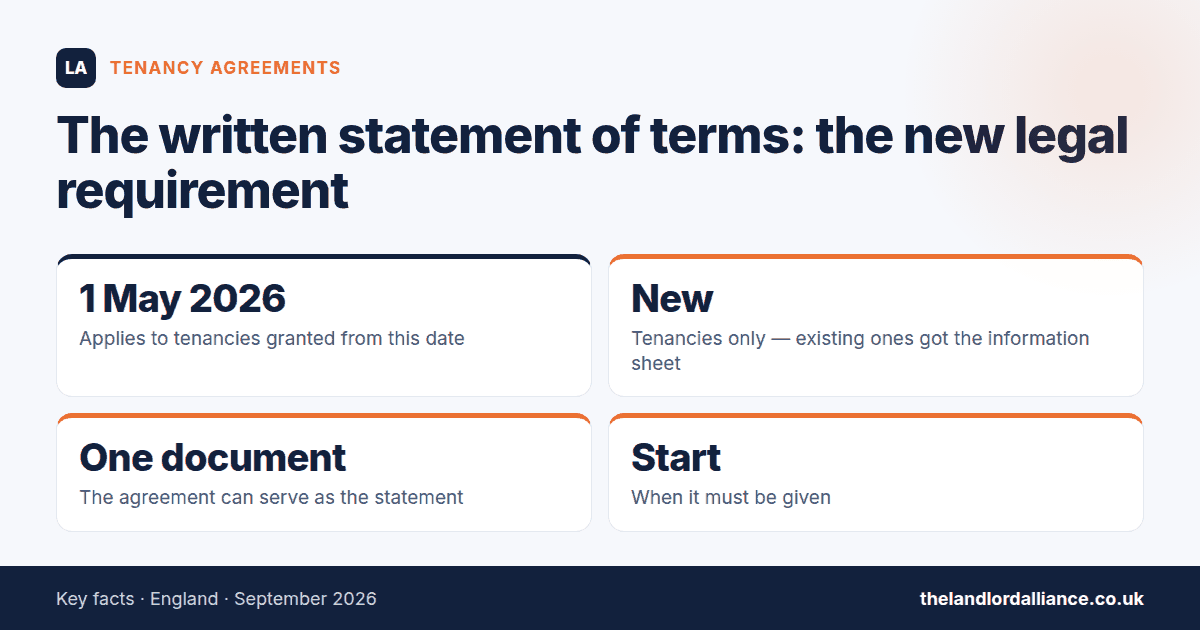
Every assured tenancy granted on or after 1 May 2026 requires the landlord to give the tenant a written statement of terms. For most landlords this is not an extra document — a properly drafted tenancy agreement does the job, provided it contains what the law requires and reflects the post-May 2026 rules. It is not the same as the Renters’ Rights Act information sheet, which was a one-off notice for tenancies that already existed on 1 May 2026 and had to be served by 31 May 2026.
Statement of terms or information sheet?
| Written statement of terms | Information sheet | |
|---|---|---|
| Applies to | Tenancies granted on or after 1 May 2026 | Tenancies that already existed on 1 May 2026 |
| What it is | The terms of your particular tenancy | A government-published explanation of what the Act changed |
| Who writes it | You | The government |
| Deadline | At the start of the tenancy | 31 May 2026 — now passed |
| Ongoing? | Yes, for every new tenancy | No — one-off |
What the statement must cover
The essentials, all of which a competent tenancy agreement already contains:
- The parties. Full names of the landlord and every tenant, including all joint tenants.
- The property. The full address of what is being let.
- The rent, the rent period, and how and when it is paid.
- The start date of the tenancy.
- That the tenancy is periodic — there is no fixed term.
- The deposit, the amount, and which scheme protects it.
- Repairing obligations, yours and the tenant’s.
- How notice is given by each side, reflecting the current rules.
- An address in England or Wales for service of notices on the landlord — a long-standing requirement under section 48 of the Landlord and Tenant Act 1987, and one landlords still forget.
Do not reuse a pre-2026 template. Agreements circulating online still contain fixed terms, break clauses, section 21 references, rent review clauses and blanket pet bans. Those terms are void, and a statement of terms full of void provisions is worse than useless — it misleads the tenant about their rights, which is exactly what the duty exists to prevent. Our template is drafted for the current rules.
What must not be in it
| Clause | Why it fails |
|---|---|
| A fixed term of any length | Abolished — all assured tenancies are periodic. See break clauses. |
| A break clause | Nothing left to break |
| Rent review or automatic uplift | Rent rises go through a section 13 notice, once a year |
| Blanket ban on pets | You cannot unreasonably refuse a request |
| “No DSS” or no children | Unlawful discrimination since 1 May 2026 |
| More than one month’s rent in advance | Capped |
| Rent periods longer than a month | Not permitted |
| A requirement for professional cleaning at the end | A prohibited payment under the Tenant Fees Act 2019 |
Serving it
Give it at the start of the tenancy, before or at the point the tenant takes occupation. Get it signed if you can; if you serve it electronically, make sure the tenant has agreed to receive documents that way and keep proof of sending.
Serve it alongside everything else that belongs at the start: the gas safety record, the EICR, the EPC, and the deposit prescribed information within 30 days of receiving the deposit. Our compliance checklist sets out the full list and the deadlines.
Read next
Is the tenancy agreement the statement of terms?
It can be, and for most landlords it is — provided it contains the required information and reflects the current law.
Do I need to give one to existing tenants?
No. Tenancies that already existed on 1 May 2026 required the information sheet instead, by 31 May 2026.
When must I give it?
At the start of the tenancy. Do not leave it until after the tenant has moved in.
Does it have to be signed?
Not necessarily, but a signature is useful evidence that it was given and agreed.
Can I serve it by email?
Yes, where the tenant has agreed to electronic service. Keep proof of sending.
What if I do not provide one?
It is a breach carrying a civil penalty. It also removes your best evidence of what was agreed, which tends to cost more in the long run than the penalty.
Sources. Renters’ Rights Act 2025 (c. 26), written statement of terms provisions, commenced 1 May 2026 by SI 2026/421; Landlord and Tenant Act 1987, section 48; Tenant Fees Act 2019; Consumer Rights Act 2015 Part 2. Checked 8 September 2026.
Related: Tenancy agreements · The Renters’ Rights Act · All guides