
The short version
Every private landlord in England with a property let on an assured or regulated tenancy must register themselves, and each of those properties, on a new government service called Register your rental property. It opens on 15 December 2026 in the West Midlands and reaches a new region every month. Each region gets three months, and the whole country must be registered by 14 November 2027. Registering yourself is free. Each property costs £65 a year, but the first payment is pro-rated, so many landlords will pay under £10 to start. You then have 28 days to upload your certificates and tenancy details, and 28 days to report any change after that. Fines go up to £7,000, or £40,000 for false information or repeated breaches.
I let property in Surrey, so my own window runs from 15 March to 14 June 2027. That felt a long way off until I went through what the service will ask for: every owner’s date of birth, the ownership type of each property, how many people live there and in how many households, the rent and how often it’s paid, which bills are included, licence details, and the latest gas, electrical and energy certificates with their dates. Most landlords I speak to could produce two-thirds of that today. The rest is in an agent’s inbox, a filing cabinet, or a certificate that quietly ran out.
This guide is built from the government’s own guidance for landlords, letting agents and third parties (published 29 October 2026 and updated on 4 November), the Housing Hub, and the Private Rented Sector Database Regulations 2026, which Parliament approved on 4 November. Where the guidance stops, I say so. There are five tools further down: a region and deadline checker for every property you own, a fee calculator that uses the government’s exact formula, a “who has to register” checker, a readiness checklist and a 28-day deadline calculator.
Free guide · 51 pages · England
Want it all in one place? Get The Ultimate Guide To The Landlord Register 2027
- Every field the service asks for, in a printable checklist
- Your whole portfolio on one page, sorted by deadline
- Every council in England matched to its region
- The agent agreement and joint-owner checklists
On this page
- What Register your rental property is
- Every region’s dates, and the checker
- Who has to register
- Which properties: empty, new lets and sales
- What it costs, and the fee calculator
- Everything you’ll be asked for
- How to register, step by step
- The 28-day rules
- What your letting agent can and can’t do
- If the landlord has died or lost capacity
- Fines, rent repayment and possession
- Who can see your information
- Six worked examples
- Eight mistakes that will catch people out
- Your action plan
- Questions landlords are asking
What is Register your rental property?
The landlord register the Renters’ Rights Act created, now with a name, a price and dates.
Register your rental property is the government’s online service for England’s new landlord register. The Renters’ Rights Act 2025 calls it the Private Rented Sector Database, and most landlords call it the landlord database or the landlord register. Private landlords must register themselves and each property let on an assured or regulated tenancy, pay £65 a year per property, and keep the details up to date. The Ministry of Housing, Communities and Local Government runs it.
Three things make it different from the accreditation schemes and voluntary registers landlords have seen before:
- It’s compulsory. Not registering is a breach of the Act, enforced by your local council with fines of up to £7,000.
- It’s about the property as much as the landlord. You register yourself once, then register each let property with its own certificates, rent and occupancy, and you keep it current. It’s a live record, not a one-off sign-up.
- It’s wired into the rest of the system. Rent repayment orders can follow certain breaches, and from winter 2027 a court won’t make a possession order unless the landlord and the property are registered.
You’ll sign in with GOV.UK One Login, the same account used for a growing list of government services, with the option of verifying your identity. If you can’t get online, there’s a paper application, and the government says a contact centre will help with registration and renewal once the service is live.
| At a glance | The position on 20 November 2026 |
|---|---|
| Service name | Register your rental property (the legal name is the Private Rented Sector Database) |
| Law | Renters’ Rights Act 2025, and the Private Rented Sector Database Regulations 2026 (approved by Parliament on 4 November 2026) Approved |
| Who registers | Private landlords of assured or regulated tenancies in England, including companies, charities and trusts |
| Opens | 15 December 2026, West Midlands first Date set |
| Everyone registered by | 14 November 2027 (South West deadline) |
| Window per region | Three months. You can register before your region opens |
| Cost | Free for you as a landlord. £65 per property per year, no VAT, pro-rated during the rollout |
| Your numbers | A landlord number in the format L-XXXX-XXXX, and a rental property number P-XXXX-XXXX for each property |
| Ongoing duty | Report changes within 28 days, and renew every year |
| Enforced by | Local councils, once a region’s deadline has passed |
One register, several names
| You’ll hear | What it means |
|---|---|
| Register your rental property | The name of the GOV.UK service you’ll actually use |
| Private Rented Sector Database (PRS database) | The legal name, in the Renters’ Rights Act 2025 and the 2026 regulations |
| Landlord database or landlord register | What most landlords, agents and councils call it |
| Property portal | The name in the government’s 2022 white paper, before the Renters (Reform) Bill called it the Private Rented Sector Database |
They’re all the same thing. The one it isn’t is the database of rogue landlords and property agents, a separate government list of landlords and agents with banning orders or certain convictions.
If you want the background, why the register exists and how it fits into the rest of the Renters’ Rights Act, my guide to the PRS database covers that in depth. This page is about doing it: when, how, and what it will cost you.
When do I have to register? Every region’s dates
Nine regions, one a month. The property’s location decides the date, not where you live.
The service opens on 15 December 2026, but the legal duty arrives one region at a time. Each region gets a three-month window. Properties that are let must be registered by the end of their region’s window: the government says the end date means before midnight on that day.
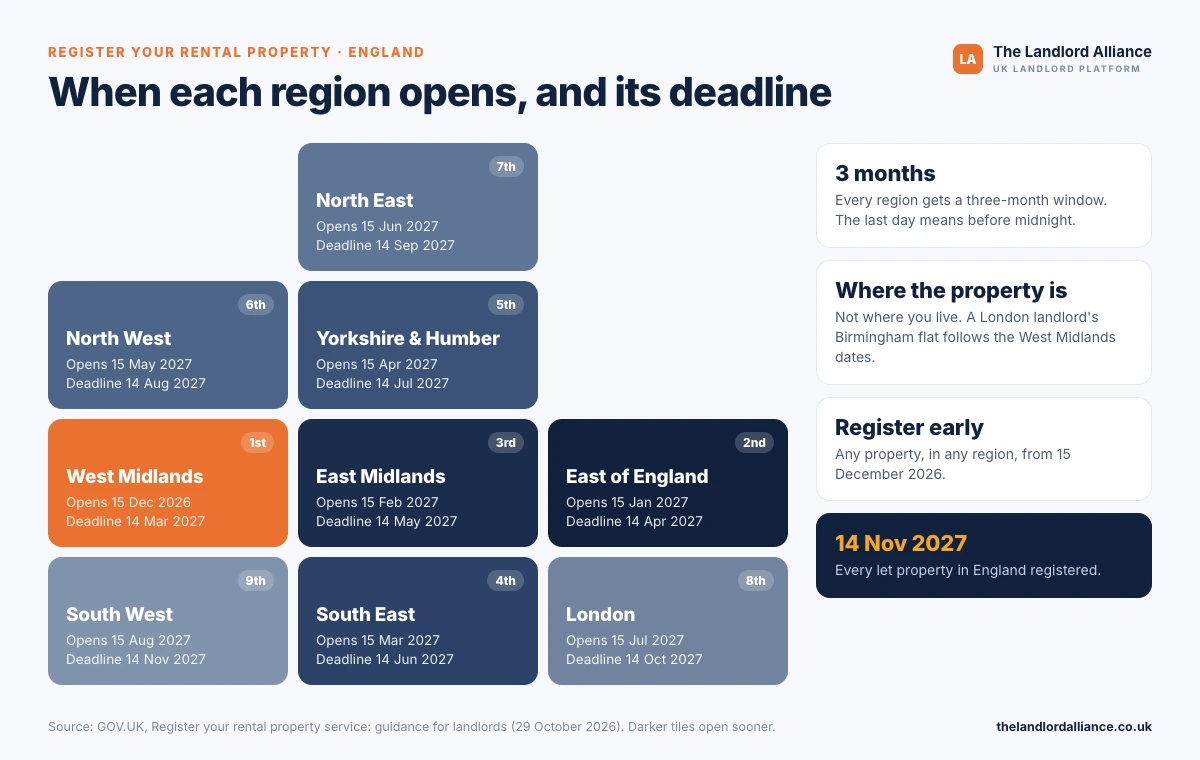
| Order | Region the property is in | Registration opens | Last day to register |
|---|---|---|---|
| 1st | West Midlands | 15 December 2026 | 14 March 2027 |
| 2nd | East of England | 15 January 2027 | 14 April 2027 |
| 3rd | East Midlands | 15 February 2027 | 14 May 2027 |
| 4th | South East | 15 March 2027 | 14 June 2027 |
| 5th | Yorkshire and the Humber | 15 April 2027 | 14 July 2027 |
| 6th | North West | 15 May 2027 | 14 August 2027 |
| 7th | North East | 15 June 2027 | 14 September 2027 |
| 8th | London | 15 July 2027 | 14 October 2027 |
| 9th | South West | 15 August 2027 | 14 November 2027 |
Two rules decide everything about timing:
- It’s where the property is. The government’s own example: if you live in London but your rental property is in Birmingham, that property follows the West Midlands timetable. A landlord with homes in three regions has three deadlines.
- You can register early. Any property in England can be registered from 15 December 2026, whatever its region. If you own in several regions, you can register them all at once, as long as none is registered after its own region’s deadline.
Regions are defined by council. The government has published a list of every county, unitary and London borough council against its region. If you know your district council but not your county, the postcode checker below sorts that out for you.
Dates from GOV.UK’s guidance for landlords (29 October 2026). The last day means before midnight. The service opens on 15 December 2026 for every region.
Set your own date four weeks early. The published deadline is the day you’re in breach, not a target. If a gas safety record or EICR turns out to have expired when you go to upload it, four weeks is about what it takes to get an engineer out, have any remedial work done and get the paperwork back. The checker’s calendar file includes that earlier reminder.
Who has to register?
Every landlord of an assured or regulated tenancy in England, including joint owners, companies and trusts.
The duty falls on private landlords renting out a property in England that’s occupied by tenants on an assured or regulated tenancy. Since 1 May 2026, every new private tenancy in England is an assured periodic tenancy, so in practice that’s the normal let: a house or flat rented to people who live there as their home. Regulated tenancies are the older, pre-1989 protected tenancies that still exist in some properties.
If you own on your own
You register as an individual landlord, whether you let in your own name or as a sole trader. You’ll give your name, date of birth, residential address, phone number and email.
If you own with someone else
Every joint landlord must register. One of you registers the property, then invites the others onto that property’s registration. And the rule that matters most for couples: the government says that if you own part of a rental property and are entitled to possession of it, you must register as a joint landlord even if you’re not named on the tenancy agreement. Leaving a spouse off the tenancy doesn’t take them out of the register.
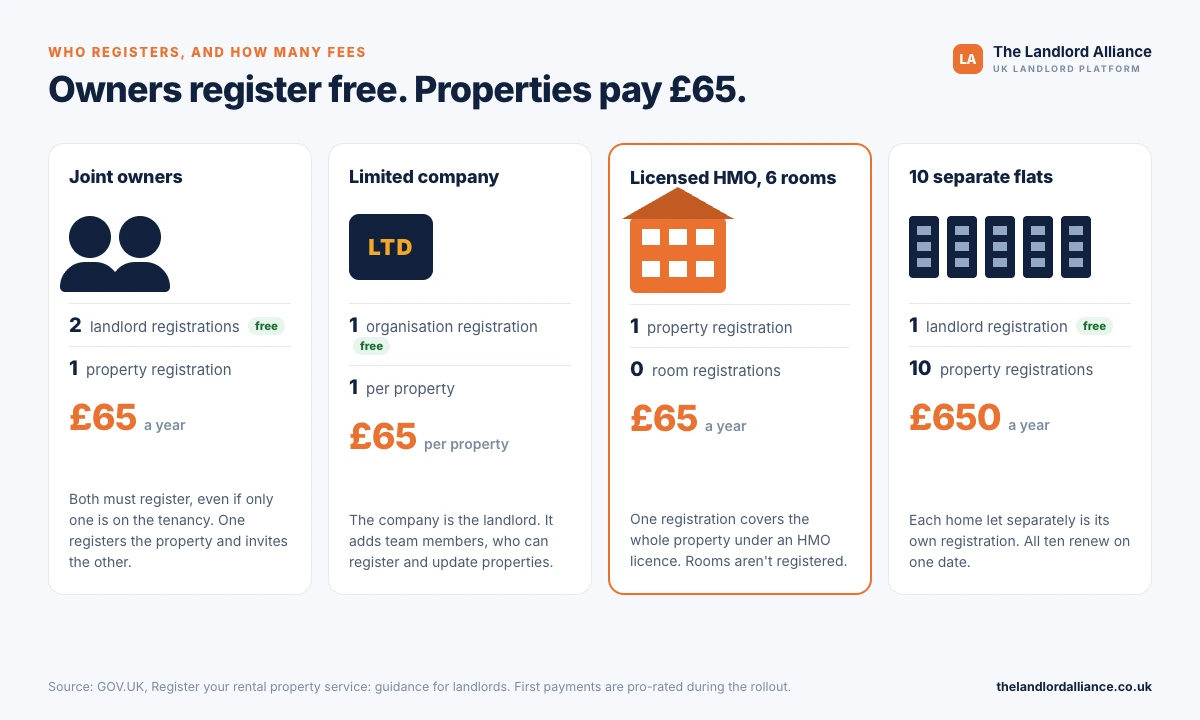
The fee follows the property, not the people. Two owners of one buy-to-let have two free landlord registrations and one property registration, so one £65 fee.
If a company, charity or trust owns it
The organisation registers as an organisation landlord. That covers limited companies, charities, trusts, limited liability partnerships and Scottish partnerships. Anyone in the organisation can register it, then add team members, who can register and update properties. You’ll give the organisation’s name and legal type, its address (not a PO box), a nominated contact and its Companies House or charity number where it has one. If there’s no Companies House number, you give the names, dates of birth and addresses of all the directors, trustees, partners or governing body members. For a trust, the lead trustee’s details are needed.
The company is the landlord. A director doesn’t register personally just for being a director, though the person who makes the entry gives their own name, date of birth and contact details too.
If you’re in a partnership
This one trips people up. Members of an English business partnership who rent out property together register as individuals and follow the joint landlord rules, because an English partnership isn’t a separate legal person. An LLP or a Scottish partnership is, so it registers as an organisation and gives details of all its partners.
Who doesn’t register
- Supported exempt accommodation, as defined in section 12 of the Supported Housing (Regulatory Oversight) Act 2023, is the only exemption written into the regulations.
- Lettings that aren’t assured or regulated tenancies. The duty only bites on those two kinds of tenancy. A lodger who lives in your own home, a genuine holiday let, and a let to a company rather than to people are generally not assured tenancies, so they’re generally outside the register. Edge cases exist, so if you’re relying on one of these, check how your particular arrangement is classed.
- Social landlords. The service is for private landlords. Council and housing association homes are outside it.
- Landlords with banning orders. The government says landlords with a live banning order may not be allowed to register, depending on the order’s conditions.
Based on the government’s guidance for landlords. General information, not legal advice: whether a particular letting is an assured tenancy depends on its facts.
Which properties: empty homes, new lets and sales
During the rollout only let properties must be registered. That changes later.
During the rollout, from 15 December 2026 to 14 November 2027, you only have to register properties that are let, or that become let during that period. An empty buy-to-let sitting between tenants doesn’t have to be registered just because you own it. The government’s guidance for agents puts it precisely: you register properties let on an assured periodic or regulated tenancy at their region’s deadline, and properties that become let after that deadline.
That’s going to change. The government says that in future, under new legislation, an empty property will have to be registered before you or your agent market it to let, and adverts will have to show both the landlord number and the property number. That requirement isn’t in force yet, and the government says it will update its guidance before it is. You can put your numbers on adverts now if you want to.
Register now (during the rollout)
- Every property let on an assured or regulated tenancy
- A property that becomes let during the rollout
- A licensed HMO, once, as a single property
- Each self-contained flat you let separately
Not yet required
- A property that stays empty throughout the rollout
- Your numbers on adverts (coming later)
- Supported exempt accommodation (exempt)
- Lettings that aren’t assured or regulated tenancies
Selling a let property
The regulations allow only one active registration per property at a time, with one exception built for sales: once contracts have been exchanged, while the property is still let, the buyer can register it before completion if they want to market it. On completion the new owner becomes the landlord with their own registration duty.
Register yourself, then your property
The order matters. A property registration needs an active landlord registration behind it, so you register yourself first. Don’t then leave it: the regulations say a landlord registration goes inactive if no property is added within three months, and it also goes inactive when your last active property registration does.
How much does it cost to register a rental property?
£65 per property per year. Your first payment is pro-rated, and usually far smaller.
Registering yourself as a landlord is free. Each property costs £65 a year, paid when you register it and then every year to keep it on the service. There’s no VAT. Updating your details is free. The government says the fee is tax-deductible, and points you to HMRC’s guidance when you do your tax return. The money pays for running the service and for tackling non-compliance, including council enforcement.
Three details decide what you’ll actually pay:
1. The fee is per property, not per owner or per room
Joint owners pay once per property. A licensed HMO is a single registration: the government says one registration covers the whole property under an HMO licence, and rooms aren’t registered individually. Ten separate flats are ten registrations.
2. Every property shares one renewal date
Your renewal date is one year after you register your first property. Every property you add after that takes the same renewal date, so a second property registered two months later renews with the first. You pay a part-year fee for it at the start, and from then on the whole portfolio renews together.
3. During the rollout, you’re never charged for days before 15 November 2027
Because some regions have to register almost a year before others, the government pro-rates the fee so nobody pays more for being early. It ignores every day before 15 November 2027, the date by which everyone must be registered. In practice, your first payment only covers the days from 15 November 2027 to your renewal date.
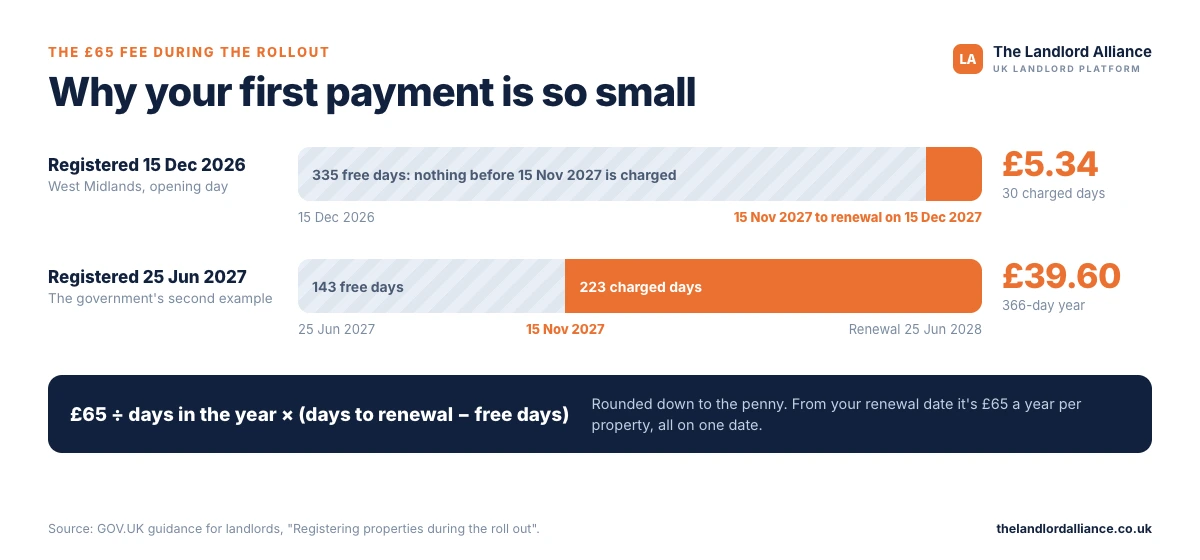
The government’s formula is: fee ÷ days in the year × (days to your renewal − free days), with the answer always rounded down to the penny. It gives two worked examples:
| Registered on | Renewal date | Days in the year | Free days (before 15 Nov 2027) | First payment |
|---|---|---|---|---|
| 15 December 2026 | 15 December 2027 | 365 | 335 | £5.34 |
| 25 June 2027 | 25 June 2028 | 366 (leap year) | 143 | £39.60 |
Here’s the bit the headlines miss: registering early doesn’t save you money overall, and registering late doesn’t cost you more. Either way you’re paying £65 a year from 15 November 2027. Early registration just means a smaller first payment and an earlier renewal. Choose your date for convenience and peace of mind, not to game the fee.
Formula and examples from GOV.UK’s guidance for landlords, “Registering properties during the roll out”. Assumes the fee stays at £65; the government can review it. Renewal shown as the same date a year after your first registration, as in the government’s examples.
What it costs from year two
Once the rollout is over, it’s simply £65 per property every year, on one renewal date:
| Properties | Every year | A month, for budgeting | Over five years |
|---|---|---|---|
| 1 | £65 | £5.42 | £325 |
| 2 | £130 | £10.83 | £650 |
| 3 | £195 | £16.25 | £975 |
| 5 | £325 | £27.08 | £1,625 |
| 10 | £650 | £54.17 | £3,250 |
| 20 | £1,300 | £108.33 | £6,500 |
| 50 | £3,250 | £270.83 | £16,250 |
Five-year totals assume the fee doesn’t change, which is an assumption rather than a promise: the regulations let the operator set the fee by reference to its costs. Put it in the same column as insurance and the gas safety check, a standing annual cost, and if your agent charges an admin fee for helping, keep that separate so you can see what each is costing you.
Everything you’ll be asked for
The government’s list, field by field. Gather it before your window opens.
The service asks for information in stages. First you (or your organisation), then each property’s basic details, which is enough to pay the fee and get your rental property number. Then the tenancy, rent and safety details, which you can give straight away or within 28 days. Here’s the full list from the Housing Hub and the regulations.
About you
| Who you are | What you’ll give |
|---|---|
| Individual landlord | Name, date of birth, residential address, telephone number, email address |
| Organisation landlord | Organisation name (or the name it’s known by) and its legal type; address (not a PO box), phone and email; the name, date of birth, email and phone of the person making the entry; a nominated contact’s name, email and phone; Companies House and/or charity number where applicable |
| No Companies House number? | Names, dates of birth and addresses of all directors, trustees, partners or governing body members |
| A trust | The lead trustee’s name, date of birth, address, email and phone |
| Acting for someone else | Your capacity (attorney, personal representative, deputy and so on), your contact details, and a certified or sealed copy of your authority |
About each property
| Stage | What you’ll give | When |
|---|---|---|
| Property basics | The address; the landlord’s name; a correspondence address in England or Wales (not a PO box) and an email; ownership type and property type; number of bedrooms; whether it’s let now; the name and email of any freeholder, superior landlord and property manager | When you register, before you pay |
| Tenancy | Number of people living there and number of households; whether an HMO, additional or selective licence is needed, and how many; whether it’s let furnished, part-furnished or unfurnished | Now, or within 28 days |
| Rent | The rent and how often it’s paid; whether it includes any bills, and which | Now, or within 28 days |
| Gas | A copy of the gas safety record and its issue date, if the property has a gas supply | Now, or within 28 days |
| Electrical | A copy of the EICR (or EIC for new wiring) and its expiry date | Now, or within 28 days |
| Energy | Whether a valid EPC had to be given to the current tenant, and a copy of the latest EPC. If it’s no longer valid, the date the current tenancy started. If the rating is below the minimum, whether a MEES exemption is registered, and which type | Now, or within 28 days |
Four details in that list deserve a second look:
- No gas, no gas record. The gas safety record is only needed if the property has a gas supply. An all-electric flat isn’t expected to produce one.
- The EPC questions are about the current tenancy. A certificate that expired during a tenancy isn’t automatically a problem, because the duty is to give a valid EPC when the tenancy starts. That’s why the service asks when the current tenancy began. If your rating is below the minimum E, it asks whether you’ve registered an exemption. My EPC guide for landlords covers the rules.
- The correspondence address must be in England or Wales. Overseas landlords will need a UK address, such as an agent’s.
- Licences are asked about, not replaced. Registration doesn’t remove any HMO, additional or selective licensing requirement. Use the licensing checker if you’re not sure whether your property needs one.
0 of 16 ready
How to register, step by step
From One Login to a complete registration, in the order the service works.
After that, the registration is a living record. You update it within 28 days whenever something changes, and you renew once a year on your shared renewal date. The government says it will add features over time, and will contact registered landlords about important changes, including to its privacy notice.
The 28-day rules
The biggest trap isn’t registering. It’s what happens afterwards.
Registering is a morning’s work. Keeping it right for years is the real job, because the regulations set several 28-day clocks, and missing one can make a registration inactive, which leaves you renting out an unregistered property.
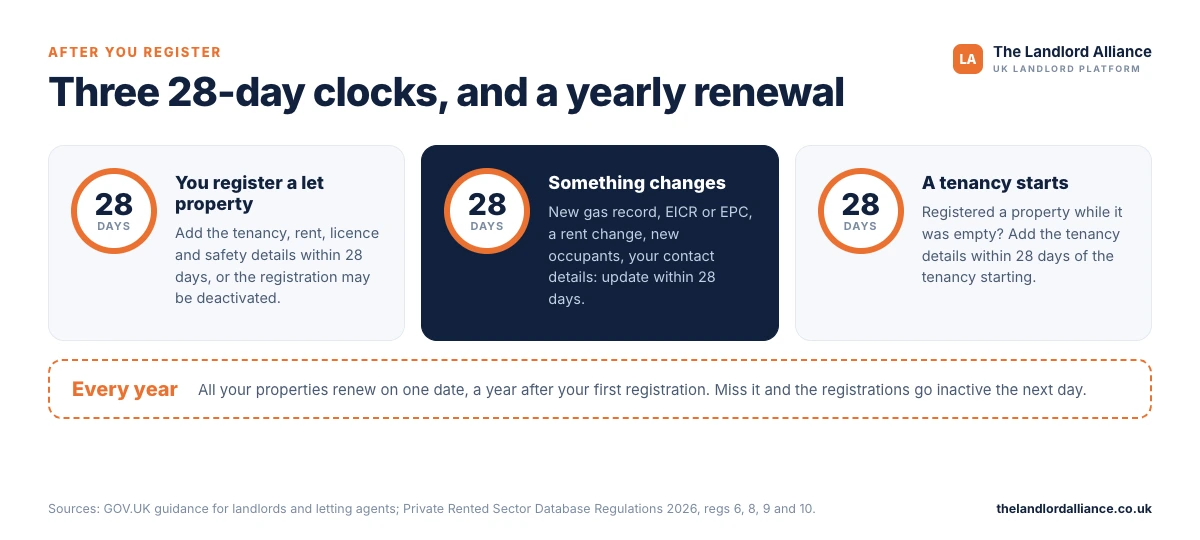
| The clock | Starts when | What happens if you miss it |
|---|---|---|
| Finish the property details | You register a let property without the tenancy, rent and safety details | The property registration may be deactivated. The government says this could put you in breach if the property is rented out |
| Report a change | Anything you’ve told the service becomes out of date: a new gas record or EICR, a new EPC, a rent change, a change of occupants, your own contact details | You’re in breach of the duty to keep the record current. Continuing or repeated breaches of certain requirements can carry a penalty of up to £40,000 |
| A tenancy starts | A tenancy begins in a property you registered while it was empty | The tenancy, rent and safety details must be added within 28 days |
| Renewal | Your shared renewal date comes round | A registration that isn’t renewed and paid for by the renewal date becomes inactive the next day |
28 days counted from the date of the change, per the government’s guidance. If you’re near the limit, don’t cut it fine: update the same week.
The certificate trap. Gas safety records last a year, EICRs usually five, EPCs ten. Each renewal is a change the register has to hear about within 28 days. A landlord with ten properties can expect ten gas updates a year, a couple of EICRs and the odd EPC, plus every rent review and change of tenant. That’s the work that will catch people out, and it’s why it pays to know every expiry date in advance.
Can my letting agent register for me?
No. They can fill in and keep up most of the property details once you’ve started.
Your agent can’t start a registration or pay for it. The government is clear that landlords must start every property registration and pay the fee. Once a property has its registration number, you can give your agent access to enter and update the tenancy and safety details on your behalf. You stay legally responsible either way.
Your agent can
- Add HMO, additional or selective licence details
- Add the number of tenants and households
- Say whether it’s furnished, part-furnished or unfurnished
- Add the rent and any bills included
- Upload the gas record, EICR or EIC, and EPC with their dates
- Keep all of those updated as they change
Your agent can’t
- Register you as a landlord
- Start a property registration
- Pay the £65 fee
- Take on your legal responsibility
- Reset their own password: you cancel the link and send a new one
Here’s how access works. After you’ve registered and paid for a property, you give the service your agency’s email address. It sends a link for that property, and every property gets its own link. The first time someone at the agency opens it, they set a password. From then on anyone at the agency with the link and the password can update it, so their lettings and compliance teams can each look after their own sections. You’re notified of anything the agent submits. The agent is responsible for the accuracy of what they put in, and must belong to a government-approved redress scheme to do lettings or management work at all.
But if they don’t update it, it’s still your problem. “My agent forgot” isn’t a defence the guidance gives you. Agree in writing who uploads what, and who updates each item when it changes. The free guide has a one-page agent agreement for exactly that.
If the landlord has died, lost capacity or gone bust
Who can register on someone else’s behalf, and what they’ll need.
Some third parties can register a landlord and their properties, or update them, if they have legal authority over the landlord’s property. The government lists:
| Who can act | Typical evidence |
|---|---|
| An attorney under a power of attorney | The power of attorney document |
| A personal representative of someone who has died | The grant of probate or letters of administration |
| A court-appointed deputy, or a guardian | The court order |
| A receiver, administrative receiver or administrator | The deed, certificate or instrument of appointment |
| A trustee in bankruptcy | The bankruptcy order or certificate of appointment |
| A liquidator or provisional liquidator | The notice or instrument of appointment |
| A mortgage lender, or someone it appoints | The mortgage deed |
| Someone in an equivalent role outside England and Wales | The equivalent foreign document |
You’ll need a certified or sealed copy of the evidence. At launch, third parties contact the department and are guided through it, rather than using an online journey. Usually the landlord stays legally responsible and the third party has no duty to register them. The exception is where the third party has become the landlord, such as a personal representative dealing with an estate, or a trustee in bankruptcy, and then they also provide the tenancy and safety details.
What happens if you don’t register?
Fines from the council, rent repayment in some cases, and later a block on possession.
If you don’t register, your council can fine you up to £7,000. Knowingly or recklessly giving false or misleading information, or continuing or repeated breaches of certain requirements, can mean a penalty of up to £40,000. Councils can start enforcement in a region once its registration deadline has passed.
| Consequence | What triggers it | Who decides | From |
|---|---|---|---|
| Penalty up to £7,000 | Failing to register yourself and your property | Your local council | After your region’s deadline Date set |
| Penalty up to £40,000 | Knowingly or recklessly giving false or misleading information, or continuing or repeated breaches of certain requirements | Your local council | After your region’s deadline Date set |
| Rent repayment order | The same serious breaches: false or misleading information given knowingly or recklessly, or continuing or repeated breaches. Only once the registration period for the property’s area has opened | The First-tier Tribunal, on the tenant’s application | 15 December 2026 onwards Date set |
| No possession order | The landlord and property aren’t registered | The court | Winter 2027 Date to come |
Two things are worth being precise about, because they’re widely mis-stated:
- £40,000 isn’t the fine for forgetting. The basic failure to register carries up to £7,000. The £40,000 maximum is for false information or continuing and repeated breaches.
- The possession restriction isn’t in force from December 2026. The government says that from winter 2027 a property and its landlord must be registered before a court can make a possession order. That will be written into section 7 of the Housing Act 1988, and the government says it will publish more guidance before it starts. But once it does, an unregistered property means you can’t get it back through the courts, which is a bigger risk than any fine.
The register sits alongside your other duties rather than replacing them. A licence is still a licence, and a protected deposit is still required. My guide to the section 8 grounds for possession explains how possession works now that section 21 has gone.
Who can see your information?
Not the public, for now.
The government says landlord and property information isn’t currently shared publicly, though some of it may become publicly viewable in future. It has said future legislation will add a public interface, so tenants can check whether a landlord, or a would-be landlord, is registered. Information can also be shared with other agencies where the law requires or allows it, and your council will use it for enforcement. A privacy notice explains how your data is used, and the government says it will be updated before any change takes effect.
So the honest answer is: today, your council and the government can see it, and the public can’t. Expect that to change, and assume that anything you enter could one day be checked against what you’ve told a tenant, your lender or HMRC.
Six worked examples
Real situations, worked through with the government’s rules and fee formula.
A London landlord with one flat in Birmingham
The flat follows the West Midlands timetable: registration opens 15 December 2026 and must be done by 14 March 2027. She registers herself and the flat on opening day. Her first payment is £5.34 and she renews on 15 December 2027 at £65. Her own home in London isn’t let, so it isn’t registered.
A married couple who jointly own a buy-to-let in Leeds
Only the husband is named on the tenancy, but both own the house and are entitled to possession, so both must register as landlords. That’s free. He registers the house and invites her onto it. Yorkshire and the Humber opens on 15 April 2027, with a deadline of 14 July. If they register on 1 May 2027 they pay one fee of £29.83, then £65 a year from 1 May 2028.
A limited company with five flats in Bristol
The company registers as an organisation landlord with its Companies House number. A director makes the entry, adds the company’s bookkeeper as a team member, and registers all five flats. The South West window runs from 15 August to 14 November 2027. Registering on 1 September 2027 costs £51.68 per flat, £258.40 in total, then £325 a year from 1 September 2028.
A licensed six-bedroom HMO in Nottingham
One property registration and one fee, not six. The registration records six occupants in six households, the HMO licence, and the gas, electrical and EPC certificates. East Midlands opens on 15 February 2027, with a deadline of 14 May. Registered on 1 March 2027, the first payment is £19.00.
A flat in Manchester that’s empty between tenants
If it stays empty throughout the rollout it doesn’t have to be registered yet. If a new tenant moves in, it becomes a let property that must be registered. The North West deadline is 14 August 2027. If it’s let after that, the safe course is to register it before the tenancy starts, then add the tenancy details within 28 days of the start.
Six properties in three regions, with an agent
Three in the West Midlands, two in the South East and one in London. The landlord registers all six on 15 January 2027, inside the first window and well ahead of the other two. Each costs £10.86, £65.16 in total, and the whole portfolio renews together on 15 January 2028. He then sends his agent a link for each property, so the agent can upload certificates and keep the rent and tenant details current.
Eight mistakes that will catch landlords out
Most of them happen after registration, not before it.
- Registering the property but not finishing it. The basics get you a number. Without the tenancy, rent and safety details within 28 days, the registration may be deactivated.
- Forgetting the joint owner. Every joint landlord registers, named on the tenancy or not.
- Using the wrong region. It’s where the property is, not where you live. Run every postcode through the checker above.
- Uploading an expired certificate, or none. If your gas record or EICR has lapsed, the register will show it. Fix the certificate first.
- Leaving it to the agent, with nothing in writing. The agent can upload the details, but you’re the one who’ll be fined.
- Forgetting the updates. Every new gas record, rent change and change of occupants starts a 28-day clock.
- Missing the renewal. Every property shares one renewal date. Miss it and they all go inactive the next day.
- Leaving it to the last week. One Login, identity checks and missing documents all take time, and every landlord in your region will be doing the same thing.
Your action plan
What to do this week, this month and before your window opens.
| When | Do this |
|---|---|
| This week | Run every property’s postcode through the checker and note each deadline, with a reminder four weeks earlier. Set up a GOV.UK One Login if you don’t have one. |
| This month | Build one file per property: ownership and joint owners, the tenancy, rent and frequency, occupants and households, licences, and the gas, electrical and EPC certificates with their dates. Chase any expired certificate now. |
| Before your window | Tell every joint owner they must register too. Agree in writing with your agent who uploads and updates each item. Budget £65 per property a year. |
| When it opens | Register yourself, then every property, and pay. Finish the details the same day if you can, and in any case within 28 days. Invite joint owners. Send your agent their links. |
| Every year after | Report changes within 28 days, renew on your renewal date, and keep every expiry date where you can see it. |
Print the whole plan. The free guide has the portfolio schedule, a document pack for each property, the agent agreement and every council’s region. Get the free landlord register guide.
Questions landlords are asking about Register your rental property
When does the landlord register start?
Register your rental property opens on 15 December 2026, starting with the West Midlands. A new region’s three-month window opens on the 15th of each month after that, ending with the South West, whose deadline is 14 November 2027.
Is the landlord database the same as Register your rental property?
Yes. Register your rental property is the name of the GOV.UK service. The law calls it the Private Rented Sector Database, often shortened to the PRS database, and most landlords call it the landlord database or the landlord register. They’re all the same thing.
How much does it cost to register a rental property?
£65 per property per year, with no VAT. Registering yourself as a landlord is free, and so are updates. During the rollout the first payment is pro-rated: the government’s example of a property registered on 15 December 2026 comes to £5.34.
My wife and I jointly own the property. Do we both register?
Yes. Each joint landlord must register. One of you registers the property and invites the other onto it.
Do joint owners both pay £65?
No. The fee is per property, not per owner. Your landlord registrations are free, and the one property registration carries one fee.
My partner isn’t named on the tenancy. Do they still need to register?
If they own part of the property and are entitled to possession of it, yes. The government says this applies even if they’re not named on the tenancy agreement.
My limited company owns the property. Do I register personally?
The company registers as an organisation landlord and adds its properties and team members. The person making the entry gives their own details, but a director doesn’t register as a landlord just for being a director.
Is a six-bedroom HMO six fees?
No. One registration covers the whole property under an HMO licence, and rooms aren’t registered individually.
I have ten separate flats. Is that one registration?
No. Each property you let separately needs its own registration and its own fee, so ten flats are ten registrations, all renewing on the same date.
Can my letting agent register me?
No. You must start each property registration and pay. Once the property has its number, you can give your agent a link to add and update the tenancy and safety details.
My agent forgot to update the gas safety certificate. Who’s responsible?
You are. The landlord remains responsible for making sure the information is provided and kept up to date, even when an agent is doing the uploading.
My property is empty. Do I have to register it?
Not during the rollout, unless it’s let or becomes let before 14 November 2027. In future, under new legislation, empty properties will have to be registered before they’re marketed to let.
Can I register before my region opens?
Yes. Any property in England can be registered from 15 December 2026, and if you own in several regions you can register them together, as long as none is registered after its own region’s deadline.
Do I have to renew every year?
Yes. All your properties share one renewal date, a year after you register your first one, and each property’s £65 is due then. A registration that isn’t renewed becomes inactive the day after the renewal date.
What if my EPC, EICR or gas certificate changes?
Update the register within 28 days of the change. The same applies to rent, the number of occupants, and your own contact details.
Can I be fined £40,000 just for forgetting to register?
No. The penalty for failing to register is up to £7,000. Up to £40,000 applies to knowingly or recklessly giving false or misleading information, or continuing or repeated breaches of certain requirements.
Can I still evict if I’m not registered?
Until the possession restriction starts, yes, if you have grounds. The government says that from winter 2027 a court won’t make a possession order unless the landlord and property are registered. Register anyway: you’ll be fined long before then.
Will tenants be able to see my details?
Not at launch. The government says information isn’t currently shared publicly, but some may be in future, and future legislation will let tenants check whether a landlord is registered.
Does this apply in Wales or Scotland?
No, England only. Wales has Rent Smart Wales, Scotland has landlord registration, and Northern Ireland has its own landlord registration scheme.
Never miss a 28-day deadline
The register only stays right if you know when every certificate expires. The Landlord Alliance keeps every property, tenancy, rent and certificate in one place, reminds you before a gas record, EICR or EPC runs out, and stores the documents you’ll need to upload. From £10 a month, no contract.
See the membership plansRelated guides
England only. Position as at 20 November 2026. General information written by a landlord, not legal advice. Dates and fees are from the government’s published guidance and the Private Rented Sector Database Regulations 2026, approved by Parliament on 4 November 2026. The government says it will add features and update its guidance as the service rolls out, so check GOV.UK before you register.
Sources: GOV.UK guidance for landlords · guidance for letting agents · guidance for third parties · Housing Hub, Get ready · GOV.UK announcement, 9 September 2026 · Private Rented Sector Database Regulations 2026 · Regions of England and their local councils · Renters’ Rights Act 2025, section 98