The short version
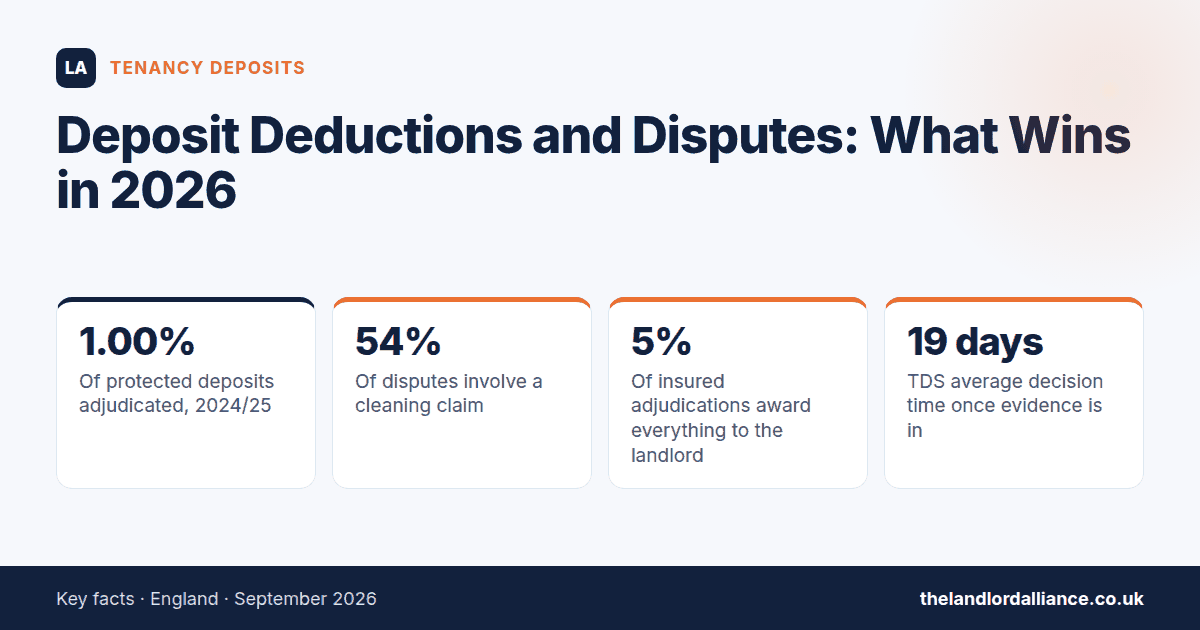
The deposit is security for the tenant's obligations, not your money. A deduction is a claim in damages, so the burden of proof sits on you, the standard is the balance of probabilities, and the award is what it costs to put the property back as it was — not to improve it. Adjudicators apportion for the age of the item, exclude fair wear and tear, and give an estimate the same weight as an invoice. Just 1.00% of deposits reached adjudication in 2024/25, and in most of those the money was split rather than awarded outright to either side.
I have made deposit claims that succeeded and claims that deserved to fail, and the difference was almost never the merits. It was the check-in report. An adjudicator cannot see your property, has no power to visit it and will never speak to you — they read what both sides send and decide on paper. A claim that would be obviously right standing in the hallway is unwinnable without a dated comparison, and that is the whole game.
What the deposit legally is
Section 212(8) of the Housing Act 2004 defines a tenancy deposit as money intended to be held as security for the performance of the tenant's obligations or the discharge of their liabilities under the tenancy. The identical definition appears in Schedule 1 of the Tenant Fees Act 2019.
Two consequences follow, and they explain nearly every adjudication outcome that surprises landlords.
It is security, not a fund
You cannot draw on it because you feel out of pocket. A deduction is only lawful if it compensates an actual breach of the tenant's obligations under the agreement.
It is a damages claim
So the ordinary damages principles apply: prove the loss, do not profit from it, mitigate, and account for the state the item was already in.
The Tenant Fees Act did not remove your right to claim. The current statutory guidance to enforcement authorities says so directly: the Act "does not affect the landlord's entitlement to recover damages through the tenancy deposit or through the courts". What it removed was your ability to make the tenant pay for things as a term of the tenancy.
The four principles adjudicators actually apply
| Principle | What it means in practice |
|---|---|
| Burden on the landlord | TDS states it plainly: because the deposit is the tenant's money, it is the landlord's responsibility to show entitlement. A tenant who submits nothing at all can still win if your evidence does not stand up. |
| Balance of probabilities | Not beyond reasonable doubt. You need to make your version more likely than the alternative, which is achievable — but you do need to make it. |
| No betterment | No award for making the property better than the tenant found it. Tenants are responsible on a like-for-like basis only. |
| Apportionment for age | DPS's own worked example: a £500 carpet, two years into an assumed five-year life, produces an award of roughly £300. Five years is the typical assumption for carpets and decoration in a standard let; three years in student lets. |
Fair wear and tear
There is no statutory definition, and the phrase does not appear in section 11 of the Landlord and Tenant Act 1985 — despite being widely attributed to it. Section 11 is the landlord's repairing covenant; its only tenant-side reference is to the duty to use the premises in a tenant-like manner, which comes from Warren v Keen [1954] 1 QB 15.
The wording the deposit schemes use is older than either: "the reasonable use of the house by the tenant and the ordinary operation of natural forces", from Talbot J in Haskell v Marlow [1928] 2 KB 45, later considered by the House of Lords in Regis Property Co Ltd v Dudley [1959] AC 370.
You will find this definition attributed to the House of Lords on scheme and trade body websites. It is a first-instance King's Bench decision. That does not weaken it — the schemes apply it either way — but if you are quoting it in a dispute submission, quote it correctly.
What adjudicators actually assess is functional rather than doctrinal: deterioration through reasonable use over the length of this tenancy, judged against the item's age, quality and condition at check-in. A six-month tenancy and a six-year tenancy do not get the same allowance.
Cleaning: the rule everyone half-knows
The Tenant Fees Act does not mention cleaning anywhere. The ban works by omission: section 1 prohibits requiring a payment that is not on the permitted list, section 1(6) extends that to requirements imposed by a term of the tenancy agreement, section 1(3) stops you requiring the tenant to contract with a third party, and Schedule 1 does not include cleaning. So a mandatory professional-cleaning clause is a prohibited payment.
You can
- Require the property to be returned in the condition it was found, fair wear and tear excepted
- Ask that it is cleaned to a professional standard
- Deduct at the end where it is returned dirtier than at check-in, evidenced by comparison
- Claim the cost of restoring the original standard
You cannot
- Require professional cleaning as a term of the tenancy
- Require the tenant to use a named company
- Charge for a clean where the property came back as it went out
- Claim the cost of a better clean than the property had at check-in
A citation trap worth knowing about. The passage everyone quotes for this — "Can I charge a tenant for a professional clean at the end of a tenancy? No." — is from the 2020 Tenant Fees Act guidance, which was withdrawn on 8 May 2026. The three pages that replaced it do not mention cleaning at all. Anyone still linking gov.uk for the cleaning rule is linking a withdrawn document. The underlying law in section 1 and Schedule 1 has not changed.
What evidence actually wins
Scheme adjudication guidance is unusually specific about this, and it is worth following literally.
The evidence bundle
- Inventory
- From the start of the tenancy, signed by the tenant — or evidence you sent it and gave them seven to ten days to comment
- Check-in and check-out
- The comparison is the case. Check-out is usually completed within two days of the tenant moving out
- Photographs
- Visibly date and time stamped. Wide shots and close-ups. Similar lighting and camera angles at both ends. Blurry or dark images do not help
- Cost evidence
- Invoices broken down by area and work done. Receipts confirming an item's age, or its cost and quality when new — this is what makes apportionment possible
- The agreement
- Signed, with the clause you say was breached
Counter-intuitive but confirmed: an estimate for future work and an invoice for completed work are considered equally by an adjudicator. You do not have to spend the money before you claim. What you do have to do is show the item's age and original quality, which is where most claims fall apart.
What the numbers say
Across all three schemes in the year to March 2025, 4,706,470 deposits were protected in England and Wales with a total value of £5.53 billion — an average of £1,175. Against that, 46,950 adjudications were run: exactly 1.00%, the highest rate since 2010 but still a rounding error.
| Category | 2024/25 | 2023/24 | 2022/23 |
|---|---|---|---|
| Cleaning | 54% | 65% | 50% |
| Damage | 49% | 45% | 44% |
| Redecoration | 31% | 32% | 27% |
| Gardening | 14% | 11% | 13% |
| Rent arrears | 10% | 22% | 13% |
The outcome data is the part landlords should read before deciding whether to fight.
| Outcome | TDS Insured | TDS Custodial |
|---|---|---|
| Everything to the landlord or agent | 5% | 23% |
| Everything to the tenant | 37% | 32% |
| Split between the parties | 58% | 45% |
Five per cent. That is how often a landlord in the insured scheme gets the whole claim. If you are going to adjudication expecting everything, the published data says you are almost certainly wrong about your evidence. Separately, 42% of disputes submitted to TDS in 2024/25 were resolved by agreement without an adjudicator at all — which is usually the better outcome for both sides.
How the dispute process runs
Schedule 10 paragraph 10 requires every scheme to offer facilities for resolving disputes without recourse to litigation — and expressly forbids the scheme from making them compulsory. So adjudication is free, but voluntary. Either party can decline and go to court instead.
| Stage | What happens |
|---|---|
| Raising it | Tenant applies, typically within three months of the end of the tenancy |
| The money | Custodial: the scheme already holds it. Insured: Schedule 10 para 5A(3) requires you to pay the disputed amount into a designated account within 10 days of being directed. Undisputed sums are released |
| Evidence | DPS gives 14 calendar days. TDS gives 5 working days each side. mydeposits gives the landlord 20 working days |
| Decision | TDS targets 28 days from receipt of all evidence; the actual average in 2024/25 was 19 days |
| Payment | Within 10 days of an agreement, a final court decision or a binding adjudication |
The decision is binding — Schedule 10 refers to it in terms as a binding decision, and no scheme offers a merits appeal. TDS offers only an internal review for an error of fact or law. The parties can still take the dispute to court, but as an alternative route rather than an appeal from the adjudicator.
Rent arrears and the deposit
Arrears are a legitimate deduction, but the timing interacts with possession in a way that catches landlords out.
Since 1 May 2026 Ground 8 requires thirteen weeks' rent unpaid where rent is paid weekly or fortnightly, or three months' where it is paid monthly — up from eight weeks and two months — and the threshold must be met both when the notice is served and at the hearing. The universal credit housing element is disregarded where it is unpaid only because the tenant has not yet received the award.
A deposit is security, not a payment of rent. Arrears are not reduced until the deposit is actually applied to them. So a landlord who applies the deposit to arrears before the hearing may drop below the Ground 8 threshold and lose the mandatory ground. That is a strong reason to deal with arrears deductions at the end of the tenancy rather than during it.
The thing that undoes all of this
None of the above matters if the deposit was not protected properly. Under section 215 of the Housing Act 2004 as substituted on 1 May 2026, the court may make a possession order only if the deposit is held in an authorised scheme and the prescribed information has been served. Get that wrong and an arrears claim is dead before the evidence is looked at — and you face a mandatory award of between one and three times the deposit on top. The penalties page covers it in full.
Can I deduct for a professional clean?
You can deduct the cost of returning the property to its check-in standard where it came back dirtier. You cannot require a professional clean as a term of the tenancy, or insist on a particular company, and you cannot claim for a standard the property never had.
The tenant never signed the inventory. Is it worthless?
No, but it is weaker. Adjudicators will accept evidence that you sent it and gave the tenant a reasonable window — seven to ten days — to comment. An unsigned inventory the tenant never saw is very hard to rely on.
Do I have to have paid for the work before I claim?
No. An estimate and an invoice carry the same weight. What you do need is evidence of the item's age and original quality, so the adjudicator can apportion.
The carpet is ruined. Why won't I get the replacement cost?
Because you would end up with a new carpet in place of a part-worn one, which is betterment. The award reflects the remaining life the tenant destroyed, not the price of a replacement.
Can I refuse adjudication and go to court?
Yes — Schedule 10 forbids a scheme from making adjudication compulsory. But be aware that failing to respond to the scheme is treated as consent, so refusal has to be active, and court costs money that adjudication does not.
How long does the tenant have to raise a dispute?
Typically three months from the end of the tenancy under scheme rules. That is a scheme rule, not a limitation period — a court claim has its own, longer clock.
The case is made at check-in, not at check-out
The Landlord Alliance keeps your inventories, dated condition evidence and protection records against each tenancy, so the comparison an adjudicator needs already exists when you need it. £10 a month, cancel anytime.
See what is includedEngland only. Position as at 31 August 2026. General information from a landlord, not legal advice.
Sources: Housing Act 2004 s.212(8) and Schedule 10 paras 4, 5A and 10; Tenant Fees Act 2019 s.1 and Schedule 1; Renters' Rights Act 2025 Schedule 1 para 24; Haskell v Marlow [1928] 2 KB 45; Warren v Keen [1954] 1 QB 15; Regis Property Co Ltd v Dudley [1959] AC 370; TDS Statistical Briefing and Annual Review 2024/25; published adjudication guidance from DPS, mydeposits and TDS.
Related: Tenancy deposits: the complete guide · Unprotected deposit penalties · Protection schemes compared · Deposit cap calculator