The short version
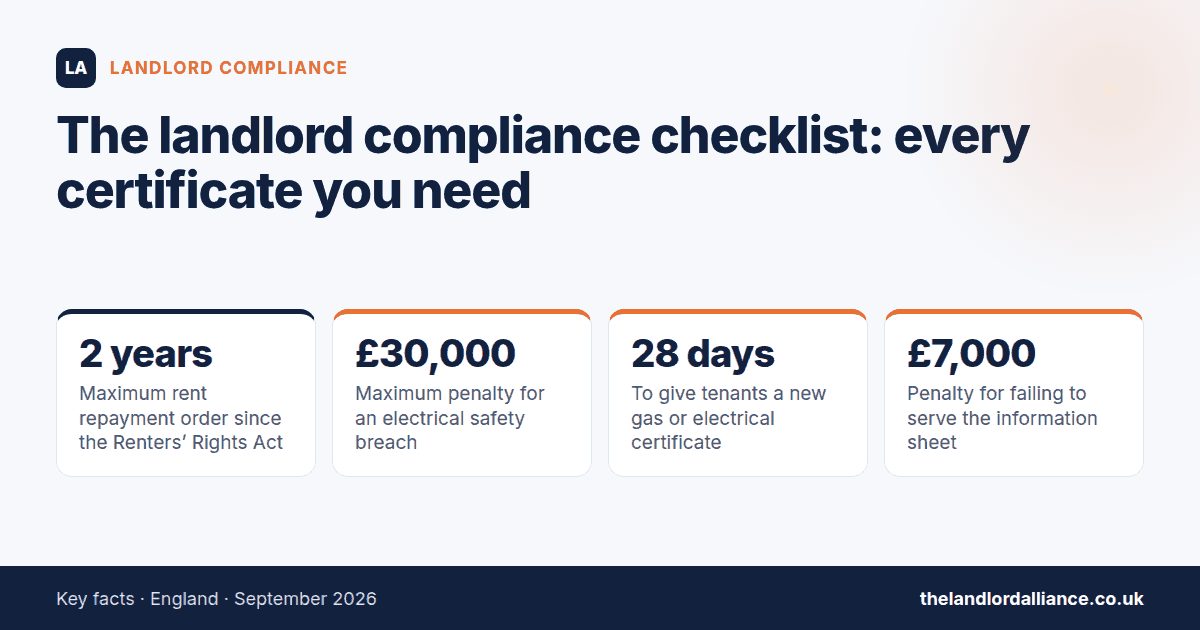
There is no single landlord licence and no one certificate that proves you are compliant. There are ten or so separate obligations, each with its own frequency, its own deadline for giving a copy to the tenant, and its own penalty. The expensive ones are not always the ones people worry about: an unprotected deposit costs up to three times the deposit, an unlicensed property can now cost up to two years’ rent through a rent repayment order, and a missed right to rent check is £10,000 per person. The table below is the whole list on one screen.
The whole list, on one screen
| Obligation | How often | Give the tenant a copy | Maximum penalty |
|---|---|---|---|
| Gas safety record (CP12) | Every 12 months, by a Gas Safe engineer | Within 28 days; before a new tenant moves in | Unlimited fine, and imprisonment in serious cases |
| EICR | At least every 5 years | Within 28 days; before a new tenant moves in; to the council within 7 days on request | £30,000 |
| Smoke alarms | One per storey with living accommodation; tested on day one | Not required — but record the test | £5,000 |
| Carbon monoxide alarms | Every room with a fixed combustion appliance, excluding gas cookers | Not required — but record the test | £5,000 |
| EPC, minimum rating E | Valid for 10 years | Before the tenancy starts | £5,000 per property |
| Deposit protection | Within 30 days of receipt | Prescribed information within 30 days | 1–3× the deposit |
| Right to rent check | Before occupation; follow-ups if time-limited | Keep the evidence for the tenancy plus a year | £10,000 per occupier |
| Written statement of terms | Every tenancy granted from 1 May 2026 | At the start of the tenancy | Civil penalty |
| Information sheet | One-off, for tenancies existing on 1 May 2026 | Deadline was 31 May 2026 | £7,000 per breach |
| Licence, if required | Before letting; renewals vary by council | Not applicable | £30,000 civil penalty or prosecution, plus a rent repayment order of up to 2 years’ rent |
| Legionella risk assessment | No fixed interval; review on change | Not required | Enforced under health and safety law |
What has to be in the tenant’s hands before day one
Four documents, and the order matters less than the fact that all four are done before the tenancy begins rather than in the first busy fortnight afterwards.
- The gas safety record, if there is any gas appliance in the property.
- The EICR.
- The EPC.
- The written statement of terms, which for most landlords is the tenancy agreement itself.
Then, within 30 days of receiving it, the deposit goes into a scheme and the prescribed information goes to the tenant. And before any of that, the right to rent check on every adult who will live there.
What non-compliance actually costs now
The enforcement picture changed materially with the Renters’ Rights Act, and not in the direction most landlords assume.
Civil penalties, not prosecutions. Councils increasingly issue financial penalties directly rather than going to court. They are quicker, they do not need a criminal standard of proof, and the money stays with the local authority — which is why enforcement activity has risen.
Rent repayment orders now reach two years. Previously capped at twelve months’ rent, an RRO can now require repayment of up to two years of rent for a qualifying offence, and the range of offences has been widened. For an unlicensed property at £1,200 a month that is a £28,800 exposure, and the tenant can apply, not only the council.
The section 21 gateway is gone, but that is not a relief. Compliance failures used to bite mainly by invalidating a section 21 notice. Section 21 no longer exists, so that consequence has disappeared — and been replaced by direct financial penalties that do not depend on you wanting possession at all. You can now be penalised for a compliance failure in a tenancy that is going perfectly well.
The PRS database. England’s landlord register now has a timetable: registration opens in the West Midlands on 15 December 2026 and reaches every region by 14 November 2027, at £65 per property per year. Once the requirement applies to your property, a landlord who has not registered cannot get a possession order on most grounds and cannot market the property. Find your regional deadline and everything the register will ask for.
The ones people miss
- The carbon monoxide alarm rule changed in 2022 and now covers any room with a fixed combustion appliance, not just solid fuel. A gas boiler in a kitchen cupboard counts. A gas cooker does not.
- Alarms have to be tested on the first day of the tenancy, not merely installed. Have the tenant sign the inventory confirming it.
- The EICR runs from the inspection date, not the tenancy date, and remedial work coded C1 or C2 must be done within 28 days, or sooner if the report says so.
- A gas check can be done up to two months early without losing the original expiry date, so there is no reason to let one lapse over an access problem.
- Selective licensing is local. Whether you need a licence depends on the street, not the property type, and schemes come and go. Check your council’s current designation rather than what you remember from last time.
- Keeping records is part of compliance. Gas records for two years, right to rent evidence for the tenancy plus one year, and a dated copy of everything you served.
Read next
Is there a single landlord compliance certificate?
No. There is no combined certificate and no register that proves compliance. Each obligation is separate, and anyone offering a single “landlord compliance certificate” is selling a private product, not a legal document.
What if the tenant will not let the engineer in?
Keep a written record of every attempt: letters, texts, dates offered. That evidence of reasonable steps is your defence. Do not force entry, and do not let the certificate lapse quietly — a gas check can be done up to two months early.
Do I need an EICR for a new build?
Yes. The five-year cycle applies regardless of age. An installation certificate for new work is not a substitute, though it will start the clock.
Do I need a legionella certificate?
No. You need to have assessed the risk, which for a typical domestic property is a short written assessment you can do yourself. There is no certificate and no annual requirement.
Does an HMO need anything extra?
Yes — licensing, additional fire safety measures, and in most cases annual rather than five-yearly electrical checks under the licence conditions. Check the conditions on your own licence; they vary by council.
How long do I keep all this?
Gas records two years, right to rent evidence for the tenancy plus one year, and everything else for at least the length of the tenancy plus six years, which matches the limitation period for a contract claim.
Sources. Gas Safety (Installation and Use) Regulations 1998; Electrical Safety Standards in the Private Rented Sector (England) Regulations 2020; Smoke and Carbon Monoxide Alarm (Amendment) Regulations 2022 and the GOV.UK landlord booklet; Energy Efficiency (Private Rented Property) (England and Wales) Regulations 2015; Housing Act 2004; Renters’ Rights Act 2025 (c. 26); Home Office right to rent code of practice. Checked 7 September 2026.
Related: All landlord guides · Free calculators · Our pricing