Grant schemes change often and close without much warning. Everything below was checked on 8 September 2026, but always confirm current terms on GOV.UK or with the scheme administrator before you commit to work. Treat any installer who tells you a scheme is guaranteed with real caution.
The short version
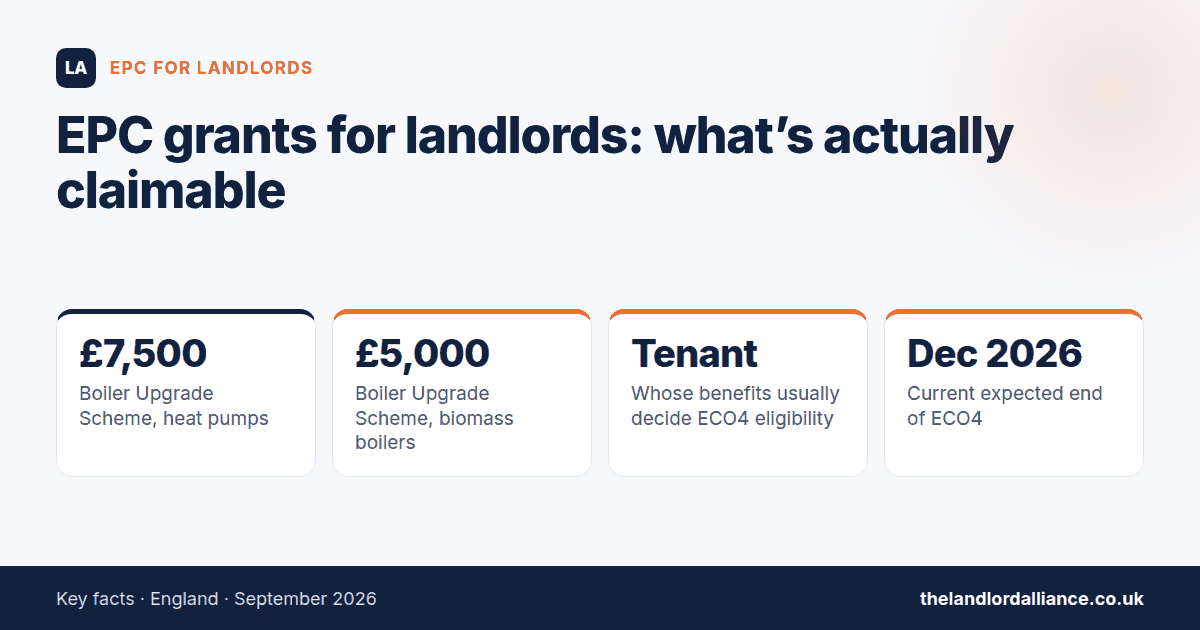
Landlords can access less grant funding than owner-occupiers, and most of what is available is means-tested on the tenant’s circumstances rather than yours. The exception, and the most useful scheme for landlords, is the Boiler Upgrade Scheme: £7,500 towards a heat pump, with no tenant income test at all. Beyond that, ECO4 and the Great British Insulation Scheme can fund insulation where your tenant receives qualifying benefits or your council operates a flexible eligibility route. With the EPC C deadline confirmed for October 2030, grant-funded work now is considerably cheaper than self-funded work in 2029.
Boiler Upgrade Scheme — the one built for you
The most straightforward scheme for landlords, because eligibility attaches to the property and the installation rather than to the occupier’s income.
| Technology | Grant |
|---|---|
| Air source heat pump | £7,500 |
| Ground source heat pump | £7,500 |
| Biomass boiler | £5,000 |
| Air-to-air heat pump | £2,500 |
| Additional payment: off-gas-grid property heated by oil or LPG | +£1,500 towards an air or ground source heat pump, until March 2027 |
How it works: you choose an MCS-certified installer, they apply on your behalf, and the grant is deducted from what you pay. The property must be replacing a fossil fuel heating system, and the installation must meet the scheme’s standards.
Why this matters for 2030. A heat pump is one of the largest single EPC improvements available, and on a solid-wall property where insulation is impractical it is frequently the difference between reaching C and registering an exemption. £7,500 off the cost changes that calculation substantially.
ECO4 and the Great British Insulation Scheme
These are funded by energy suppliers rather than by government directly, and they pay for insulation and heating measures. The key point for landlords: eligibility is normally assessed on the tenant’s circumstances.
| Route | How it qualifies | What it typically funds |
|---|---|---|
| ECO4, benefits route | The tenant receives a qualifying means-tested benefit — Universal Credit, Pension Credit, income-based ESA or JSA, tax credits and others | Insulation, heating upgrades, sometimes solar. Often a whole-house package on low-rated property. |
| ECO4 Flex (LA Flex) | Your local authority declares the household eligible on low income, health vulnerability or fuel poverty grounds — even without a qualifying benefit | As above. Rules vary by council, so check yours specifically. |
| Great British Insulation Scheme | Broader eligibility, focused on single insulation measures in lower council tax bands and lower EPC ratings | Loft and cavity wall insulation mainly |
The landlord contribution. Do not expect a fully funded job. Schemes commonly require landlords to contribute a proportion of the cost — often a third or more — on the reasonable basis that you own an asset that increases in value. A “free landlord grant” advertised with no contribution deserves scrutiny.
Local authority and other routes
- Warm Homes: Local Grant. Delivered by councils to improve low-EPC homes for lower-income households, including private rentals. Availability, funding and criteria vary enormously by area — your council’s energy or housing team is the place to ask.
- Council retrofit schemes. Some authorities run their own landlord-facing offers, occasionally tied to accreditation or to letting to households on the housing register.
- Solar and battery finance. Not a grant, but zero-rated VAT on qualifying energy-saving materials continues to apply to installations in residential property, which is a real saving on a solar or heat pump job.
What to check before you commit
- Confirm the scheme directly on GOV.UK or with the administrator, not with the installer who is selling you the work.
- Get the eligibility assessment in writing before work starts. Retrofitting an application to work already done is usually impossible.
- Ask what happens if the tenant moves out mid-application. Benefit-linked eligibility can lapse with the household.
- Check the effect on your cost cap. Only what you spend counts towards the £10,000 cap for the 2030 standard, so a grant-funded measure may not build your exemption case. Keep the invoices either way.
- Use MCS-certified installers for heat pumps — it is a scheme requirement, and it protects the warranty.
- Beware cold calls. Unsolicited approaches offering free landlord grants are a well-established route to poor workmanship and cavity wall problems that cost more to remedy than the measure saved.
Be careful with your tenant’s data. Benefit-linked eligibility means the assessment needs information about your tenant’s circumstances. Ask for their consent, explain what it is for, and let them supply the evidence to the scheme directly rather than to you. And remember that refusing a tenant because they receive benefits is now unlawful — see the ban on benefit discrimination.
Read next
Can landlords get the Boiler Upgrade Scheme?
Yes. It is one of the few schemes where eligibility attaches to the property and the installation rather than to the occupier’s income, which makes it the most accessible route for landlords.
Are there free insulation grants for landlords?
Rarely fully free. ECO4 and the Great British Insulation Scheme can fund insulation where the tenant qualifies, but landlords are usually asked to contribute a share of the cost.
Does my tenant have to be on benefits?
For the ECO4 benefits route, yes. ECO4 Flex allows councils to declare a household eligible on low income or health grounds instead, and the Boiler Upgrade Scheme has no income test at all.
When does ECO4 end?
It is currently expected to run to December 2026, having been extended. Successor arrangements sit under the Warm Homes Plan, with details still emerging — check before relying on it.
Does grant-funded work count towards the £10,000 cap?
The cap is about qualifying expenditure. Only what you actually spend builds your case for an exemption, so keep invoices showing your contribution.
Can I claim grant-funded work against tax?
You can only deduct what you actually paid, and the repair versus improvement rules still apply — see allowable expenses.
Sources. GOV.UK Boiler Upgrade Scheme guidance including grant values; Energy Company Obligation (ECO4) and Great British Insulation Scheme guidance; Warm Homes Plan announcement, January 2026; VAT zero rate on the installation of energy-saving materials in residential accommodation. Scheme terms and end dates change — verify before committing. Checked 8 September 2026.
Related: EPC rules · Compliance checklist · All guides