We do not sell insurance and take no commission from any insurer. Cover varies substantially between policies — this explains what the sections do, not what your particular schedule says. Read the schedule.
The short version
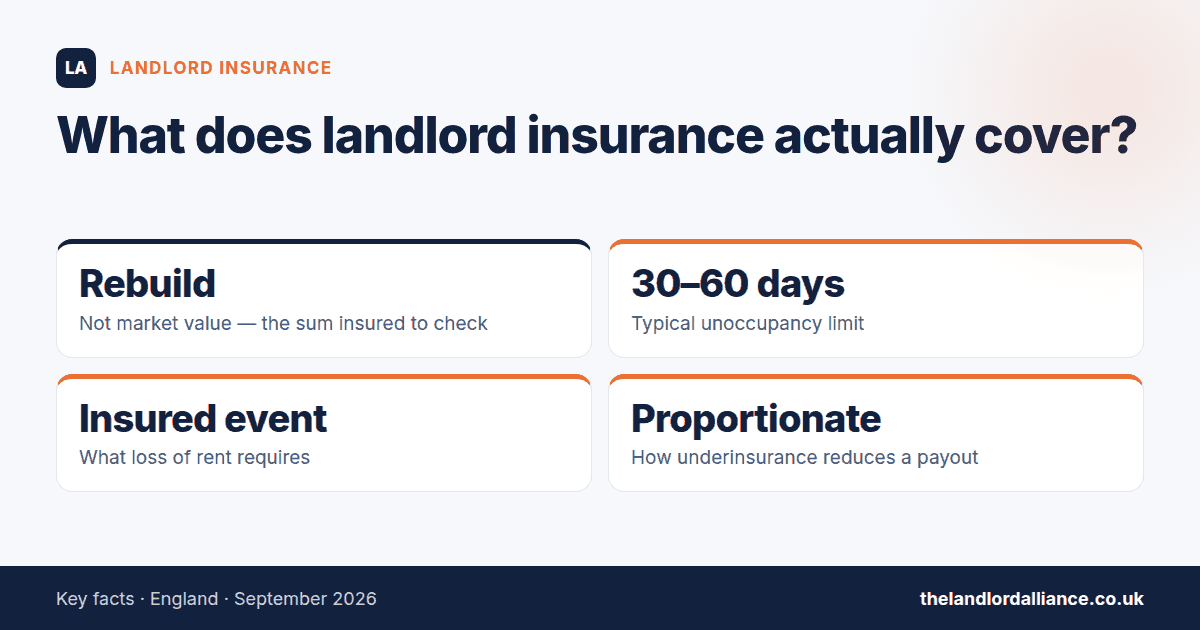
A landlord policy is a bundle of separate covers, and knowing which one responds to which event is most of the value. Buildings pays to rebuild. Property owners’ liability pays when someone is hurt because of the property. Loss of rent pays when an insured event makes the property uninhabitable — not when a tenant simply stops paying, which is rent guarantee. Contents covers only what you own. The three things that most often defeat a claim are letting on a residential policy, an unnotified void beyond the policy’s unoccupancy limit, and underinsuring the rebuild cost.
Section by section
| Section | What it pays for | Typical exclusions |
|---|---|---|
| Buildings | Rebuilding or repairing the structure after fire, flood, storm, escape of water, subsidence, impact, theft damage | Wear and tear, gradual deterioration, faulty workmanship, damage during an unnotified void |
| Property owners’ liability | Compensation and legal costs where a tenant or visitor is injured, or their property damaged, because of the property | Injury to your own employees (that is employers’ liability), deliberate acts |
| Loss of rent / alternative accommodation | Rent lost, and rehousing costs, while the property is uninhabitable after an insured event | Tenant default, voids between tenancies, uninhabitability caused by disrepair you failed to fix |
| Landlord’s contents | Your carpets, curtains, white goods, furniture in a furnished let | The tenant’s belongings, items outside the sum insured |
| Malicious damage by tenant | Deliberate damage beyond fair wear and tear | Frequently excluded as standard; often needs the tenant to be prosecuted or a police reference |
| Accidental damage | One-off accidents — a foot through a ceiling, a drilled pipe | Gradual damage, anything deliberate |
| Legal expenses | Costs of pursuing possession or a dispute | Matters arising before the policy started; claims with poor prospects |
| Employers’ liability | Injury to someone you employ, such as a regular cleaner | Genuine contractors with their own insurance |
The three things that defeat claims
1. The wrong policy
Letting a property insured on a residential buildings policy voids the cover. It is not a technicality an insurer might overlook — the risk they priced is not the risk they are carrying. This catches accidental landlords most: the flat kept on after moving in with a partner, the inherited house let out, the policy left running because switching felt like admin. Tell the insurer the day the use changes.
2. The unnotified void
Most policies restrict cover once a property is empty for 30, 45 or 60 consecutive days — typically dropping back to fire, lightning and explosion, and excluding escape of water and theft. Since May 2026 tenants can leave on two months’ notice at any point, so unplanned voids are more common. Read your limit, diarise it, and tell the insurer when a property goes empty. A burst pipe in an unnotified empty flat is the classic declined claim.
3. Underinsurance
The buildings sum insured should be the rebuild cost, not the market value, and rebuild costs have risen sharply. If you are insured for 70% of the true rebuild cost, an insurer can reduce a claim proportionately — so a £20,000 fire claim pays £14,000. Reassess the figure at renewal rather than letting it index quietly.
For a leasehold flat, the freeholder insures the building. You do not need your own buildings cover and buying it duplicates what the service charge already pays for. What you do need is contents for what you own and your own property owners’ liability — the block policy covers the freeholder’s liability, not yours as landlord of your flat. Ask for the block schedule every year.
How a claim actually works
- Make it safe and stop it getting worse. Turn off the water, board up, get an emergency plumber. Insurers expect you to mitigate, and the cost of doing so is usually covered.
- Notify quickly. Policies require prompt notification and late notice is a reason to decline.
- Photograph everything before anything is cleared, and keep damaged items until you are told otherwise.
- Do not commit to repairs before the insurer approves, unless it is genuinely emergency work.
- Expect a loss adjuster on anything substantial, and have your paperwork ready — the schedule, the tenancy agreement, your gas and electrical certificates.
That last point matters more than it looks. An insurer investigating a fire will ask for the gas safety record and the EICR. A lapsed certificate can turn a covered event into an argument about whether you met the policy conditions.
Read next
Does landlord insurance cover a tenant who stops paying?
Not under loss of rent, which requires an insured event such as a fire. Tenant default is rent guarantee insurance, a separate product.
Does it cover damp and mould?
Almost never. Damp is treated as gradual deterioration or lack of maintenance. A sudden escape of water is a different matter.
Should I insure for market value or rebuild cost?
Rebuild cost. They are different numbers, and insuring on market value in a high-value area is a common and expensive error in both directions.
Do I need buildings cover for a leasehold flat?
Usually not — the freeholder insures the building through the service charge. You need contents and your own liability cover.
What happens if the property is empty?
Cover typically restricts after 30 to 60 consecutive days. Tell your insurer, and consider unoccupied property cover for a long void or refurbishment.
Is malicious damage by the tenant covered?
Often only as a paid extra, and usually with conditions such as a police reference number. Check the schedule before you assume.
Sources. Financial Conduct Authority guidance on insurance disclosure and fair value; published policy wordings and schedules from mainstream UK landlord insurers, September 2026; Insurance Act 2015 on fair presentation of risk and proportionate remedies. Checked 8 September 2026.
Related: Landlord insurance · All guides · Compliance checklist