The short version
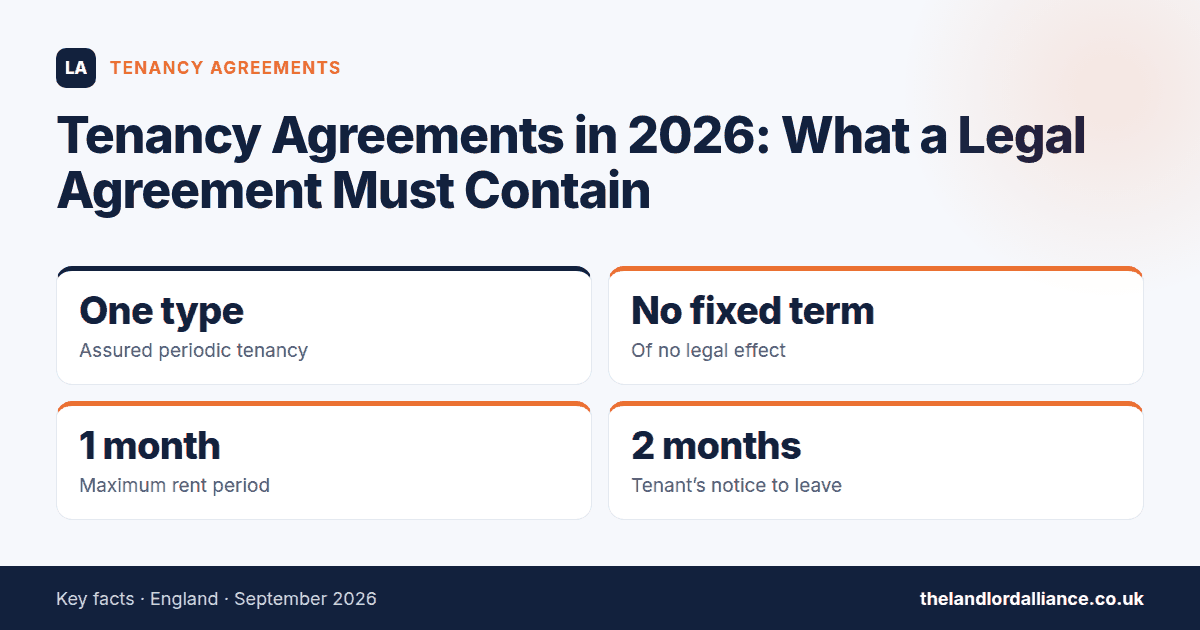
Since 1 May 2026 there is only one kind of private tenancy in England: the assured periodic tenancy. Assured shortholds no longer exist. You cannot create a fixed term, you cannot include a break clause that does anything, and you cannot set a rent period longer than a month. Every new tenancy needs a written statement of terms given to the tenant at the outset. If you are using an agreement template from before May 2026, it is out of date in ways that matter.
Tenancy agreements used to be the settled part of letting. You bought a template, filled in the names and the rent, and it worked for a decade. That ended on 1 May. The changes aren’t cosmetic — several of the clauses in a standard pre-2026 AST are now legally inert, and a couple create obligations you no longer want to be signing up to.
What kind of tenancy do you have now?
| Before 1 May 2026 | Now | What happened |
|---|---|---|
| Assured shorthold tenancy, fixed term | Assured periodic tenancy | Converted automatically. Same tenancy, no re-grant |
| Assured shorthold tenancy, already periodic | Assured periodic tenancy | Converted automatically |
| Old-style assured tenancy (pre-1997) | Assured periodic tenancy, but a “legacy” one | Converted, but ground 1A does not apply to it |
| Lodger / licence | Unchanged | Not an assured tenancy. Different rules entirely |
| Company let | Unchanged | Not an assured tenancy |
You did not need to issue new agreements. Section 146 of the Act preserved every existing tenancy and converted it in place — no surrender, no re-grant, no new paperwork. What you did need to do was give existing tenants the information sheet by 31 May 2026.
What a 2026 agreement must contain
For any tenancy granted on or after 1 May 2026, you must give the tenant a written statement of terms. In practice, for most landlords, that means a properly drafted tenancy agreement — the statement and the agreement can be the same document.
The basics
- Names of all parties, including all joint tenants
- The address of the property
- The rent, and the rent period
- The date the tenancy begins
- Deposit amount and which scheme protects it
Now required or expected
- A statement that the tenancy is periodic
- How and when rent is paid
- Repairing obligations, yours and theirs
- How notice is given, by each side
- Landlord’s contact address for service
Remove these
- Fixed term of any length
- Break clauses
- Rent review or annual uplift clauses
- Blanket “no pets”
- “No DSS” or no children restrictions
- Quarterly or six-monthly rent
Serve alongside it
- Gas safety certificate
- EICR
- EPC
- Deposit prescribed information
- How to Rent guide
The “remove these” list is the important one, and it’s why last year’s template is a liability. Those clauses are not merely redundant — a blanket no-pets clause or a no-DSS restriction sitting in a signed agreement is evidence of a prohibited practice, even if you never enforce it.
The clauses that stopped working
Fixed terms
The Act provides that terms purporting to make a tenancy fixed-term are of no effect. The tenancy operates as periodic with periods matching the rent period. You can write “12 month term” into an agreement and it will do nothing — the tenant can still leave on two months’ notice from day one.
This is the change landlords find hardest, because the fixed term was doing real work: it gave you certainty of income for a year. That certainty has gone, and no drafting recovers it. What you have instead is a tenant who has to give two months’ notice, and possession grounds that need four months for the discretionary-sale route. How periodic tenancies actually work.
Break clauses
There is no express prohibition on break clauses — they’re simply pointless. With no fixed term, there is nothing to break. Possession runs on section 8 grounds and nothing in your agreement can add to them. More on what happened to ASTs.
Rent review clauses
Rent can now only be increased by a section 13 notice, once every 52 weeks, on Form 4A, with two months’ notice. A contractual uplift clause has no effect. See section 13 rent increases.
Rent periods longer than a month
A term providing for a rent period longer than a month is of no effect, and the tenancy defaults to successive monthly periods. Quarterly rent — common on higher-value lets and some company arrangements — no longer works for assured tenancies.
Ending a tenancy now
Who can end it, and how
- Tenant
- Two months’ notice, unless you agree less in writing
- Joint tenants
- Any one tenant can serve notice, ending it for all. A shorter period needs all of them to agree
- Landlord
- Section 8 ground only. No no-fault route exists
- Selling
- Ground 1A, four months’ notice, not in the first year, then a twelve-month re-letting ban
- Moving in yourself
- Ground 1, four months’ notice, not in the first year, same ban
- Serious arrears
- Ground 8, three months’ arrears, four weeks’ notice
The asymmetry is deliberate and it’s the single biggest commercial shift in the Act. A tenant can leave on two months’ notice at any point. You need a ground, evidence, and in the two most common landlord-driven scenarios, four months plus a year-long re-letting ban. Price that into your planning rather than discovering it when you want the property back. The full picture is on section 8 grounds for possession.
The tenancy agreement hub
Questions
Do I need to reissue agreements to existing tenants?
No. They converted automatically and remain the same tenancy. You did need to give them the information sheet by 31 May 2026.
Can I still offer a twelve-month tenancy?
You can write it down, but it has no legal effect. The tenancy is periodic and the tenant can leave on two months’ notice.
What if my agreement still has a no-pets clause?
It’s overridden by the implied term in the Act, and it shouldn’t be there. Take it out of your template now.
Is a written agreement compulsory?
A written statement of terms is required for new tenancies. A verbal tenancy is still a tenancy, but you’d be creating an obligation you’ve already failed.
Can I use a company let to avoid all this?
Company lets aren’t assured tenancies, so the regime doesn’t apply — but they must be genuine. A sham arrangement to sidestep the Act is a bad idea and unlikely to survive scrutiny.
Does any of this apply to lodgers?
No. A lodger sharing your home is a licensee, not an assured tenant, and none of this applies.
Agreements, certificates and deadlines in one place
Store every tenancy document against the property, track what’s been served and when, and get told before anything expires. £10 a month, cancel anytime.
See what’s includedTaking a deposit with the tenancy? The cap is five or six weeks' rent depending on the annual rent — our deposit cap calculator works it out — and you have thirty days to protect it and to serve the prescribed information. See the tenancy deposits guide.
England only. Position as at 20 August 2026. General information from a landlord, not legal advice.
Sources: Renters’ Rights Act 2025 ss.1, 2, 20, 21, 146; Housing Act 1988 s.4A as inserted; SI 2026/421.