The short version
England now has a confirmed national landlord register. The government has published the fee and the full rollout timetable: £65 per property, per year, renewed annually, on a service called Register your rental property, backed by the Private Rented Sector Database (the PRS database) created by the Renters' Rights Act 2025.
It opens in the West Midlands on 15 December 2026 and reaches the South West on 15 August 2027. Every region gets a three-month window to register. Your region is decided by where the property is, not where you live.
Miss it and a council can issue a civil penalty of up to £7,000, rising to £40,000 or prosecution for repeat or fraudulent breaches. More immediately: while you are in breach you cannot get a possession order except on the anti-social behaviour grounds, and you cannot legally advertise the property once your region has gone live.
Watch the video version. The rollout dates, the £65 fee, and what being unregistered actually stops you doing. Everything below is the written version, with the deadline finder and the cost calculator.
Get the whole thing as a free 38-page handbook
Everything on this page, plus the parts that work better on paper:
- A portfolio schedule — one line per property, sorted by deadline
- A per-property document pack to photocopy and fill in
- The 20-point readiness checklist and an agent responsibility record
- A full region lookup: every county, unitary authority and London borough
Free. We will email it straight to you and you can unsubscribe any time.
I let property in Surrey, so my own window is 15 March to 14 June 2027. That sounds comfortably far away until you read the field list the service is going to ask for: date of birth and contact details for every landlord, the ownership structure of every property, bedroom count, how many people live there, the rent and how often it is paid, whether bills are included, and the current gas, electrical and EPC certificates with any MEES exemption. Most landlords I speak to could produce about two thirds of that today. The other third is in an agent's inbox, a filing cabinet, or a certificate that quietly expired.
This page is the working version of what I put together for my own portfolio: the exact dates, a deadline finder, a cost calculator, the full list of what you will be asked for, and a checklist you can tick off as you go. Everything here is cited to the government's own guidance, and where the guidance genuinely does not answer a question yet, I say so rather than guessing.
On this page
- Find your registration deadline
- What it will cost you
- All nine regional dates
- What the PRS database actually is
- How to register your rental property
- Everything the PRS database will ask for
- Limited companies, SPVs and trusts
- Your readiness checklist
- Keeping your registration up to date
- Registration numbers in adverts
- Fines, possession and rent repayment
- Who can see your information
- Existing tenants and empty homes
- Lodgers, council homes and small HMOs
- The expired EPC question
- Does it replace licensing?
- HMOs and multiple units
- Can your agent do it?
- Scotland, Wales and Northern Ireland
- HMRC and rent increases
- A twelve-step preparation plan
- Questions landlords are asking
Find your registration deadline
Type a county, town or borough — or tap your region on the map below.
Deadline finder
Your region is set by where the property is. If you own in more than one region you will have more than one deadline, and they are up to eight months apart.
Region
Your deadline
- Registration opens
- —
- Last day to register
- —
- Position in the rollout
- —
The rollout at a glance
Nine regions, one a month, darkest first. Tap a region to load its dates above.
Arranged roughly by geography, shaded by how soon registration opens. Darker means sooner.
Only want to think about this once? The Landlord Alliance stores every field the register asks for against each property and reminds you before your regional deadline. £10 a month, founding member price locked in for life.
Join for £10 a monthWhat it will cost you
£65 per property, per year, renewed annually. Not one payment for a portfolio.
Registration cost calculator
Drag or type the number of let properties you own in England. The fee is announced at £65 per property per year; multi-year figures assume it stays there, which is not guaranteed.
| Registered properties | Each year | Monthly equivalent | Over three years | Over five years |
|---|---|---|---|---|
| 1 | £65 | £5.42 | £195 | £325 |
| 2 | £130 | £10.83 | £390 | £650 |
| 5 | £325 | £27.08 | £975 | £1,625 |
| 10 | £650 | £54.17 | £1,950 | £3,250 |
| 20 | £1,300 | £108.33 | £3,900 | £6,500 |
| 50 | £3,250 | £270.83 | £9,750 | £16,250 |
Treat it as a recurring cost, not a one-off. The fee renews annually at the same rate, so a ten-property portfolio is adding £650 a year to its fixed costs before a single certificate is renewed. That is roughly a 2 to 5 per cent bite out of the net profit on a typical single let, and it cannot be charged to your tenant as a separate fee.
Four questions landlords ask about the fee
| Question | Answer |
|---|---|
| Will registering early cost me more? | No. The government says the fee will be pro-rated during the rollout, so that landlords who sign up first do not pay more. Registering in December rather than on your deadline day should not cost you extra. |
| Is it tax deductible? | It is a cost of running your letting business, so in normal circumstances it sits with your other allowable expenses against rental income — or against company profits if you let through a limited company. Confirm the treatment with your accountant. |
| Can I pass it on to the tenant? | Not as a charge. The Tenant Fees Act 2019 limits what a landlord or agent can take from a tenant to a short list of permitted payments, and a registration fee is not one of them. It can only reach the rent through a section 13 rent increase, at most once a year, which the tenant can challenge. |
| Will it go up? | Probably, over time. The draft regulations deliberately do not fix the amount, so that it can change to account for things like inflation, and the database operator sets it by reference to its costs. Budget for £65 now and assume it will rise. |
All nine regional dates
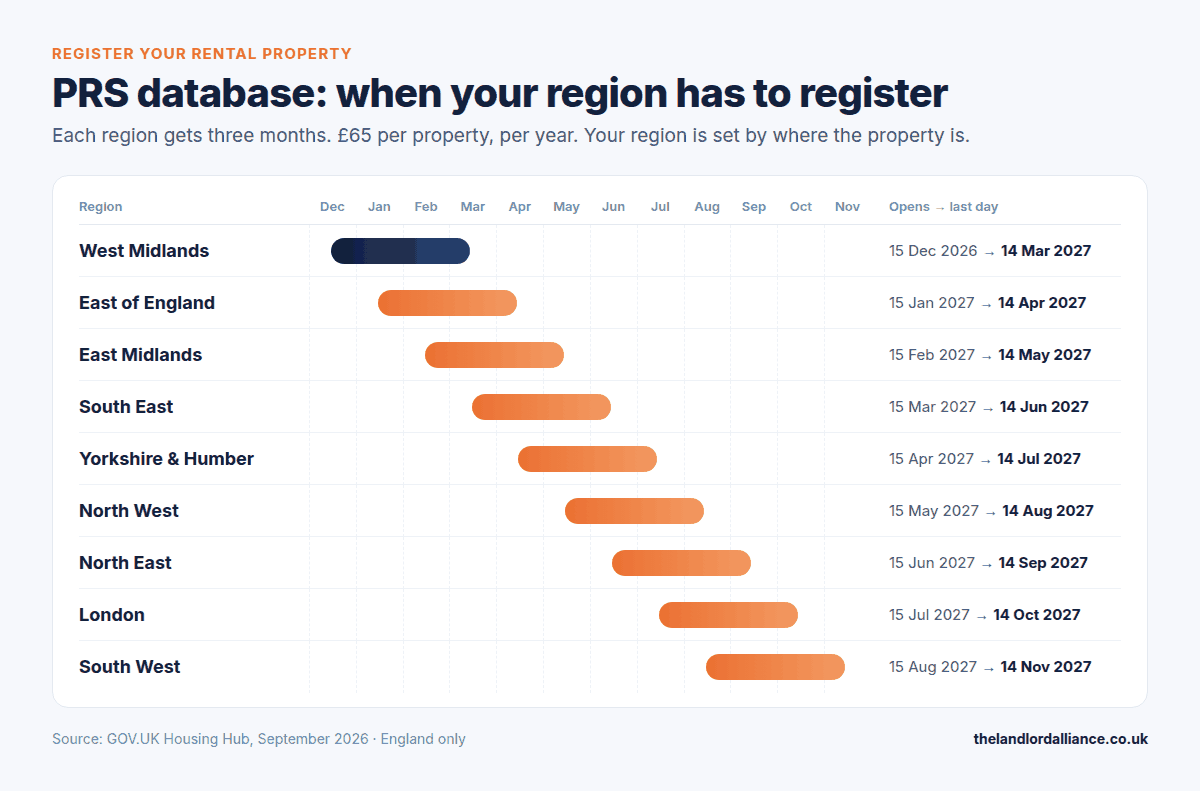
Registration opens region by region from 15 December 2026. Each region then has three months.
| Region the property is in | Registration opens | Last day to register | Order |
|---|---|---|---|
| West Midlands | 15 December 2026 | 14 March 2027 | 1st |
| East of England | 15 January 2027 | 14 April 2027 | 2nd |
| East Midlands | 15 February 2027 | 14 May 2027 | 3rd |
| South East | 15 March 2027 | 14 June 2027 | 4th |
| Yorkshire and the Humber | 15 April 2027 | 14 July 2027 | 5th |
| North West | 15 May 2027 | 14 August 2027 | 6th |
| North East | 15 June 2027 | 14 September 2027 | 7th |
| London | 15 July 2027 | 14 October 2027 | 8th |
| South West | 15 August 2027 | 14 November 2027 | 9th |
You do not have to wait for your own region. Once the service is live from 15 December 2026, properties in any region can be registered ahead of their deadline. If you own across several regions, doing the lot in one sitting is far easier than tracking five separate windows across eleven months — and it removes the risk that the one you forgot is the one you need to serve notice on.
At a glance
- Service name
- Register your rental property
- Legal basis
- Private Rented Sector Database, Renters' Rights Act 2025
- Who must register
- Landlords of assured and regulated tenancies in England
- Fee
- £65 per property, per year, renewed annually
- First region live
- 15 December 2026 (West Midlands)
- Fully rolled out
- 14 November 2027
- Window per region
- Three months from the region's start date
- Enforced by
- Local councils, by civil penalty or prosecution
What the PRS database actually is
A national database of landlords and rented homes, with real consequences attached to being missing from it.
The Private Rented Sector Database — the PRS Database, or what most landlords will simply call the national landlord database — was created by the Renters' Rights Act 2025. The public-facing service built on top of it is called Register your rental property. It requires landlords of assured and regulated tenancies to register both themselves and each property they let.
Three things it is designed to do, in the government's own framing: give tenants information before they commit to a home, give councils the property-level data they currently have to assemble by hand, and give landlords a single place to see what they are legally required to do.
What makes it different from a voluntary accreditation scheme is that it is wired into the rest of the regime. Registration is not just an administrative box. It is a precondition for advertising a property and a precondition for obtaining possession. A landlord who is not on the register is not merely unregistered — they are, in practice, unable to get their property back through the courts on the ordinary grounds.
It sits alongside a set of reforms that have already landed. Section 21 and fixed-term assured shorthold tenancies ended on 1 May 2026, which means the section 8 grounds are now the only route to possession — and registration is about to become a gate in front of that route. If you have not yet worked through what the Act changed, start with the Renters' Rights Act overview and the commencement tracker.
How to register your rental property
What is confirmed about the process — and what has not been published yet.
The service you will use is called Register your rental property. It is the front end of the national landlord database, and this is how registering is confirmed to work.
| Step | What happens |
|---|---|
| 1. Wait for your region | The service opens region by region from 15 December 2026. Once it is live you can register properties in any region, ahead of their own deadline. |
| 2. Start it yourself | Landlords must begin and complete registration personally. An agent may supply certain information on your behalf, but cannot register for you. |
| 3. Register as a landlord | Your name, date of birth, correspondence address and contact details — or the company, Companies House number and director details if you let through a limited company. Joint owners each register separately. |
| 4. Register each property | Address, ownership type, property type, bedrooms, occupants, households, rent and frequency, bills included, licence status, and your gas, electrical and EPC information. |
| 5. Pay the fee | £65 per property, per year. Charged per dwelling, not per landlord. |
| 6. Use your numbers | You receive a Landlord Registration Number and a Property Registration Number. The Act says both will have to appear in written adverts, but the government says that part switches on later, with guidance first. More below. |
| 7. Keep it current and renew | Changes must be updated within 28 days. Each entry lasts a year; if you let several properties, later ones renew on the same date as your first, so there is one renewal date to diarise. |
What has not been published yet. The detailed on-screen instructions for each region, and the rules for agents uploading information on your behalf, are still to come. A group of landlords tested the service in a closed beta during summer 2026, so early accounts of the screens do exist — but screens change before launch. Work from the official instructions when they are released for your region — and this page will be updated when they are.
Everything the PRS database will ask for
Published in the government's guidance, grouped the way the service groups it.
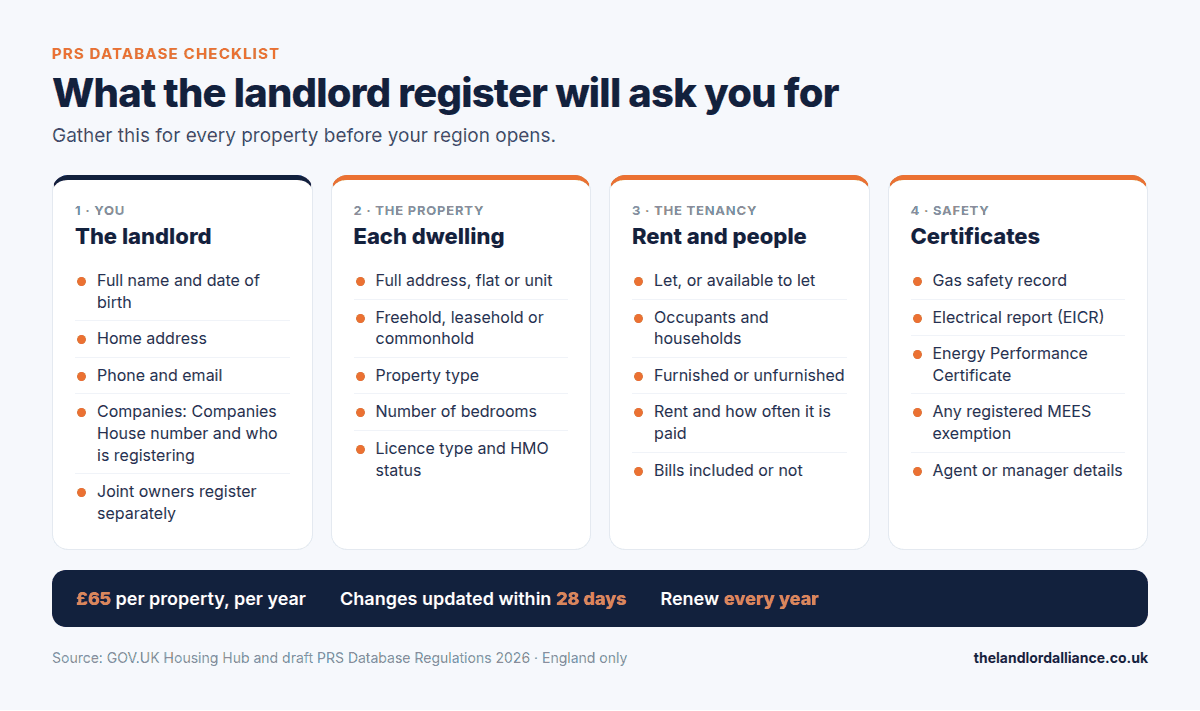
This is the part worth acting on now, because none of it is quick to assemble under time pressure. The lists below are taken from the official guidance on what the service will ask for.
| About you as a landlord | Notes |
|---|---|
| Full name | The legal owner, not a trading name |
| Date of birth | Individual landlords |
| Home address | Your residential address, not the property's. Organisations give an address that cannot be a PO box |
| Telephone number and email address | Used for service notifications |
| Company name, type and Companies House number | Company landlords |
| Name, date of birth, email and phone number of the person making the entry for the organisation | Company landlords |
| Names and dates of birth of directors or governing body members | Where no Companies House number is supplied |
| Lead trustee details with evidence of authority | Trusts |
| About each property | Why it trips people up |
|---|---|
| Full address including flat or unit identifier | Inconsistent addressing across tenancy, EPC and gas certificate is the single most common mess |
| Ownership type: freehold, leasehold or commonhold | Needs the title, not a memory |
| Property type | House, flat, maisonette, bedsit and so on |
| Number of bedrooms | Must match how the property is actually let, including any room converted from a reception |
| Whether the property is licensed, and the licence type | Selective, additional or mandatory HMO |
| Whether it is an HMO | Declared at registration |
| Property manager or agent details | Who is actually running it day to day |
| About the tenancy and the rent | Why it trips people up |
|---|---|
| Occupancy status — let, or available to let | Determines whether it needs registering at all in the first phase |
| Number of occupants and number of households | Households, not just people — this is what drives HMO status |
| Furnishing level | Furnished, part furnished, unfurnished |
| Rent amount | The rent actually being paid now, not the advertised figure |
| Rent frequency | Weekly and monthly get mixed up constantly — a £250 weekly rent is not £250 a month |
| Whether any utilities or bills are included | Common in HMOs and in all-inclusive lets |
| Safety and energy documents | What to check before you start |
|---|---|
| Gas safety record | In date — twelve-month cycle. Find the current certificate, not last year's |
| Electrical Installation Condition Report | Five-year cycle in the private sector, with any C1 or C2 remedial work evidenced |
| Energy Performance Certificate | Ten-year validity, and the rating drives your MEES position |
| MEES exemption details | Only if an exemption is actually registered on the PRS Exemptions Register |
Two of these deserve their own pages, because they are where landlords most often find a gap: the gas safety record and its twelve-month cycle, and the EICR and what a C1 or C2 code obliges you to do.
Every field on that list, stored against the property, before your region opens
The Landlord Alliance keeps your certificates, rents, occupancy and licence details in one place per property, warns you before anything expires, and gives you a single view of what is still missing — which is exactly the view the register is about to ask you for. £10 a month, founding member price locked in for life, cancel any time.
Start for £10 a monthLimited companies, SPVs and trusts
A question from the comments on my YouTube video about the register: how does this affect landlords who own through a limited company?
Same duty, different landlord. If a limited company owns the property and is the landlord on the tenancy, the company registers — not you personally — and the company pays the £65 for each property it lets.
| Your set-up | What gets registered |
|---|---|
| One limited company that owns your lets | One landlord entry for the company, then a property entry and a £65 fee for each property. The landlord registration number belongs to the company. |
| Several SPVs | Each company is a separate landlord, so each makes its own landlord entry and gets its own number. Register every property under the company that owns it and is named on the tenancy. |
| Some properties in your own name, some in a company | Two landlord entries: one for you as an individual, one for the company. Put each property under whichever of the two is the landlord on that tenancy. |
| A property owned jointly | The draft regulations say joint landlords each make their own landlord entry but share a single entry for the property. |
| A property held in a trust | The lead trustee's name, date of birth, address and contact details, with evidence of their authority to act. |
What a company has to supply
- The company name and its type of legal entity
- An address that is not a PO box, plus a telephone number and email address
- Its Companies House number, or charity number if it has one
- The name, date of birth, email and phone number of the person making the entry on the company's behalf
- If there is no Companies House number, the names, dates of birth and addresses of all directors, partners or members of the governing body
Does the company protect the directors?
For civil penalties, the company is the landlord, so the company is the one fined. The criminal offences are different. Section 92 of the Act says that where an offence by a company is committed with the consent or connivance of one of its officers, or is down to their neglect, the director commits the offence as well and can be prosecuted personally. That covers knowingly or recklessly giving false information, carrying on with a breach after a penalty, and repeat breaches. Incorporating does not put a wall between you and the register.
The possession restriction applies to companies in exactly the same way. An unregistered SPV cannot get a possession order on the ordinary section 8 grounds any more than an individual landlord can.
Moving properties into a company? The transfer changes who the landlord is, so the company needs its own landlord entry and the property needs registering under it. The draft regulations anticipate this: normally only one active entry can exist for a property, but there is an exception to allow a sale where the property carries on being privately let by the new landlord. Build the registration into your incorporation timetable rather than finding out afterwards.
Your readiness checklist
Tick these off as you go — your progress is saved in this browser.
Or let something else hold the list. Compliance tracking, expiry reminders and a per-property record of all of the above — £10 a month for the whole portfolio.
See what is includedKeeping your registration up to date
Registering is not a one-off. The draft regulations add an ongoing duty that most coverage has missed.
Section 78 of the Act requires landlords to keep their entries up to date, and the draft Private Rented Sector Database Regulations 2026 set the clock: information and documents in your entries must be updated within 28 days of becoming out of date.
| Something changes | What to do |
|---|---|
| You renew the gas safety record, EICR or EPC | Add the new certificate within 28 days |
| The rent changes after a section 13 increase | Update the rent within 28 days |
| Tenants move out and new ones move in | Update the occupants and households within 28 days |
| Your phone number, email or address changes | Update your landlord entry within 28 days |
| You get, renew or lose a property licence | Update the licence details within 28 days |
Do you pay again when something changes? Nothing published so far charges for updating an entry — the fee is annual, per property. Each entry lasts a year and then has to be renewed, and if you let several properties the later ones renew on the same date as your first, so you have one renewal date. An entry that is not renewed becomes inactive, which puts you straight back in breach.
This is where a system beats a folder. The Landlord Alliance already records the certificates, rent changes and tenancies on each property and reminds you before certificates expire — the same list of changes the register wants to hear about. £10 a month. See what is included.
Registration numbers in adverts
The detail most coverage has skipped, and the one letting agents will notice first.
Registration produces two numbers: a Landlord Registration Number for you, and a Property Registration Number for each property. Two separate marketing rules sit in section 82 of the Act, and they do not switch on at the same time.
| Rule | What the Act says | When it bites |
|---|---|---|
| No marketing unless registered | A property must not be marketed for let unless the landlord and the property both have active entries on the database. | Once the registration requirement applies to the property. For homes that are empty today, the government says future legislation will require registration before they are marketed. |
| Numbers in adverts | Written adverts must include the unique identifiers for the landlord and the property. | Not yet. The government says this comes in under future legislation as the public side of the service rolls out, with guidance published first. |
Where a property is jointly owned, the draft regulations say each joint landlord makes their own landlord entry, sharing one entry for the property. So a couple who own a flat between them need two landlord registrations, not one — and when the advert rule does switch on, expect both of their numbers to be needed in the listing.
This is the part that bites in practice. A fine for late registration is a discrete event you can deal with. Being unable to advertise is a void period that grows every week — and it lands at exactly the moment you need to re-let. If your region opens in December and you have a tenancy ending in April, register in December.
Fines, possession and rent repayment
Three separate consequences, frequently mixed up in the coverage.
| What happened | What can follow | Who decides |
|---|---|---|
| Letting or advertising a property without the required registration | Civil penalty up to £7,000 | Local council |
| Knowingly or recklessly giving false or misleading information, carrying on a breach more than 28 days after a penalty, or a further breach within five years | Civil penalty up to £40,000, or criminal prosecution | Local council, or the courts |
| Continuing to fail to register after a civil penalty | A rent repayment order can follow | First-tier Tribunal |
| Seeking possession while in breach of the duty to register | Possession order restricted, except on ground 7A or ground 14 (anti-social behaviour) | The court |
Who actually fines you? The local council for the area the property is in. A civil penalty is imposed by the council, not by a court, and you can appeal it to the First-tier Tribunal. Prosecution for the section 92 offences takes place in the magistrates' court, and a landlord who has already been given a financial penalty for conduct cannot then be convicted of the false-information or repeat-breach offences for the same conduct.
The possession restriction is the one that matters most
Since section 21 ended on 1 May 2026, the only way to recover a property in England is a section 8 ground. Registration sits in front of that door. If you are in breach of the duty to register, the court cannot make a possession order against you except on ground 7A or ground 14, which are the anti-social behaviour grounds.
Read that again in practical terms: an unregistered landlord with serious rent arrears, or one who needs the property back in order to sell, has no route to possession until the registration is fixed. That is a far bigger commercial risk than a £7,000 penalty, and it is why I would not leave this to the last fortnight of the window.
Rent repayment orders
A rent repayment order is a separate route with its own test. It requires a qualifying offence and a tribunal decision — it does not follow automatically from a missed deadline. What has changed is the scale: for offences committed on or after 1 May 2026, rent repayment orders run to up to two years' rent, doubled from twelve months, and the list of qualifying offences was widened.
So the honest version is this. Missing a registration deadline does not automatically hand your tenant two years of rent. But continuing to fail to register after the council has already penalised you can put a rent repayment order on the table, and the ceiling on that order is now twice what it used to be.
The cheapest insurance against all of this is a system that does not forget. Deadline reminders, certificate expiry alerts and a per-property compliance record — £10 a month.
Join The Landlord AllianceWho can see your information
The biggest worry in the comments on my video — and the part the government has decided least.
There are three audiences for what you register, and only the first has been settled.
| Who | What they get | Status |
|---|---|---|
| Your council | The information you register, to target enforcement. Giving councils property-level data they currently have to assemble by hand is one of the stated aims. | Confirmed |
| Tenants | The government says tenants will be able to use the service to check whether a landlord is compliant with key legal requirements. | Coming later |
| The general public | The government says it does not envisage all the data being publicly accessible, and will publish the list of what the public can see at a later stage, through further regulations. | Not yet decided |
So, to the questions people keep asking — will my rent be public, will my home address be public, could someone search my name and find every property I own? None of that is decided in anything published so far. Anyone telling you for certain that names, rents or addresses will or will not be shown is ahead of the government. What is settled is that the information exists and councils can use it.
Can you opt out or have your details removed? No. Registration is a legal duty for a landlord of an assured or regulated tenancy, not a service you can decline. Data protection law still governs how the operator holds and uses what you give it.
One sensible step while you wait. Sign up to HM Land Registry's free Property Alert service for each property. It emails you if someone applies to change the register for your property — for example to take out a mortgage against it — which is a cheap defence against title fraud, whatever ends up being public.
Existing tenants and empty homes
Two questions I get constantly, with different answers.
A long-standing tenancy still has to be registered
- The duty covers assured and regulated tenancies, including ones that started years ago
- There is no exemption for a tenant who has lived there a decade and is not moving
- No new advert is needed to trigger it — the property is let, so it is in scope
- Register on your region's timetable like any other property
An empty property is a phase, not an exemption
- Initial guidance says unoccupied properties do not need registering yet
- Further legislation will require registration before you or your agent market it
- So a renovation project escapes for now and gets caught the moment you advertise
- Put a registration check into your pre-marketing routine now, not later
The practical version: if it is let today, it needs registering in your window. If it is empty today, register it before you advertise it, and expect that to become a formal requirement rather than good practice.
Lodgers, council homes, small HMOs and other edge cases
The duty follows the type of tenancy, not the size of the landlord.
Registration applies to landlords of assured and regulated tenancies in England. That one phrase answers most of the edge-case questions I get.
| Situation | Do you register? |
|---|---|
| A lodger in the home you live in, sharing your kitchen or bathroom | No. A letting by a resident landlord cannot be an assured tenancy (Housing Act 1988, Schedule 1, paragraph 10), so a genuine lodger arrangement sits outside the duty. |
| Rooms let to “lodgers” in a house you do not live in | Almost certainly yes. If you do not live there, they are not lodgers in the legal sense. Room lets in a house you do not occupy are normally assured tenancies, and the property is in scope. |
| A small HMO that does not need a licence | Yes. Licensing and registration are separate duties. You declare the HMO status and licence position when you register. |
| A property you already hold a selective or HMO licence for | Yes. A licence does not exempt you. See below. |
| A council home | Not on this service. Council tenancies are secure tenancies, not assured ones. |
| Supported exempt accommodation | No. The government has confirmed it is outside the service. |
| A property you own but do not let | No, while it is not let. If you decide to let it, future legislation will require registration before it is marketed. |
The expired EPC question
Where the published guidance genuinely stops — and where it does not.
This is the question I have been asked more than any other since the announcement, and it deserves a careful answer rather than a confident one.
An EPC is valid for ten years. The duty to provide one is triggered when a property is to be sold or rented out (Energy Performance of Buildings Regulations 2012, regulation 6), not continuously through a tenancy. So a certificate that expires part-way through an ongoing tenancy does not have to be renewed simply because it has expired. So a tenant who moved in during 2018 on a 2016 certificate does not, by that fact alone, trigger a renewal in 2026.
What the published material does not yet settle is how the registration service will handle that. The service asks for EPC information. Whether it will accept a legitimately expired certificate on a continuing tenancy, or push you towards a new one, is not answered in the guidance available as at 10 September 2026. Anyone telling you definitively either way is guessing.
What to do about it now. Keep the old certificate and the tenancy start date together, so you can evidence why it expired mid-tenancy. Do not describe an expired certificate as current on any form. And check the detailed registration instructions when they are published for your region — that is when this gets answered. If you were planning to wait for the new EPC methodology before commissioning a certificate, that is a reasonable plan on a continuing tenancy, and it stops being one the moment you re-let.
Do not confuse validity with the minimum standard
Two separate things get tangled here. Certificate validity is one question. The minimum energy efficiency standard is another, and it is moving.
| Question | Position now | What is coming |
|---|---|---|
| How long does an EPC last? | Ten years from issue | New EPC methodology compulsory for new certificates from 1 October 2029 |
| What rating do I need to let? | Band E, unless a valid exemption is registered | Band C for all tenancies by 1 October 2030, not just new ones |
| What is the penalty? | Currently capped at £5,000 in total under MEES | Proposed up to £30,000 per property, per breach under the new regulations |
If your portfolio has D and E rated stock, the register is the small problem. We cover the bigger one in detail on what the 2030 EPC C requirement actually means and how MEES and its exemptions work today. There is also a rundown of the grant funding that can take a chunk out of the upgrade cost.
Does it replace selective or HMO licensing?
No. Do not let a licence lapse on this assumption.
The government's own guide keeps selective licensing in place as a complementary tool. Its argument is that the database removes the biggest barrier councils face — simply knowing which properties are rented — which may reduce how much licensing is needed over time. That is a long way from abolishing it.
So you may end up doing all three: national registration, a selective licence if your council operates a scheme in that street, and an HMO licence if the property is licensable. They are separate duties with separate fees, separate renewal dates and separate penalties.
Not sure whether your property needs a licence? Our free checker walks through mandatory, additional and selective licensing by property type.
Check licensingIf it does, the property licensing guide covers what the application involves and what councils look for.
HMOs, rooms and converted flats
The one genuinely unanswered charging question.
£65 per property is straightforward for a self-contained house or flat on a single tenancy. It is not obvious what it means for:
- A house let by the room on six separate tenancy agreements
- A building converted into four self-contained flats under one title
- A property with a licensed HMO on the upper floors and a separate ground-floor let
HMO status is something you declare during registration, and the fee is described as being calculated per property rather than per landlord. But whether "property" means the building, the dwelling or the tenancy in each of those cases is not settled by the guidance published so far. The sources checked do not support a universal answer, and I would rather say that than invent one.
What to do in the meantime: build a schedule of your units, the tenancy arrangement on each, and any existing licence, so that when the detailed instructions land you can price it in an afternoon instead of a weekend. If you let by the room, the HMO licensing guide is the place to start on the licensing half of it.
Can your letting agent do it for you?
Not the registration itself. Parts of the paperwork, yes.
The government is explicit that landlords must start and complete the registration themselves. Agents will be able to supply certain information on your behalf, with further instructions to follow, but the duty and the liability stay with you. Full stop.
That makes one conversation worth having now, well before your region opens:
Ask your agent
- Which of my certificates do you actually hold, and can you send me copies now?
- What rent figure and frequency are you holding for each property?
- How many occupants and households are recorded on each tenancy?
- Will you be uploading information to the register on my behalf, and when?
- Is there a charge for that, or is it inside my existing fee?
What is not good enough
- "My agent deals with everything" — that is not an audit trail
- An agreement made on a phone call with nothing in writing
- Assuming the agent is watching your regional deadline for you
- Discovering at renewal that neither of you registered the property
Scotland, Wales and Northern Ireland
This is an England scheme. The rest of the UK already has its own.
| Nation | Scheme | Shape of it |
|---|---|---|
| England | Register your rental property (PRS Database) | New. £65 per property per year, regional rollout from 15 December 2026 |
| Scotland | Scottish Landlord Register | Long established. Registration with the local authority, renewed on a three-year cycle |
| Wales | Rent Smart Wales | Long established. Registration and licensing are separate steps, with training required to be licensed |
| Northern Ireland | Landlord Registration Scheme | Long established. One registration covers the landlord's properties, on a three-year cycle |
The structural difference worth noticing: England has gone for an annual, per-property fee. Northern Ireland and Scotland charge per landlord or per multi-year cycle. Over a ten-property portfolio across a decade, that design choice is the difference between a few hundred pounds and several thousand.
HMRC and rent increase disputes
Announced at the same time. A different reform, and not live yet.
Alongside the register, the government said that initial decisions on rent increase challenges will move to HMRC's Valuation Office, with the stated aim of faster decisions and less pressure on the tribunal system.
It is not operating yet. A tenant challenging a rent increase today still applies to the First-tier Tribunal, and that stays the route while the new arrangements are built. Tenants also will not pay the increased rent until the case is finally decided.
One thing this is not: a system that approves your rent increases. It is a route for challenging them. If you are working through a rent increase, the mechanics are on the section 13 notice page, and there is a calculator for the numbers.
Prefer it on paper? The full 38-page handbook has a schedule for every property, a printable document pack and the 20-point checklist. Free, emailed to you.
Send me the handbookA twelve-step preparation plan
Organisation, not extra law. This is the order I would do it in.
- List every English property you let. One line each, with the full address exactly as it appears on the title.
- Put the region against each one. Use the finder above. Sort by deadline.
- Set an internal target four weeks before each real deadline. The real date is when you are in breach; your date is when you act.
- Decide whether to do them all in December. If you own across regions, doing everything in one sitting once the service opens removes eleven months of tracking.
- Budget the fee. £65 per property, annually, as a fixed cost. Keep any agent admin charge separate from it so you can see what the agent is charging you for.
- Pull the certificates. Gas, EICR, EPC for each property, in one folder per property. Open every file — a corrupt scan you cannot read is the same as not having it.
- Check the dates on all of them. Anything expiring before your registration window is a job to book now, not later.
- Reconcile the rent. Confirm the current rent and its frequency against your bank statements, not against the tenancy agreement, which may be out of date.
- Confirm occupancy. Number of people and number of households, per property. This drives HMO status.
- Sort the joint ownership. Every joint owner needs their own landlord registration, so establish now who is doing what.
- Have the agent conversation. Written allocation of who supplies what, who checks it, and what it costs.
- Keep the completion evidence. Registration numbers, confirmation emails, dates. Then diarise the annual renewal, because this repeats every year.
If you can answer three questions for every property — what is due, who is doing it, and where is the evidence it was done — you are ready. Most landlords cannot answer the third one, and that is the gap the register is going to expose.
Stop keeping this in your head and a folder of emails
The Landlord Alliance gives every property a record: certificates with expiry alerts, rent and occupancy, licence status, documents and a compliance view that shows what is missing. Built by a UK landlord for UK landlords, and priced to be obvious — £10 a month, founding member price locked in for life, no setup fee, cancel any time.
Join for £10 a monthRead next
Questions landlords are asking
Is the landlord register live yet?
Not yet. The service opens for the West Midlands on 15 December 2026 and then reaches a new region each month until the South West on 15 August 2027. Nothing is required of you before your region opens, but you can register early once the service is running.
How much does it cost to register?
£65 per property, per year. It is not a single fee covering a whole portfolio, and it renews annually. Ten properties is £650 a year, every year.
Which region am I in if I live somewhere else?
The region is decided by where the property is, not where you live. If you live in Leeds and let a flat in Coventry, that flat is on the West Midlands timetable, opening 15 December 2026.
What happens if I miss my deadline?
A council can issue a civil penalty of up to £7,000, rising to £40,000 or prosecution for repeated breaches or false information. Separately, while you are in breach you cannot advertise the property and a court cannot grant you possession except on the anti-social behaviour grounds 7A and 14. Those are maximum penalties, not automatic fixed charges.
Do I need to register a property that already has a long-term tenant?
Yes. The duty covers assured and regulated tenancies including existing ones. There is no exemption for an established tenancy and no need for a new advert to trigger it.
Do I have to register an empty property?
Not in the first phase — the initial guidance says unoccupied properties do not need registering yet. Further legislation will require registration before you or your agent market it for let, so treat it as a delay rather than an exemption.
Can my letting agent register for me?
No. You must start and complete the registration yourself. Agents will be able to supply certain information on your behalf once further instructions are published, but the legal duty and the liability remain yours.
What if my EPC expired during the tenancy?
An EPC lasts ten years and, under the current position, does not have to be renewed purely because it expires part-way through a continuing tenancy. How the registration service will treat an expired certificate is not settled in the guidance published so far. Keep the old certificate and the tenancy start records, and check the detailed instructions when they are released for your region.
Do I need to register my rental property?
If you let it on an assured or regulated tenancy in England, yes. That includes tenancies that started years ago and tenants who are not moving. Unoccupied properties are outside the first phase, but will need registering before you or your agent market them for let.
How do I register on the landlord database?
You start and complete it yourself on the Government service called Register your rental property, once it opens for your region. You register yourself as a landlord, then each property, and pay £65 per property per year. You are then issued a Landlord Registration Number and a Property Registration Number. The detailed screens have not been published yet — the confirmed steps are set out in the how-to-register section above.
When does the landlord register open in my region?
West Midlands first on 15 December 2026, then a new region each month: East of England, East Midlands, South East, Yorkshire and the Humber, North West, North East, London, and finally the South West on 15 August 2027. Each region then has three months. Use the deadline finder at the top of this page to get your own two dates.
Does registering replace my selective or HMO licence?
No. Selective licensing remains in place as a complementary tool, and HMO licensing is unaffected. You may end up with national registration plus one or two licences, each with its own fee and renewal date.
Do I need to put a registration number in my adverts?
Not yet. The Act says written adverts must include both the landlord and the property identifiers, but the government says that part will switch on later, under future legislation as the public side of the service rolls out, with guidance first. Separately, once the requirement applies to a property it must not be marketed at all without active registration entries.
Is the fee per property or per bedroom?
The fee is described as per property, per year. What that means for a house let by the room, or a building divided into several self-contained units, is not answered by the guidance published so far. Prepare a schedule of your units and tenancy arrangements and check the treatment of your actual layout when the detailed instructions arrive.
How does the landlord register work if my properties are in a limited company?
The company registers, not you personally. It makes one landlord entry with its name, Companies House number and the details of the person registering for it, then pays £65 for each property it lets. Several SPVs means several landlord entries. Directors are not shielded from the offences: where a company commits one with a director's consent, connivance or neglect, the director commits it too. Full breakdown above.
Which region is Essex, Hampshire, or Kingston and Richmond in?
Go by the local authority the property is in, not the postcode. Essex is East of England, opening 15 January 2027. Hampshire is South East, opening 15 March 2027. Kingston upon Thames and Richmond upon Thames are London boroughs, so they are on the London timetable from 15 July 2027, even with a KT or TW postcode. The deadline finder above covers everywhere else.
Will my rent, name or home address be made public?
Not decided. Councils will see what you register, and the government says tenants will be able to check whether a landlord is compliant with key requirements. It says it does not envisage all data being public, and the list of what the public can see will come in later regulations. More above.
Is it worth registering early?
The government says the fee will be pro-rated during the rollout so that landlords who sign up first do not pay more. Registering early should not cost extra, and it removes the risk of a problem surfacing in the last week of your window.
Is the £65 fee tax deductible, and can I charge it to my tenant?
It is a cost of running a letting business, so in normal circumstances it is treated like your other allowable expenses — confirm with your accountant. You cannot charge it to a tenant as a fee: the Tenant Fees Act 2019 does not allow it. It can only reach the rent through a section 13 rent increase.
Do I pay again every time a tenant changes?
No fee for updates has been published. The fee is annual, per property. But you must update the entry within 28 days when something changes, such as new occupants, a new rent or a renewed certificate.
Do I need to register a lodger?
Not if they are a genuine lodger in the home you live in. A letting by a resident landlord cannot be an assured tenancy, so it falls outside the duty. If you do not live in the property, people renting rooms there are normally assured tenants and the property must be registered.
Who issues the fines, the council or the courts?
The council for the area the property is in issues civil penalties, and you can appeal to the First-tier Tribunal. Criminal prosecution for the offences in section 92 goes through the magistrates' court.
What counts as a bedroom?
The guidance published so far does not define it. Two statutory yardsticks help: the Housing Act 1985 space standard ignores rooms under 50 square feet (4.64 square metres), and a licensed HMO cannot use a room under 4.64 square metres as sleeping accommodation at all, with 6.51 square metres the minimum for one adult. Count rooms actually let and used as bedrooms, and keep the number consistent with your licence and tenancy paperwork.
Do councils have to register their own council homes?
Not on this service. The duty covers assured and regulated tenancies, and council tenancies are secure tenancies.
Does this apply in Wales or Scotland?
No. This is an England scheme. Scotland has the Scottish Landlord Register, Wales has Rent Smart Wales, and Northern Ireland has its own Landlord Registration Scheme, all with different fees, cycles and requirements.
Your region opens sooner than it feels
The register is going to ask you, property by property, for information most landlords keep in four different places. The Landlord Alliance keeps it in one, tells you what is missing and reminds you before anything expires — for less than the cost of registering two properties. £10 a month. Founding member price, locked in for life. Cancel any time.
Join The Landlord AllianceEngland only. Position as at 10 September 2026. General information from a landlord, not legal advice. This page will be updated when the detailed service instructions are published, particularly on expired EPCs, multi-unit properties, and public access to the register.
Sources: GOV.UK Housing Hub — Get ready to register; GOV.UK — Guide to the Renters' Rights Act; GOV.UK — Stronger protections and greater confidence for renters; GOV.UK — MEES landlord guidance; Energy Performance of Buildings Regulations 2012, regulation 6; Renters' Rights Act 2025, Part 2 Chapter 3 (sections 75 to 92); Draft PRS Database Regulations 2026 — explanatory memorandum; Shelter Legal — rent repayment orders.
Related: Renters' Rights Act · Landlord compliance · EPC 2030 changes · Section 8 grounds · Free landlord tools
Register-ready in one place. Certificates, rents, occupancy and expiry reminders for your whole portfolio — £10 a month.
Join nowGet the free 38-page handbook
Every regional deadline, the £65 fee, the fines, and four printable worksheets for your portfolio. We will email it to you now.
- Portfolio schedule — one line per property, sorted by deadline
- Per-property document pack, ready to print
- The 20-point readiness checklist
- Full region lookup for every part of England
We will send you the handbook and occasional updates for UK landlords. Unsubscribe any time. No spam, ever.