
The short version
On 11 November 2026 the government confirmed start dates for the new service charge rules in the Leasehold and Freehold Reform Act 2024. From 1 April 2027 you can demand information about what you pay and why, going back years, and your landlord can no longer put its legal costs on your bill without a court or tribunal’s approval. From 1 November 2027 private landlords must send standard bills, accounts and an annual report, stop passing on insurance commission and publish their admin fees in advance. Councils and housing associations follow on 1 November 2028. Nothing caps your service charge, but the law now favours the person paying the bill.
I’m a landlord, not a lawyer. When the announcement landed I read it against the Act itself and the commencement regulations the Housing Minister signed on 25 October, because the headlines skip the part that matters to anyone holding a service charge bill: which of these rights can you use today, which arrive in April, and which are still only a promise? This page answers that, and gives you seven calculators to run your own numbers through each change.
If you own a flat to live in, this is your money. If you let flats, it is just as much yours. The government’s own figures count 4.83 million leasehold homes in England, and 1.96 million of them (41%) are owned by landlords and let to private tenants. Service charges are often the biggest cost on a buy-to-let flat after the mortgage, and the one the owner controls least.
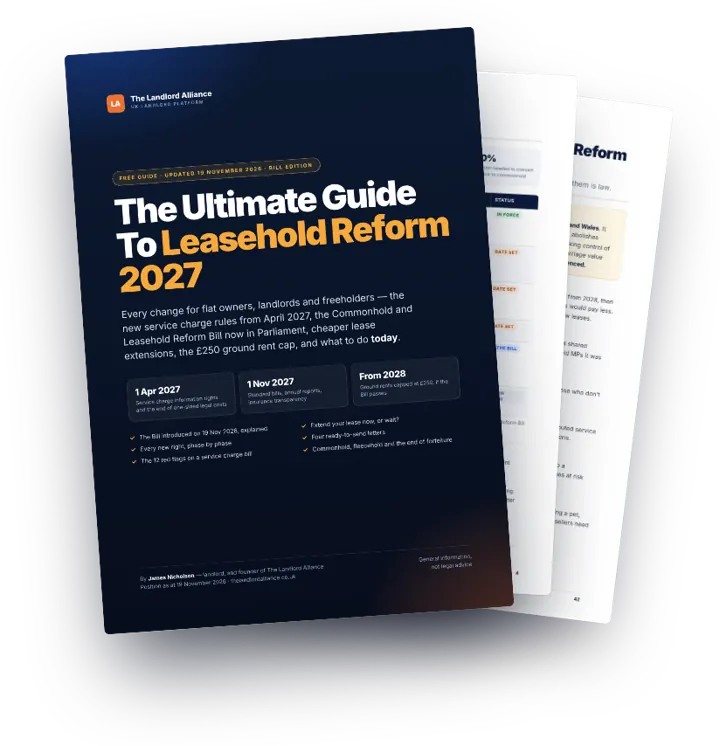
Free guide · 52 pages
Want the whole story? Get The Ultimate Guide To Leasehold Reform 2027
- Four letters you can adapt and send this week
- All 12 red flags on a service charge bill
- The 24-point checklist for buying a leasehold flat
- The Commonhold and Leasehold Reform Bill, change by change
On this page
- What was announced on 11 November
- The new service charge rules, date by date
- 1 April 2027: the right to know, and legal costs
- 1 November 2027: standard bills and insurance
- 1 November 2028: councils and housing associations
- The rights you already have, and the bill checker
- Should you stop paying?
- If you let a leasehold flat
- If you own the freehold
- What comes next: the Bill now in Parliament
- What is still not switched on
- Why it has taken 140 years
- Your action plan to November 2028
- Questions people are asking
What was announced on 11 November 2026
Five sets of regulations, three start dates, and a bigger Bill promised before Christmas.
The Ministry of Housing, Communities and Local Government said that flat owners had been handed a “massive boost” to fight rip-off service charges. Behind the headline there are three separate things, and it pays to keep them apart.
First, the 2024 Act is finally being switched on. The Leasehold and Freehold Reform Act 2024 received Royal Assent on 24 May 2024 and has done very little since. Its service charge chapter, Part 4, needed a commencement order before any of it could apply. That order now exists: the Leasehold and Freehold Reform Act 2024 (Commencement No. 4 and Saving Provision) (England) Regulations 2026, SI 2026/1128, made on 25 October 2026. It fixes the dates in law: 1 April 2027, 1 November 2027 and 1 November 2028.
Second, the detail is going before Parliament. The government said five sets of regulations would be laid on 12 November 2026, covering service charges, information, building insurance and landlords’ legal costs, with a sixth set on litigation costs to follow before the end of 2026. The prescribed forms, information lists and deadlines live in those regulations. They need Parliament’s approval, so the detail can still move. The start dates are already law.
Third, a bigger Bill. The government promised the Commonhold and Leasehold Reform Bill before Christmas, and introduced it in Parliament on 19 November 2026. That Bill, not these regulations, is the one that would cap ground rents at £250, make commonhold the default for new flats and abolish forfeiture. It is Proposed and not law.
“Rapidly escalating and frequently opaque service charges are placing huge financial strain on hard-pressed leaseholders,” said the Housing Minister, Matthew Pennycook. The Leasehold Advisory Service, the government-funded advice body, said service charges are the issue leaseholders contact it about most.
What the announcement does not do
It does
- Make service charges visible, in a standard format
- Remove the legal-costs threat that stopped people challenging
- Stop insurance commission being passed on
- Make admin fees knowable in advance
It does not
- Cap service charges. Nobody is setting a maximum
- Make lease extensions cheaper yet. Marriage value is still payable
- Apply in Wales on these dates
- Change anything before 1 April 2027
The new service charge rules, date by date
Every change, who it applies to and whether it is law yet.
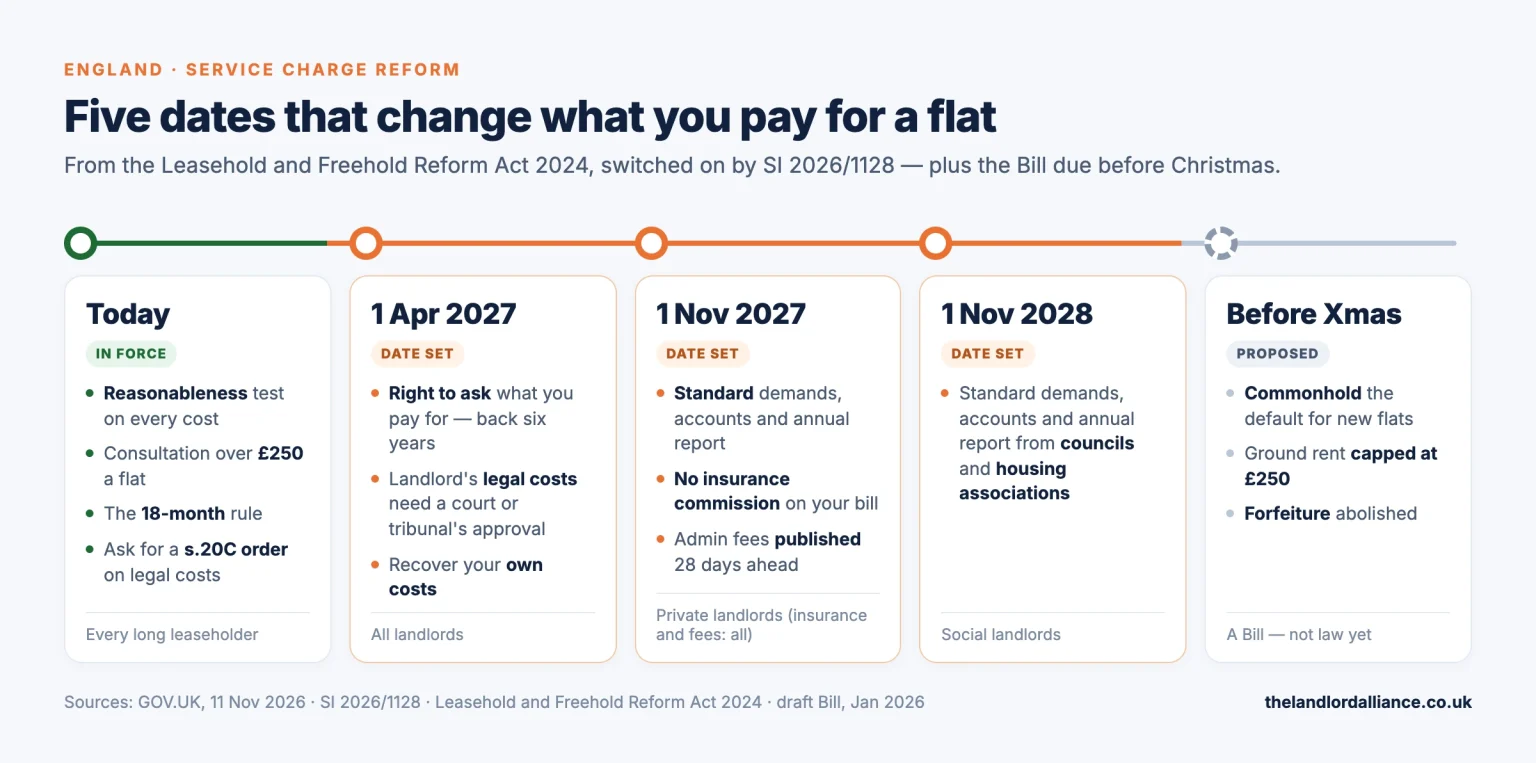
| When | What changes for leaseholders | Applies to |
|---|---|---|
| Now In force | Reasonableness test, section 20 consultation, the 18-month rule, summary of costs and inspection, insurance summary, tribunal challenges, section 20C orders. The full list is below. | All long leaseholders |
| 6 Nov 2026 In force | Powers only: ministers can now make the detailed regulations. No new duties on landlords yet. | — |
| 1 Apr 2027 Date set | Right to request service charge and management information, including previous years. Landlord’s legal costs not recoverable without a court or tribunal order. New right to apply for your own legal costs. Prescribed future demand notice for costs over 18 months old. Fixed service charges brought into the statutory regime. | All landlords of leaseholders |
| 1 Nov 2027 Date set | Standard demand forms, standard accounts and an annual report. Insurance commission can’t be recovered through the service charge; prescribed insurance information. Admin charges payable only if published 28 days in advance. | Standard forms: private landlords. Insurance and admin fees: all landlords |
| 1 Nov 2028 Date set | Standard demand forms, accounts and annual reports. | Councils and housing associations |
| In Parliament In the Bill | Commonhold and Leasehold Reform Bill: commonhold the default for new flats, conversion with 50% support, existing ground rents capped at £250, forfeiture abolished. | If and when it passes |
1 April 2027: the right to know, and the end of one-sided legal costs
Phase one applies to every landlord, private or social.
A right to ask, going back six years
From 1 April 2027 you can demand information about your service charge: what you pay for and why, and how the building is managed, maintained, repaired, improved and insured. In its response to the consultation the government said the prescribed list will reach back six years, and landlords will need a good reason to refuse.
The response also sets the shape of the rules, with the exact deadlines to come in regulations:
- Deadlines on a sliding scale, depending on how old and how wide the request is.
- Information held by someone else: the landlord must start asking third parties within 15 working days, and their delays don’t stop the clock. A superior landlord who holds the information must hand it over.
- Inspection in person within up to three months of your request.
- Narrow grounds to refuse: commercially sensitive material is redacted rather than withheld, there is a tightly drawn rule on vexatious requests, and records that were lawfully disposed of, or never held, must be explained to you.
Today’s equivalent, a summary of costs under section 21 and inspection under section 22 of the 1985 Act, is narrower and usually needs you to know which section to quote. The new right is designed to work without a solicitor.
Your landlord’s legal bill stops being yours by default
This is the change that matters most, because it removes the threat that stopped people challenging anything. Many leases let the landlord recover its legal costs through the service charge. So if you disputed a bill at the tribunal, you could end up paying a share of the lawyers arguing against you, and so could every other flat in the block.
From 1 April 2027 a new section 20CA of the Landlord and Tenant Act 1985 says a landlord’s litigation costs in proceedings with a leaseholder cannot be counted in the service charge, and a new paragraph 5B of Schedule 11 to the 2002 Act says no administration charge is payable for them either, unless a court or tribunal orders otherwise on what it considers “just and equitable”. The presumption flips. Today you must apply to stop the costs being passed on. From April, the landlord must apply for permission to pass them on.
The government has said lower-value costs claimed as an administration charge will be exempt below a threshold, and that resident-led buildings and tribunal-appointed managers will get a temporary, safeguarded suspension. Those details are in the litigation costs regulations due before the end of 2026.
There is a second half: a new section 30J lets you apply for an order that the landlord pays some or all of your own legal costs, in the kinds of case the regulations specify.
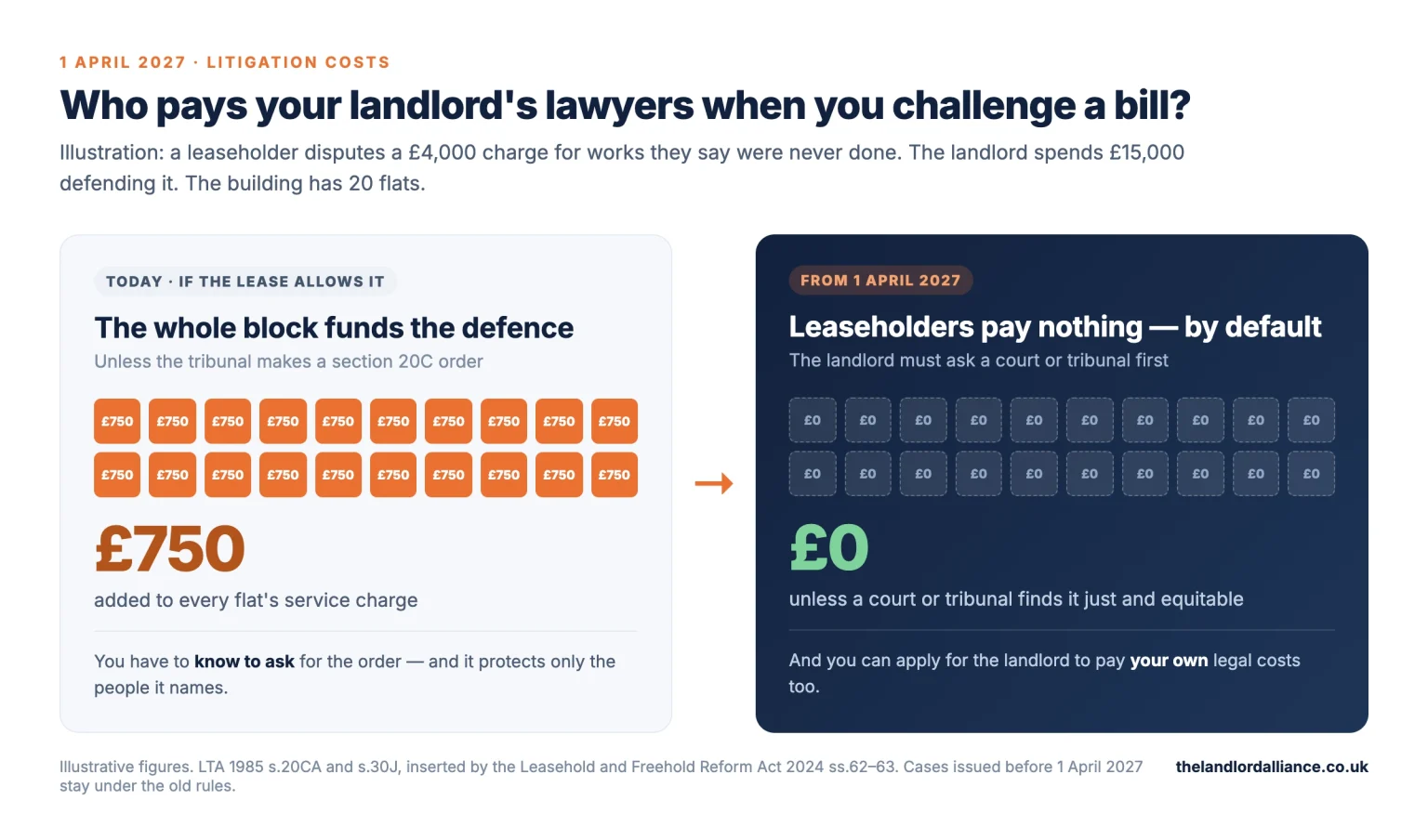
An illustration, not legal advice. The new rules don’t apply to proceedings issued before 1 April 2027 (SI 2026/1128, regulation 6). Exemptions for low-value administration charges and resident-led buildings will be set by regulations.
Going to the tribunal soon? Timing matters. Cases issued before 1 April 2027 stay under the current rules. If you issue before then, apply for a section 20C order (and a paragraph 5A order for administration charges) at the same time, so the landlord’s costs don’t come back to you. Ask a solicitor or the Leasehold Advisory Service whether issuing before or after the date is better in your case.
Late bills and fixed charges
Two smaller changes also start in April. A prescribed future demand notice replaces today’s informal section 20B warning for costs not billed within 18 months. The government says it will set out the estimated cost, your share, the expected demand date and your rights. And fixed service charges, which some leases use instead of variable ones, come within the statutory protections for the first time.
Chapter 3 of the free guide has the list of what to gather before April, so you know exactly what to ask for on day one. Get the free leasehold reform guide
1 November 2027: the bill itself changes shape
Phase two: standard paperwork from private landlords, and insurance and admin fee rules for everyone.
Standard demands, accounts and an annual report
Today a service charge demand can look like anything. From 1 November 2027 private landlords must use prescribed forms, so every leaseholder in England gets the same information in the same order. According to the government’s response:
- The initial demand comes with a budget for the year, using headline categories compared with the previous period. Interim and balancing demands follow the same format.
- Forms go by post unless you agree to receive them digitally.
- Accounts must be prepared and signed off by appropriately qualified professionals, under a standard reporting framework, with an accountant’s statement.
- An annual report covers the building’s condition, plans for major works, and a declaration of relevant relationships with third parties such as managing agents.
- Private landlords get at least 12 months’ notice of the final forms. Social landlords get 24.
The sting for landlords. Under the Act, if a demand isn’t in the prescribed form, the lease’s provisions about non-payment or late payment, such as interest and late fees, don’t apply to it. A landlord who keeps sending old-style bills loses its leverage.
Insurance: the commission ends
Buildings insurance is usually the biggest line on the bill, and the one that causes most anger, because the person choosing the insurer can also be paid by it. When the Financial Conduct Authority looked at the market, it found average broker commission per policy rose by 46% over its review period, and the brokers it studied paid more than £80 million of commission on to other parties, usually the freeholder or the managing agent.
From 1 November 2027, under a new section 20G of the 1985 Act:
- Commission and similar payments for arranging or managing the insurance become “excluded insurance costs” and cannot be counted in the service charge.
- The landlord can still recover a “permitted insurance payment”: a transparent, fair fee for the work it genuinely does. Regulations define it.
- Landlords must give you prescribed insurance information: connections and pay arrangements with brokers and insurers, how quotes were obtained and chosen, pricing and the reinstatement value.
- If commission is passed on anyway, the tribunal can order it repaid, plus damages of between one and three times the amount, payable by the landlord or anyone who benefited (section 20H).
Illustrative. Commission rates vary widely and some pay for genuine work. The point is that from 1 November 2027 you will be able to see it, and the tribunal can act if it is still passed on.
Admin fees: published, or not payable
Every landlord must publish a schedule of the administration charges it may demand: fees for consents, document packs, late payment and the like, with the fixed price or the method used to work it out. Under the new paragraph 4A of Schedule 11 to the 2002 Act, a charge is payable only if it appeared on the published schedule for 28 days before the day it is demanded. Revised schedules must be published at least 28 days before new charges take effect. No more discovering the price of a subletting consent on the day you need it.
What happens if a landlord ignores all this
| Failure | What the First-tier Tribunal can do | Where |
|---|---|---|
| Demand not in the prescribed form, annual report not provided, or requested information not given | Order compliance within 14 days; damages of up to £5,000 | LTA 1985 s.25A |
| Administration charge schedule not published | Order compliance within 14 days; damages of up to £1,000 | CLRA 2002 Sch 11 para 4B |
| Insurance commission passed on through the service charge | Repayment, plus damages of one to three times the amount paid | LTA 1985 s.20H |
1 November 2028: councils and housing associations
From 1 November 2028 the standard demand forms, accounts and annual reports extend to social landlords: housing associations, councils and certain joint-venture landlords. The government gave them twelve extra months because their accounting systems are more complex.
Only those three items wait. The information right, the legal costs change, the insurance rules and the admin fee schedule apply to social landlords from the same 2027 dates as everyone else. That matters to a large group: many Right to Buy leaseholders pay their service charge to a council, and many shared owners pay theirs to a housing association.
Don’t wait for 2027: the rights you have today
Ten protections that are law now. Most leaseholders have never used one of them.
The reforms make the information arrive without being asked for, and they remove the cost threat. But leaseholders have been able to challenge an unreasonable service charge since 1985. Almost everything below is in the Landlord and Tenant Act 1985.
| Your right | Where | What it gets you |
|---|---|---|
| Reasonableness | s.19 | Costs count only so far as they were reasonably incurred, and works only if of a reasonable standard. The foundation of every challenge. |
| Consultation on major works | s.20 | Works costing any one leaseholder over £250, or a contract over 12 months costing anyone over £100 a year, need consultation first. If not, the landlord can usually recover only £250 (or £100) each unless the tribunal grants dispensation. |
| The 18-month rule | s.20B | Costs incurred more than 18 months before you were billed aren’t payable, unless you were told in writing within that time. |
| Stopping legal costs | s.20C; CLRA 2002 Sch 11 para 5A | Ask the tribunal to stop the landlord’s costs of a case going on your service charge or an admin charge. |
| Summary of costs | s.21 | Ask in writing for a summary of the costs behind the service charge for an accounting period. |
| Summary of rights with every demand | s.21B | Every demand must come with the prescribed summary. Without it you may withhold payment until it is served. |
| Inspect the paperwork | s.22 | After the summary, inspect and copy the invoices, receipts and accounts. |
| Insurance information | Schedule | A summary of the cover, and the right to inspect the policy. |
| The tribunal | s.27A | The First-tier Tribunal decides whether a charge is payable, how much and when, even before the cost is incurred. |
| Recognised tenants’ association | s.29 | Leaseholders together get extra rights, including to be consulted and to appoint a surveyor. |
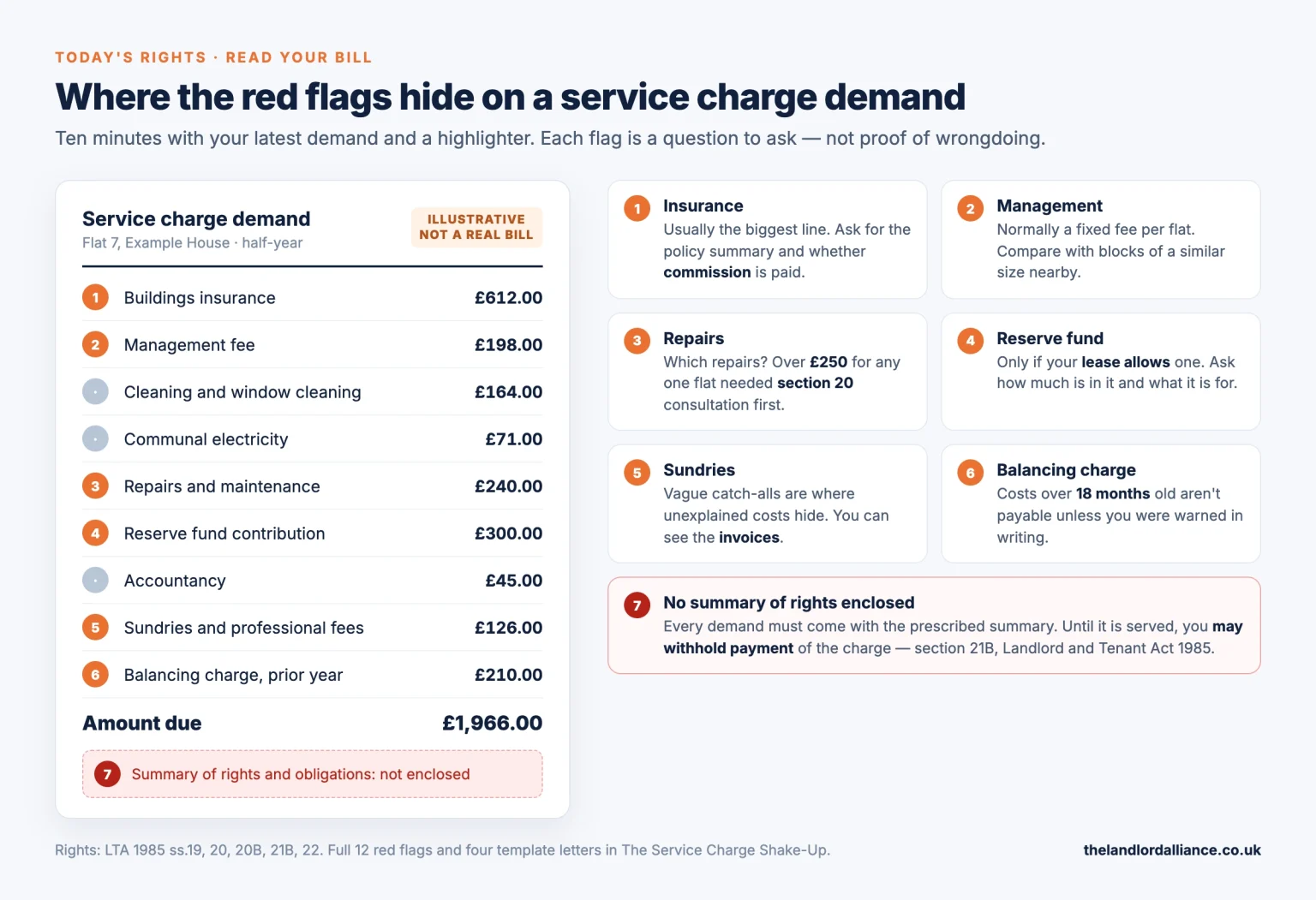
Tick anything that applies to your latest demand or accounts.
Thresholds from the Service Charges (Consultation Requirements) (England) Regulations 2003. The test is whether any one leaseholder pays more than the threshold, so works can need consultation even if your own share is under it. The tribunal can dispense with consultation where it is reasonable, often on terms.
Landlord and Tenant Act 1985 s.20B. It mainly bites on balancing charges and late one-off bills. From 1 April 2027 the written warning takes a prescribed form, the future demand notice.
Found a red flag? Chapter 9 of the guide has four letters ready to adapt: a summary of costs and inspection request, an insurance request, a letter disputing specific items, and observations on proposed major works. Download the letters free
How to challenge a service charge, in six steps
Tribunal fees went up in July 2026 and depend on the type of case, so check the current fee on the application form. Help with fees is available if you are on a low income.
Should you stop paying until the new rules start?
Almost always no. The new rules aren’t in force, and withholding has real risks. Pay what isn’t disputed and dispute the rest formally.
The safer path
- Pay the undisputed part, in writing, saying what you dispute and why
- If you must pay a disputed amount, say in writing you pay under protest and without prejudice to a tribunal application
- Withhold only where the law plainly lets you, such as a demand served without the summary of rights
- Take advice before withholding any significant sum
The risks of withholding
- Late-payment interest and admin charges, if your lease allows them
- Debt recovery in the county court, with costs
- Your mortgage lender being told, paying the arrears and adding them to your loan
- Forfeiture remains possible once arrears are decided by a court or tribunal, until the new Bill abolishes it
Paying doesn’t usually mean you’ve agreed a charge and lost the right to challenge it. An express agreement or admission can, which is why a written protest keeps your position clear.
If you let a leasehold flat: the yield the advert doesn’t show
Two in five leasehold homes are let to tenants. For landlords, a service charge is a line in your profit and loss you don’t control.
Gross yield, annual rent divided by price, flatters every leasehold flat because it ignores the two costs a house doesn’t have. Service charge and ground rent come off the top, before the agent, the repairs or the mortgage. Both are allowable expenses against rental income, but they still come out of your cash.
Gross yield: rent ÷ price.
For a full return after mortgage interest and tax, use our rental yield calculator.
Three things follow from those numbers.
- A service charge rise is a rent cut you can’t refuse. Under the Renters’ Rights Act you can only raise the rent once a year, through section 13, so read the last three years of accounts before you buy and ask what works are coming.
- Transparency is worth money to you. From November 2027, standard demands, accounts and annual reports mean you can compare flats in different blocks like for like, and challenge a bill without risking the landlord’s legal costs.
- The service charge is yours, not your tenant’s. The Tenant Fees Act 2019 limits what you can charge a tenant on top of rent, and service charges aren’t on the list. Your rent has to cover them.
Once a leasehold flat is let, get these right
- You answer to the freeholder for your tenant’s behaviour under the lease. Give the tenant the building rules.
- Get any consent to sublet the lease requires, and keep it on file.
- Know who fixes what. A leak from the flat above is usually the freeholder’s job, but your tenant will call you.
- Your own compliance still applies: gas safety, electrics, EPC, alarms and deposit protection. Ask for the building’s fire risk assessment too.
If you are still deciding whether a flat is worth buying at all, Fundamentals of Property Investing, our buy-to-let training course, walks through running the real numbers, leaseholds included, before you make an offer.
If you own the freehold, these rules are yours to follow
Plenty of investors are freeholders without thinking of themselves that way. You converted a house into three flats, sold two on long leases and kept one. You own a share of your block’s freehold company. You bought a small freehold for the ground rents. For these reforms, you are the landlord.
| Change | What it means for a small freeholder | From |
|---|---|---|
| Information requests | Leaseholders can ask what they pay for and why, back six years. Keep invoices and decisions organised and retrievable. | 1 Apr 2027 |
| Your legal costs | You can’t add the costs of a dispute to the service charge without a court or tribunal order. Resolve disputes early. | 1 Apr 2027 |
| Standard demands | Prescribed forms. An old-style demand loses the lease’s late-payment provisions. | 1 Nov 2027 |
| Accounts and annual report | Professionally prepared accounts and an annual report. Watch the regulations for any lighter rules for small buildings. | 1 Nov 2027 |
| Insurance | No commission through the service charge. Prescribed information. A fair fee for genuine work only. | 1 Nov 2027 |
| Admin fees | Publish a schedule. A charge is payable only once it has been on it for 28 days. | 1 Nov 2027 |
What comes next: the Commonhold and Leasehold Reform Bill
In the Bill Introduced in Parliament on 19 November 2026. None of this is law yet.
The government published the Bill in draft on 27 January 2026 and introduced it in Parliament on 19 November 2026 (GOV.UK, 18 November 2026). Our free leasehold reform guide takes the Bill as introduced, change by change. Based on the January draft, it would:
- Make commonhold the default for most new flats and ban new leasehold flats, with exemptions still being decided. The Housing Minister told MPs a ban before the next general election was “highly unlikely”.
- Let existing buildings convert to commonhold with 50% support rather than every leaseholder agreeing.
- Cap existing ground rents at £250 a year for most long residential leases of single homes granted for a premium, falling to a peppercorn (nothing) after 40 years. The government has said it expects the cap to start in 2028.
- Abolish forfeiture, the landlord’s right to take a flat back for a breach, even over a small debt, and replace it with a proportionate scheme overseen by the courts.
- Repeal old rentcharge enforcement powers that can let an estate rentcharge owner take possession of a freehold house over a small arrear.
The Commons Housing, Communities and Local Government Committee scrutinised the draft and reported on 27 May 2026. It supported the ground rent cap but asked for evidence for a 40-year transition rather than 20, wanted the cap to apply two months after Royal Assent, called the absence of managing agent regulation a significant shortcoming, and expected a human rights challenge from investors.
Proposed law only: the cap’s amount, start date and 40-year transition could all change in Parliament. Don’t stop paying ground rent in anticipation. Figures are not discounted for inflation.
Commonhold versus leasehold, in one table
| Leasehold flat | Commonhold unit |
|---|---|
| You own the flat for a term of years, which runs down | You own it outright, with no end date |
| A freeholder decides on services, contractors and insurance | The owners’ association owns the common parts, and you vote |
| Ground rent may be payable | No ground rent |
| Extending the lease or buying the freehold costs money | Nothing to extend, nothing to buy |
| Forfeiture possible, until abolished | Rules in a standard Commonhold Community Statement, plus a mandatory reserve fund |
What is still not switched on
The headline promises of the 2024 Act are still not in force, so the old law applies:
- Abolition of marriage value, the extra premium when you extend a lease with 80 years or less left Not in force
- 990-year lease extensions at a peppercorn ground rent, instead of 90 years for flats Not in force
- The new valuation method for extensions and freehold purchases Not in force
- The ban on new leasehold houses Not in force
Two smaller changes are already law: you no longer have to own a flat for two years before claiming a statutory lease extension (since 31 January 2025), and Right to Manage now covers buildings with up to 50% commercial space, usually without paying the freeholder’s costs (since 3 March 2025).
The 80-year trap. If a lease you own is close to 80 years, waiting for reform is a gamble. Once it drops to 80 years or below, marriage value is payable and the cost of extending can jump. Nobody can tell you when, or in what form, the valuation reforms will start, and they face a legal challenge from freeholders. Get a valuation and take advice while you still have the choice.
Why it has taken 140 years
England sells flats on leases because of a court case about a road. In Austerberry v Oldham Corporation (1885), the Court of Appeal held that a promise to do something, such as repairing a road, doesn’t automatically bind the next owner of freehold land. A block of flats runs on exactly those promises: the top floor needs the roof repaired and the ground floor holds everyone up. Obligations in a lease do bind whoever owns it, so flats were sold on long leases with a landlord at the top of the building holding it all together.
For most of the twentieth century that was a management job with a modest income. In the decades either side of 2000 it became an investment: ground rents set at real sums and doubling every ten or fifteen years, freeholds bundled and sold to funds, and a person at the top of the building with a financial interest in the fees. The reforms on this page are, in large part, the law catching up with that change.
The full story, from the medieval manor through Georgian Mayfair and the expiring leases of the Welsh valleys, is Part Five of our free leasehold guide.
Your action plan to November 2028
| When | If you own a flat | If you own a freehold |
|---|---|---|
| This month | Find your lease and three years of accounts. Check each demand came with the summary of rights. Note lease lengths. | List every lease you have granted. Find out whether insurance commission is paid, and to whom. |
| December 2026 | Read the Bill when it is introduced. Check the ground rent cap against your leases. | Read the litigation costs regulations. Model the cap if you hold ground rents. |
| Jan to Mar 2027 | Decide on any tribunal challenge, before or after 1 April. If a lease is near 80 years, get a valuation. | Resolve disputes early. Talk to your accountant about the new accounts format. |
| From 1 Apr 2027 | Use the new information right. | Answer information requests properly. Legal costs need an order. |
| By Oct 2027 | Talk to neighbours about Right to Manage or buying the freehold. | Publish your admin charge schedule at least 28 days before you need it. |
| From 1 Nov 2027 | Expect standard demands, accounts, an annual report and insurance details. | Prescribed demands, accounts, report and insurance information. |
| 2028 | Council and housing association leaseholders get the same paperwork from 1 November. | Ground rent income may be capped, if the Bill passes. |
The free guide · 18 chapters
Everything on this page, and three times as much again
- Four ready-to-send letters, with the right section numbers in them
- The 24-point checklist before you buy a leasehold flat
- What to do if you own a freehold, step by step
- A 30-term glossary and every source traced
Questions people are asking about the new service charge rules
When do the new service charge rules start?
In three phases. From 1 April 2027 leaseholders get a right to request information and landlords can’t pass on their legal costs without a court or tribunal’s approval. From 1 November 2027 private landlords must use standard demands, accounts and annual reports, insurance commission can’t be passed on and admin fees must be published in advance. Councils and housing associations follow on 1 November 2028.
Do the new rules cap service charges?
No. Nobody is setting a maximum. The rules make charges visible and easier to challenge, and stop some costs, such as insurance commission and the landlord’s legal costs, being passed on. A building that genuinely needs a new roof still needs one.
Can my landlord still charge me its legal costs?
For cases issued on or after 1 April 2027, only if a court or tribunal orders it as just and equitable. For cases issued before then, the current rules apply, so apply for a section 20C order (and a paragraph 5A order for administration charges) when you start your case.
Should I stop paying my service charge until 2027?
No. The new rules aren’t in force yet and withholding risks interest, court action and your lender being told. Pay the undisputed part and dispute the rest in writing. The main exception today is a demand sent without the prescribed summary of rights, which you may withhold until it is served.
Will insurance commission be banned?
From 1 November 2027 commission and similar payments for arranging the insurance can’t be recovered through the service charge. The landlord can still charge a fair, transparent fee for genuine work, set by regulations. If commission is passed on anyway, the tribunal can order a refund plus damages of one to three times the amount.
How far back can I ask for service charge information?
The government has said the prescribed list will cover information going back six years, with response deadlines that depend on how old and how wide the request is. The detail is in regulations laid before Parliament.
Do the rules apply to council and housing association leaseholders?
Yes. The information right, legal costs change, insurance rules and admin fee schedules apply to social landlords from the 2027 dates. Only the standard demands, accounts and annual reports wait until 1 November 2028.
Does any of this apply in Wales?
Not on these dates. The 2024 Act covers Wales too, but the Welsh Government is deciding its own timetable. Scotland and Northern Ireland have different systems entirely.
What is the £250 ground rent cap and when does it start?
It is in the Commonhold and Leasehold Reform Bill, introduced in Parliament on 19 November 2026. As introduced, ground rent on most existing long residential leases would be capped at £250 a year and fall to nothing after 40 years. The government expects it to start in 2028. It is not law, so keep paying what your lease says.
I let out a flat. Can I pass the service charge on to my tenant?
Not as a separate charge. Service charges and ground rent are the leaseholder’s costs, and the Tenant Fees Act 2019 limits what a landlord can charge a tenant on top of rent. Your rent has to cover them. They are allowable expenses against your rental income.
I own the freehold of a converted house. Do the rules apply to me?
Yes. If you have granted long leases, you are the landlord for these purposes: information requests and the legal costs rules from 1 April 2027, and standard demands, accounts, the annual report, insurance rules and an admin charge schedule from 1 November 2027.
Every lease, bill and deadline in one place
The new rights only help if you can find the paperwork. The Landlord Alliance records the tenure, years left on the lease, ground rent and service charge for every flat, keeps every demand and set of accounts against the property, logs recurring costs so you can see them rise, and shows your real net yield in the Deal Analyser. From £10 a month, no contract.
See the membership plansRelated guides
England only. Position as at 13 November 2026; the Bill’s status updated 19 November 2026. General information written by a landlord, not legal advice. Some of what is described here is not yet law: the detailed regulations need Parliament’s approval and the Commonhold and Leasehold Reform Bill, introduced on 19 November 2026, is not yet law. Before you withhold money, start proceedings or sign anything, take advice from a solicitor or the free Leasehold Advisory Service.
Sources: GOV.UK announcement, 11 November 2026 · SI 2026/1128 · Leasehold and Freehold Reform Act 2024 · Landlord and Tenant Act 1985 · Government response, 15 July 2026 · Draft Commonhold and Leasehold Reform Bill · GOV.UK, 18 November 2026 · MHCLG, Leasehold dwellings 2023 to 2024 · FCA, multi-occupancy leasehold insurance · Leasehold Advisory Service