The short version
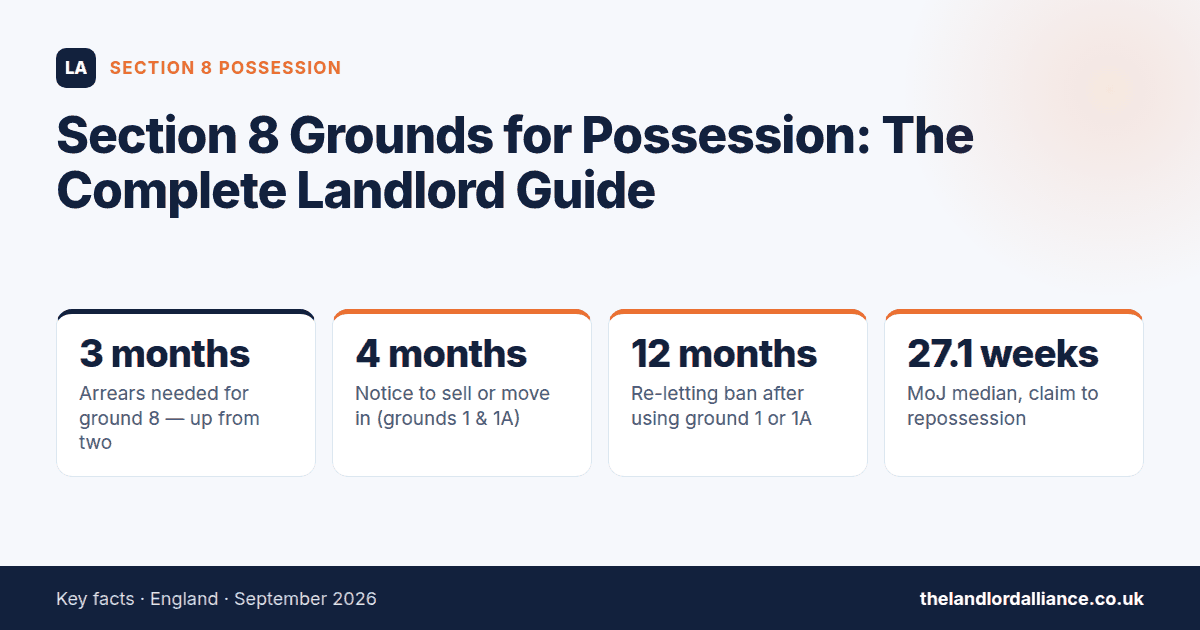
Since the Renters’ Rights Act came into force on 1 May 2026, section 8 is the only way to take back a rental property in England — section 21 is gone. You need a ground, and you need to prove it. Around eight of the 30+ grounds matter to private landlords. The traps: grounds 1 and 1A are blocked in a tenancy’s first 12 months and carry a 12-month re-letting ban afterwards; ground 8 now needs three months’ arrears held at notice and at hearing; and the courts are averaging 27.1 weeks from claim to repossession.
Since 1 May 2026, section 8 is the only way a landlord in England can take back a property. Section 21 is gone. There is no “no-fault” route any more — you need a ground, and you need to prove it.
I haven’t had to serve one on my own portfolio yet. But through my YouTube channel and The Landlord Alliance community I’ve now watched hundreds of landlords go through the new system, and the pattern is striking: the overwhelming majority are using it for one thing — getting properties back to sell. Ground 1A is doing the heavy lifting of the new regime. And the question I get asked isn’t “which ground?” — it’s “how do I make sure the paperwork is right, and that everything’s in place before I file?” That’s the right question, and this guide is built around it.
What changed on 1 May 2026
Five things are different if you last dealt with a possession before May.
1. Section 21 no longer exists
No no-fault notices, and no accelerated possession procedure. Every possession is now a section 8 possession with a stated ground.
2. There are no fixed terms
Every assured tenancy in England is now periodic. There’s no “end of the fixed term” to plan around — the tenancy runs until one side ends it.
3. Tenants leave on two months’ notice
Any time, from day one. You’re committed to the grounds; they aren’t.
4. Arrears got harder to act on
Ground 8 rose from two to three months (eight to 13 weeks), notice doubled to four weeks, and arrears caused by an outstanding Universal Credit payment don’t count.
5. Everything is slower. Grounds 1 and 1A need four months’ notice, up from two. Add the court queue — currently averaging 27.1 weeks from claim to repossession — and a “I’m selling” possession is realistically a nine-month-plus project.
The grounds that actually matter
Most of the 30-plus grounds are for social landlords, universities or agricultural employers. These eight are the ones a private landlord will realistically use.
Ground 1A — you’re selling
Three months into the new regime, this is the workhorse. Of the landlords in my community who’ve served notice since May, far more are selling than doing anything else.
The catch: after possession you cannot re-let or re-market for 12 months. Not a portal listing, not an advert, nothing.
Sales collapse more often than landlords expect — what the 12-month ban actually costs when one does.
Ground 1 — you or family moving in
Covers you, a spouse or civil partner, parents, grandparents, children, grandchildren, siblings — and their partners. The property must become their only or principal home.
You can serve during the first 12 months so long as the notice expires after month 12. The same re-letting ban applies.
Ground 8 — serious rent arrears
The threshold is now three months’ rent (monthly tenants) or 13 weeks. The arrears must be at that level both when you serve and on the day of the hearing — a tenant who dips below it the morning of the hearing kills your mandatory ground.
Arrears caused by an outstanding Universal Credit payment don’t count towards the threshold.
Grounds 10 & 11 — arrears and late payment
Ground 10: any arrears at all, at notice and at claim. Ground 11: persistent late payment — the tenant who always pays, three weeks late, every month.
Always serve 8, 10 and 11 together on arrears cases. Ground 8 is the one you want; 10 and 11 are what’s left when the tenant part-pays.
Ground 12 — breach of the agreement
Any breach other than rent: unauthorised occupiers, subletting, running a business from the property. The court weighs how serious it is and whether it’s been put right.
Ground 13 — deterioration of the property
Damage or neglect beyond fair wear and tear. A dated inventory with photographs at the start of the tenancy is the difference between a case and an opinion.
Ground 14 — antisocial behaviour
Nuisance, annoyance or a relevant offence by the tenant, a resident or a visitor — it doesn’t have to happen at the property. You can apply immediately; the court can’t order possession until 14 days after the notice date.
Ground 7A — severe ASB or conviction
A conviction for a relevant offence, breach of an antisocial behaviour injunction, or a closure order of 48+ hours. Prove it and the court must order possession.
Notice periods at a glance
Bar length shows the waiting period before you can even apply to court. The court queue comes after this.
The 1A trap, priced with real numbers
Use ground 1A, get possession — and if the sale falls through, you cannot re-let or re-market that property for 12 months. On one of my own properties, a three-bed house in Hastings renting at £1,500 a month, a failed sale costs:
| Cost of the 12-month ban | Amount |
|---|---|
| Rent you can’t collect (12 × £1,500) | £18,000 |
| Council tax on the empty house | ~£2,380 |
| Landlord insurance | £150 |
| Utilities standing charges | ~£300 |
| Total cost of a collapsed sale | ~£20,800 |
Twenty grand, on an ordinary house, for a sale that fell over. That’s not an argument against ground 1A — it’s an argument for having the sale genuinely ready (agent instructed, price agreed, chain understood) before the notice goes in. Once you’re committed, you’re committed for a year.
The two 12-month rules, in order
What Ground 11 evidence actually looks like
Ground 11 is persistent late payment — and you will only ever win it with records. This is the pattern a court is looking for: a tenant who always pays, and is always late.
| Month | Rent due | Rent paid | Days late |
|---|---|---|---|
| January | 1 Jan | 13 Jan | 12 |
| February | 1 Feb | 9 Feb | 8 |
| March | 1 Mar | 20 Mar | 19 |
| April | 1 Apr | 15 Apr | 14 |
| May | 1 May | 2 May | 1 |
| June | 1 Jun | 17 Jun | 16 |
| July | 1 Jul | 11 Jul | 10 |
| August | 1 Aug | 19 Aug | 18 |
If your records live in a shoebox, this is the ground you can’t use. A schedule of due dates against paid dates over a sustained period is the case.
How to serve a section 8 notice
The notice is 10% of a possession claim. This is the other 90% — assemble it before you serve, not when the hearing is listed.
1 · The notice itself
- Prescribed section 8 form, current version
- Every ground cited in full, with particulars
- Expiry set by the longest notice period cited
- Grounds 8 + 10 + 11 together on arrears cases
2 · Proof you served it
- How it was served — a method your agreement allows
- When: dated photo, certificate of posting, email log
- Who served it
- A copy of exactly what was served
3 · Evidence for your grounds
- Arrears: full rent schedule, due dates vs paid dates
- Selling (1A): proof of genuine intent — agent, memo
- Moving in (1): who, relationship, evidence of intent
- Damage (13): dated inventory + photos, both ends
- ASB (14/7A): incident log, dates, witnesses, reports
4 · The compliance file — where claims go wrong
- Deposit protected + prescribed information, before serving
- PRS database registration, as it rolls out region by region
- Gas safety, EICR, EPC — current and on file
- Statement of terms given (post-May 2026 tenancies)
What is a hard legal bar: an unprotected deposit. On most grounds the court cannot make a possession order unless the deposit scheme requirements were met — late protection can be cured, but only before you serve the notice. And as the PRS database rolls out region by region from 15 December 2026, registration becomes a second hard bar: no active registration, no possession order on most grounds (the antisocial behaviour grounds are the exception).
What is not a formal bar — but will still hurt you: gas safety, EICR and EPC gaps. Under the old law a missing gas certificate blocked section 21; that mechanism died with section 21, and there’s no equivalent bar on section 8. But don’t relax: expect any gap to be raised in the tenant’s defence, to feed a disrepair counterclaim that offsets your arrears, and to colour how a judge weighs a discretionary ground.
The rule our community has settled on: file nothing until the compliance folder is complete. You may win without it. You don’t want to find out.
Every ground, with notice periods
The full reference list. Grounds marked (specialist) apply only to social landlords, registered providers, universities, agricultural employers or similar.
| Mandatory | What it covers | Notice |
|---|---|---|
| 1 | Landlord or close family moving in | 4 months |
| 1A | Landlord selling | 4 months |
| 1B | Rent to buy (specialist) | 4 months |
| 2 | Lender taking possession | 4 months |
| 2ZA–2ZD | Superior lease ending (specialist) | 4 months |
| 4 | Student accommodation, educational institutions (specialist) | 2 weeks |
| 4A | Student HMO, re-letting to a new student group | 4 months |
| 5 | Minister of religion (specialist) | 2 months |
| 5A | Agricultural worker (specialist) | 2 months |
| 5B / 5D | Employment-criteria lettings (specialist) | 2 months |
| 5C | Tenant’s employment with the landlord ended | 2 months |
| 5E / 5F | Supported accommodation (specialist) | 4 weeks |
| 5G | Temporary homelessness accommodation (specialist) | 4 weeks |
| 5H | Stepping-stone accommodation (specialist) | 2 months |
| 6 | Demolition or redevelopment | 4 months |
| 6A | Decant accommodation (specialist) | 4 months |
| 6B | Compliance with enforcement action | 4 months |
| 7 | Death of the tenant | 2 months |
| 7A | Severe antisocial behaviour or conviction | None |
| 7B | No right to rent (Home Office notice) | 2 weeks |
| 8 | Serious rent arrears — 3 months / 13 weeks | 4 weeks |
| Discretionary | What it covers | Notice |
|---|---|---|
| 9 | Suitable alternative accommodation offered | 2 months |
| 10 | Any rent arrears | 4 weeks |
| 11 | Persistent late payment | 4 weeks |
| 12 | Breach of tenancy agreement | 2 weeks |
| 13 | Deterioration of the property | 2 weeks |
| 14 | Antisocial behaviour | None |
| 14ZA | Conviction for a riot-related offence | 2 weeks |
| 14A | Domestic abuse (social landlords) | 2 weeks |
| 15 | Deterioration of furniture | 2 weeks |
| 17 | False statement to obtain the tenancy | 2 weeks |
| 18 | Not engaging with support (specialist) | 4 weeks |
What landlords are actually asking
Real questions from The Landlord Alliance community and my Property Accelerator audience since May.
“How long are the courts actually taking?”
The current Ministry of Justice median is 27.1 weeks from claim to repossession — roughly six months, before you add the notice period in front or bailiff time behind. Industry modelling points at 50+ weeks by late 2026, and the courts service is recruiting a thousand extra staff to cope with Renters’ Rights demand.
Plan cash flow on the pessimistic number — and remember the arrears keep growing while you wait.
“No gas safety certificate — can I sort it while the case waits?”
Get it done today regardless: it’s a criminal-law duty, not just a possession issue. On the narrow legal point, a missing gas certificate doesn’t bar a section 8 claim the way it barred section 21.
But arriving at a hearing non-compliant hands the tenant’s side ammunition. And if what’s missing is deposit protection rather than gas safety — stop. That one is a bar, and it has to be fixed before the notice is served.
Common mistakes
On the grounds
- Citing ground 8 alone. The tenant pays down below the threshold and your mandatory ground evaporates. Cite 10 and 11 alongside it.
- Counting Universal Credit arrears towards the ground 8 threshold. They’re excluded.
- Forgetting the protected period. Serving 1A in month four wastes four months and tips off the tenant.
On the paperwork
- Marketing during the re-letting ban. “I only listed it to test the market” is a breach.
- Thin evidence on discretionary grounds. Mandatory grounds are about proof; discretionary grounds are about reasonableness.
- Filing before the compliance folder is complete. Every week lost to re-serving is another week of unpaid rent at the back of a 34-week queue.
Frequently asked questions
Can I still use section 21?
No. Section 21 was abolished on 1 May 2026. Notices served before then had transitional rules; no new one can be served.
How long does a section 8 possession take end to end?
Notice period (4 weeks to 4 months) + court (averaging 27.1 weeks claim to repossession) + enforcement if needed. Realistically most of a year for a defended arrears case.
Can I evict a tenant to sell?
Yes — ground 1A, after the first 12 months, on four months’ notice, with the 12-month re-letting ban if you get possession.
What if the tenant pays off the arrears before the hearing?
Ground 8 falls away. Grounds 10 and 11 remain if you cited them, but the court must also find possession reasonable.
Do I need a solicitor?
Not necessarily for straightforward arrears, but discretionary grounds turn on presentation. If the tenant is defending, get advice.
The evidence trail is the case
The Landlord Alliance app keeps your rent schedule, compliance certificates, inspection records and documents in one place — so if you ever need ground 8, 11 or 13, the file already exists.
Get membership · £10/monthThe section 8 hub
Each of these goes deeper than the summary above
Two things to check before you serve. Work the dates out with the section 8 notice period calculator — it applies the twelve month condition on Grounds 1 and 1A to the date in the notice rather than the date of service, which is where most guidance goes wrong. And check your deposit: since 1 May 2026 the court may make a possession order only if the deposit is protected and the prescribed information served, on every ground except 7A and 14. What happens if it is not.
If the ground is rent arrears, start here instead. Ground 8 changed substantially on 1 May 2026 — three months rather than two, four weeks' notice rather than two, and a universal credit disregard that gov.uk describes incorrectly. Our rent arrears guide works through the whole process, and the Ground 8 threshold checker tells you whether you are over the line.
This guide covers England only. Wales (Renting Homes (Wales) Act 2016) and Scotland (private residential tenancies) are different regimes. It’s general information, not legal advice — for a specific possession, take advice.
Sources: Grounds for possession: guidance for landlords (GOV.UK) · Guide to the Renters’ Rights Act (GOV.UK) · Renters’ Rights Act 2025, Schedule 1 · Ministry of Justice possession statistics.