Home › Renters’ Rights Act
The short version
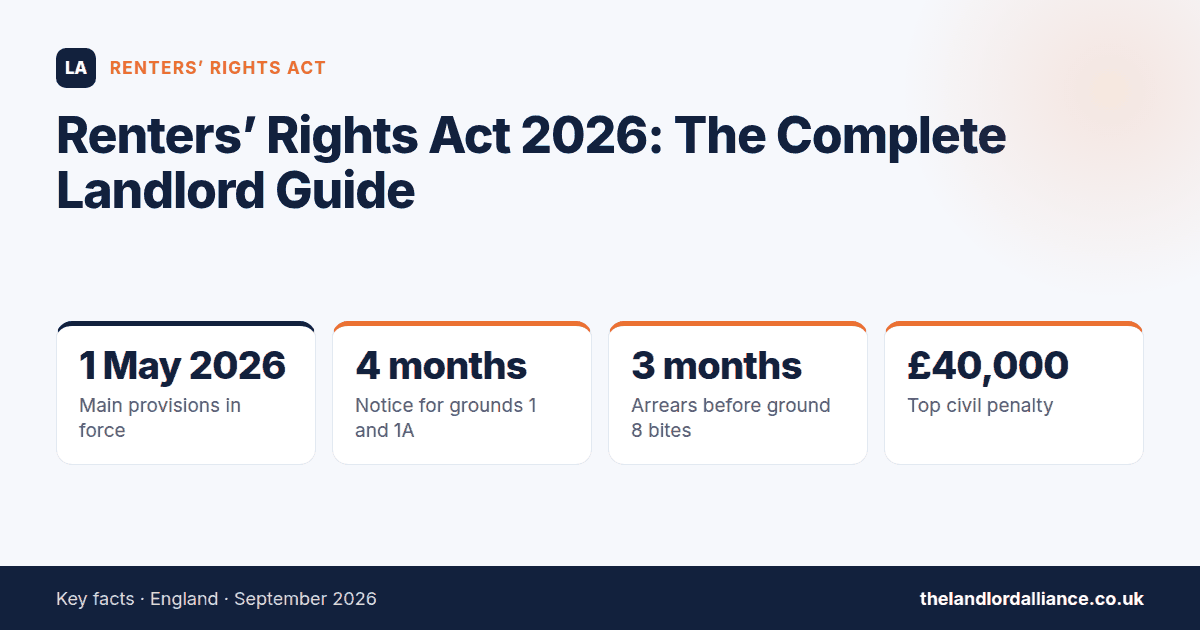
The Renters’ Rights Act came into force on 1 May 2026. Section 21 is gone. Every assured shorthold tenancy converted automatically into a periodic assured tenancy — you did not need to issue new agreements. Fixed terms no longer have any effect, rent can only be raised once a year by section 13 notice, and possession now runs entirely through section 8 grounds. Two deadlines have already passed: the information sheet was due to existing tenants by 31 May 2026, and any pre-existing section 21 claim had to be started by 31 July 2026. If you missed either, you are not out of options — but you do need to act deliberately.
I have been a landlord through every one of the last decade’s regime changes, and this is the biggest of them. Not because any single rule is unmanageable — most of them are — but because the whole shape of a tenancy changed on one day, and a lot of what landlords “know” about lettings stopped being true overnight. In the Landlord Alliance community the same handful of questions come up again and again, and almost all of them stem from the same misunderstanding: people think they were supposed to do something on 1 May. Mostly you weren’t. The conversion was automatic.
This page is the complete position as it stands in August 2026, written for landlords rather than lawyers. Where something is not yet in force I say so plainly, because a lot of what you’ll read elsewhere describes provisions that are still years away as though they applied today.
Is it the 2025 Act or the 2026 Act?
A small thing that tells you whether a source knows what it’s talking about
Both, in a sense. The statute is the Renters’ Rights Act 2025 — it received Royal Assent on 27 October 2025. But almost nothing happened until the main provisions were commenced on 1 May 2026, which is why most people search for and talk about the “Renters’ Rights Act 2026”.
If you are citing it in correspondence, in a notice, or to a court, it is the Renters’ Rights Act 2025. If you are talking to another landlord, “the 2026 changes” is what they’ll understand. Both are fine in their place. What isn’t fine is the number of pages still calling it the “Renters’ Reform Bill” or the “Renters’ Reform Act” — those were earlier, different, abandoned pieces of legislation, and a page using those names has not been updated in over a year.
What changed on 1 May 2026
The old rule, the new rule, and whether it needs anything from you
| What | Before 1 May 2026 | Now | Action needed? |
|---|---|---|---|
| Tenancy type | Assured shorthold tenancy (AST) | Assured periodic tenancy. ASTs abolished entirely | None — conversion was automatic |
| Fixed terms | 6 or 12 months typical | Of no effect. All tenancies are periodic | None |
| Rent periods | Any period | Monthly or shorter. Quarterly and annual rent no longer possible | Check any quarterly arrangements |
| Section 21 | Two months, no reason needed | Abolished | None available |
| Possession | Section 21 or section 8 | Section 8 grounds only | Learn the grounds |
| Rent increases | Rent review clause or section 13 | Section 13 only, once a year, Form 4A | Rent review clauses are now ineffective |
| Tenant’s notice | Usually one month | Two months, unless you agree less in writing | None |
| Pets | Landlord’s discretion | Tenant may request; consent not to be unreasonably refused; 28 days to reply | Have a process |
| Benefits and children | Widely refused | Discrimination unlawful | Review adverts and referencing |
| Rent in advance | Six or twelve months common | Capped at one month before the tenancy begins | Change your process |
| Rental bidding | Common | Banned — you must advertise a price and cannot accept more | Change your process |
| Deposit protection | Barred section 21 only | Bars possession on almost all section 8 grounds too | Audit every deposit now |
The single biggest misconception: that you needed to issue new tenancy agreements on 1 May. You did not. Section 146 of the Act preserved every existing tenancy and converted it in place. There was no surrender, no re-grant, and no need to re-paper anything. If an agent told you otherwise and charged you for it, that was not a legal requirement.
The deadlines — including the two that have passed
Where you actually stand in August 2026
| Date | What | Status |
|---|---|---|
| 27 Oct 2025 | Royal Assent | Done |
| 30 Apr 2026 | Last day a section 21 notice could be served | Passed |
| 1 May 2026 | Main provisions in force. Tenancies converted | In force |
| 31 May 2026 | Deadline to give existing tenants the information sheet | Passed — penalties apply |
| 31 Jul 2026 | Last day to start court proceedings on a pre-existing section 21 | Passed — those notices are now dead |
| 15 Dec 2026 | PRS database opens, West Midlands first — £65 per property a year | Dates confirmed, not yet open |
| 2028 | Landlord ombudsman, mandatory membership | Not in force |
| TBC | Awaab’s Law for the private sector | Not in force, consultation pending |
Nearly every guide you’ll find on this topic was written in March or April 2026 and still treats 31 May as something coming up. It isn’t. If you are reading this having realised you never sent the information sheet, that is a live compliance problem carrying a civil penalty of up to £7,000 per tenancy — but it is fixable, and the sooner you serve it the better your position. I’ve written that up separately: what to do if you missed the 31 May deadline.
Possession: section 21 is gone
Everything now runs through section 8 grounds
This is the change with the most practical consequence. Under the old regime you could end a tenancy without giving a reason. You now need a ground, evidence for that ground, and the correct notice period. There are 21 mandatory grounds and 11 discretionary ones; in practice most landlords will only ever use a handful.
| Ground | What it covers | Notice | Type |
|---|---|---|---|
| 1A | You intend to sell | 4 months | Mandatory |
| 1 | You or a close family member moving in | 4 months | Mandatory |
| 8 | Serious rent arrears — three months, or 13 weeks | 4 weeks | Mandatory |
| 10 | Some arrears, below the ground 8 threshold | 4 weeks | Discretionary |
| 11 | Persistent late payment, even if now clear | 4 weeks | Discretionary |
| 12 | Breach of a tenancy obligation | 2 weeks | Discretionary |
| 13 | Deterioration of the property | 2 weeks | Discretionary |
| 14 | Antisocial behaviour, nuisance, illegal use | None — file immediately | Discretionary |
| 7A | Serious ASB with a conviction or injunction breach | None — file immediately | Mandatory |
Two changes here matter more than the rest. Ground 8 moved from two months’ arrears to three — a tenant now has to be considerably further behind before you have a mandatory ground, and arrears that exist only because a Universal Credit housing payment has not yet reached the tenant are disregarded. And grounds 1 and 1A carry four months’ notice, and the date you specify in the notice cannot fall inside the first year of the tenancy. You can serve during year one — the expiry date just has to land on or after the anniversary.
The ground 1A trap, and what it actually costs
If you take possession because you intend to sell, you cannot then re-let the property. The restricted period starts the day you serve the notice and runs for twelve months from the date your notice expires — so with a four-month notice, that’s about sixteen months from service during which the property cannot be let, cannot be licensed for money, and cannot even be marketed to let.
On my own three-bed in Hastings, letting at £1,500 a month, twelve months of that ban looks like this:
| Cost of the 12-month ban | Amount |
|---|---|
| Rent you can’t collect (12 × £1,500) | £18,000 |
| Council tax on the empty house | ~£2,380 |
| Landlord insurance | £150 |
| Utilities standing charges | ~£300 |
| Total | ~£20,800 |
Breaching the re-letting ban is a criminal offence under s.16J(2). A council can impose a financial penalty of up to £40,000 as an alternative to prosecuting you — and a rent repayment order of up to two years’ rent. Marketing alone is enough to breach it. Do not put the property back on a letting portal “just to see”.
The deposit trap nobody is talking about
This is the one I’d check today if I checked nothing else
Under the old rules an unprotected deposit blocked a section 21 notice. Landlords knew that. What changed on 1 May is that deposit protection now bars possession on section 8 grounds too — with only the two antisocial behaviour grounds excepted.
So a tenant can be four months into serious arrears, you can have a textbook ground 8 case, and the court cannot make a possession order if that deposit was never protected or the prescribed information was never served. It is a hard bar, not a factor the judge weighs up.
It is curable — protect it late or return it, and you can proceed — but cure it before you serve, not after. And curing the possession bar does not extinguish the tenant’s separate claim for one to three times the deposit.
If you own more than a couple of properties, spend an hour this week confirming every deposit is protected in a live scheme and that you can produce the prescribed information you served. That hour is worth more than anything else on this page.
Rent increases: section 13 or nothing
Rent review clauses in your tenancy agreement no longer work. The only lawful route is a section 13 notice, and the rules are tighter than they were.
Section 13 at a glance
- Form
- Form 4A for private landlords. Form 4 is now social housing only
- Notice period
- At least two months, up from one
- Frequency
- Once every 52 weeks
- Tenant challenge
- First-tier Tribunal, before the proposed start date
- Tribunal outcome
- Can hold or lower the rent. It cannot set it above what you proposed
- Backdating
- None. The new rent starts from the notice date or the first period after determination
The tribunal point is the one landlords misjudge. Under the old rules a tenant challenging an increase risked the tribunal setting a market rent higher than the landlord had asked for, which deterred challenges. That risk is gone — the tenant’s worst outcome is now paying exactly what you proposed. Expect more challenges, and expect your notice to need to be defensible on market evidence.
Full detail, including how to complete Form 4A and what happens at tribunal: the section 13 rent increase guide.
Pets, benefits and children
Pets. A tenant can request one in writing. You have 28 days to reply in writing, and consent must not be unreasonably refused. If you need more information, or need to ask a superior landlord, the clock extends. A head lease prohibiting pets is the clearest reasonable refusal. Not liking pets is not. And note that the pet insurance provision landlords were told to expect was removed from the Bill during its passage — you cannot require pet insurance, and you cannot take an additional pet deposit. You can still deduct for actual damage at the end. More on pet requests.
Benefits and children. It is now unlawful to refuse a tenant because they receive benefits or because they have children, and terms in superior leases, mortgages or insurance policies purporting to prohibit such lets are of no effect. You can still assess affordability and run normal referencing — the Act preserves that expressly. What you cannot do is filter at the door.
What is not in force yet
Half the internet is describing these as though they applied. They don’t.
| Provision | Status | Expected |
|---|---|---|
| PRS database not in force | Not commenced. No registration service exists yet | Opens 15 December 2026, £65 per property a year |
| Landlord ombudsman not in force | Not commenced. Provider not yet designated | 2028 |
| Awaab’s Law (private sector) not in force | Not commenced. Timescales to be set by regulations | Subject to consultation |
| Decent Homes Standard not in force | Not commenced | 2035 or later |
Worth knowing for when they do arrive: once the database is live, not being registered will bar possession in the same way an unprotected deposit does, with the same two ASB exceptions. That is the compliance deadline to plan for, and it is the reason the database matters more than its dull name suggests.
The full guide
Each of these goes deeper than the summary above
Questions landlords are actually asking
Do I need to issue a new tenancy agreement?
No. Existing tenancies converted automatically on 1 May 2026 and remain the same tenancy. You do need to have given existing tenants the information sheet, and new tenancies need a written statement of terms — but that is not the same as re-papering the tenancy.
My section 21 notice was served in April. Can I still use it?
Only if you had already requested the claim form from the court before 1 May 2026. Otherwise the transitional protection ran out on 31 July 2026 and the notice is dead. You would need to start again on a section 8 ground.
Can I still take six months’ rent up front?
No. Rent in advance is capped at one month before the tenancy begins, and you cannot request or accept any rent before the agreement is signed.
How long does a tenant have to give me notice?
Two months, unless you have agreed a shorter period in writing. For joint tenancies any one tenant can serve notice, but a shorter period has to be agreed with all of them.
Does any of this apply in Wales or Scotland?
No. This Act is England only. Wales operates under the Renting Homes (Wales) Act 2016 and Scotland under the Private Housing (Tenancies) (Scotland) Act 2016. The rules genuinely differ — do not apply this page outside England.
What happens if a tenant challenges my rent increase?
They apply to the First-tier Tribunal before the proposed start date. The tribunal determines an open-market rent, but it cannot set it higher than you proposed, and it cannot backdate. If you have market evidence for your figure you are usually fine.
Deadlines you can’t afford to miss, tracked for you
The Landlord Alliance app tracks every compliance date on every property — gas, EICR, deposit protection, notice periods, rent increase anniversaries. £10 a month, cancel anytime.
See what’s includedDeposits changed too, and it is the change most easily missed. Section 26 of the Act rewrote the deposit rules in the Housing Act 2004 wholesale — the possession bar now stops the court making an order rather than stopping you serving a notice, late compliance cures it, and Grounds 7A and 14 are carved out. Full detail in the tenancy deposits guide and the penalties page.
England only. This page describes the law in England as at 20 August 2026. It is general information written by a landlord, not legal advice, and it is not a substitute for advice on your specific circumstances.
Sources: Renters’ Rights Act 2025 (c. 26); the Renters’ Rights Act 2025 (Commencement No. 2 and Transitional and Saving Provisions) Regulations 2026, SI 2026/421; the Assured Tenancies (Prescribed Forms) (England) Regulations 2026, SI 2026/354; Housing Act 1988 as amended; GOV.UK guidance for landlords.